Nuclei of categories with tensor products
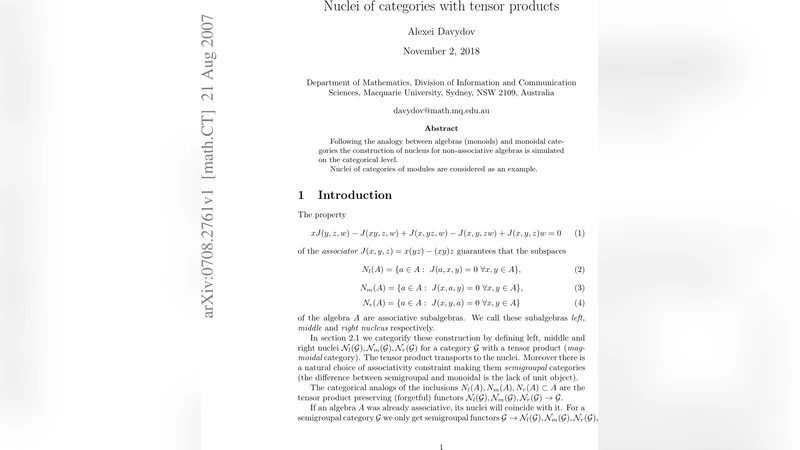
Following the analogy between algebras (monoids) and monoidal categories the construction of nucleus for non-associative algebras is simulated on the categorical level. Nuclei of categories of modules are considered as an example.
💡 Research Summary
The paper introduces a categorical analogue of the nucleus of a non‑associative algebra, extending the classical construction from algebra to monoidal (tensor) categories. The authors begin by recalling that for a non‑associative algebra (A) the nucleus consists of those elements (x) for which the associator ((x,y,z) = (xy)z - x(yz)) vanishes for all (y,z). This subset is itself an associative subalgebra and often carries a richer structure than the whole algebra. Translating this idea to category theory, the authors define the nucleus (\mathcal N(\mathcal C)) of a monoidal category (\mathcal C) as the full subcategory whose objects (X,Y) satisfy the condition that for every object (Z) the canonical associator \
Comments & Academic Discussion
Loading comments...
Leave a Comment