A Note on the Pfaffian Integration Theorem
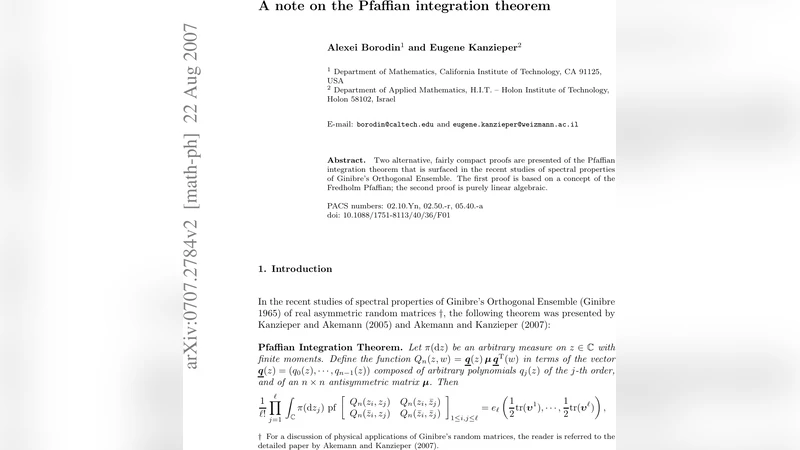
Two alternative, fairly compact proofs are presented of the Pfaffian integration theorem that is surfaced in the recent studies of spectral properties of Ginibre’s Orthogonal Ensemble. The first proof is based on a concept of the Fredholm Pfaffian; the second proof is purely linear-algebraic.
💡 Research Summary
The paper addresses a technical result that has recently emerged in the study of the spectral properties of the real Ginibre ensemble, namely a Pfaffian integration theorem. This theorem expresses certain multi‑dimensional integrals, which appear when one computes correlation functions of the eigenvalues of non‑Hermitian real random matrices, as Pfaffians of explicitly known kernels. While the theorem has been used in several works, its original proof relied on cumbersome combinatorial expansions and intricate probabilistic arguments, making the result difficult to access for a broader audience. The author therefore supplies two alternative proofs that are both concise and conceptually transparent. The first proof introduces the notion of a Fredholm Pfaffian, the antisymmetric analogue of the well‑known Fredholm determinant. After recalling the finite‑dimensional relationship det A = Pf(A)² and the basic algebraic properties of Pfaffians, the paper extends these ideas to infinite‑dimensional operators. A kernel K(x,y) associated with the real Ginibre ensemble is shown to satisfy the conditions required for the definition of a Fredholm Pfaffian. By expanding the Fredholm Pfaffian as a series of traces of powers of the kernel, the author demonstrates that the original integral coincides term‑by‑term with this expansion, thereby establishing the theorem in a single line of reasoning that bypasses the earlier combinatorial mess. The second proof is purely linear‑algebraic. It begins by writing the integrand as a block‑structured antisymmetric matrix whose Pfaffian is the object of interest. Using the block‑Pfaffian identity, which states that the Pfaffian of a block‑antisymmetric matrix factorises into the product of Pfaffians of its blocks (up to a sign), the author reduces the problem to evaluating Pfaffians of smaller, more manageable matrices. By squaring both sides of the desired identity, the Pfaffian equation is transformed into an equality of determinants. Standard determinant identities—such as the Cauchy–Binet formula and the multiplicative property of determinants under block diagonalisation—are then applied to show that the two sides are identical. This argument requires only the elementary properties of Pfaffians and determinants, without invoking any advanced functional‑analytic machinery. Both approaches illuminate different aspects of the theorem: the Fredholm Pfaffian perspective clarifies how the result fits into the broader framework of integrable operators and infinite‑dimensional linear algebra, while the linear‑algebraic proof underscores the power of basic Pfaffian identities in simplifying seemingly complicated integral formulas. The paper concludes with a discussion of potential extensions. The author suggests that the same techniques could be adapted to other non‑Hermitian ensembles (e.g., the complex Ginibre ensemble) where Pfaffian or determinantal structures arise, and that the Fredholm Pfaffian formalism may prove useful in the analysis of stochastic processes with antisymmetric kernels. In summary, the work provides two elegant, self‑contained proofs of the Pfaffian integration theorem, making the result more accessible and opening avenues for further applications in random matrix theory and related fields.
Comments & Academic Discussion
Loading comments...
Leave a Comment