Characterizing algebraic stacks
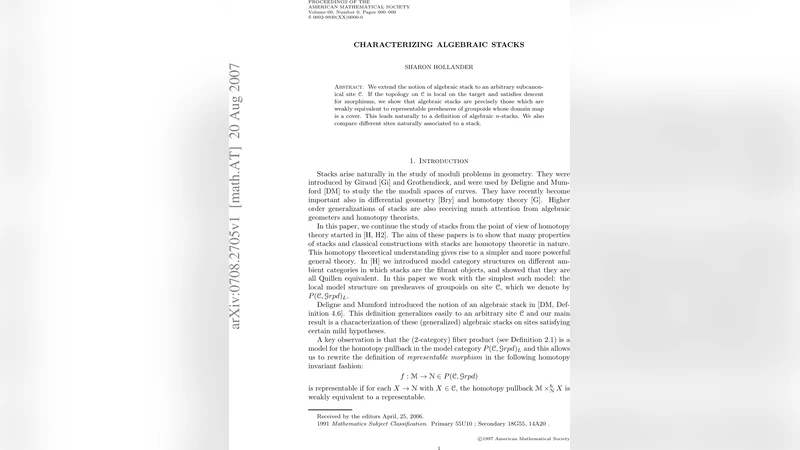
We extend the notion of algebraic stack to an arbitrary subcanonical site C. If the topology on C is local on the target and satisfies descent for morphisms, we show that algebraic stacks are precisely those which are weakly equivalent to representable presheaves of groupoids whose domain map is a cover. This leads naturally to a definition of algebraic n-stacks. We also compare different sites naturally associated to a stack.
💡 Research Summary
The paper sets out to broaden the classical notion of an algebraic stack—originally formulated on the category of schemes equipped with the fpqc, étale, or fppf topology—to any subcanonical site C. The author first isolates three structural hypotheses on the topology: (1) subcanonicity, guaranteeing that representable presheaves are sheaves; (2) locality on the target, meaning that a family of morphisms {U_i → X} is a cover precisely when each point of X is locally hit; and (3) descent for morphisms, i.e., the ability to glue morphisms along a covering family. Under these assumptions the familiar machinery of stacks, Cech nerves, and stackification works without alteration.
The central theorem (Theorem 3.1) states that, on such a site, a stack 𝓧 is “algebraic” if and only if it is weakly equivalent to a representable presheaf of groupoids whose domain map U → 𝓧 is a cover. The proof proceeds in two directions. For the forward implication, the author shows that the usual Artin‑type conditions (smoothness, finite presentation, etc.) can be encoded in a presentation U → 𝓧 where U is an object of C and the map is a covering morphism. Conversely, given a representable groupoid presheaf with a covering domain, one builds its Cech nerve, checks that each level satisfies the descent condition, and then uses the standard stackification process to obtain a stack weakly equivalent to the original. The equivalence is expressed in the homotopical language of 2‑categories: a weak equivalence means an essentially surjective, fully faithful functor up to natural isomorphism.
Having established the characterization for 1‑stacks, the author lifts it to higher categorical levels. An algebraic n‑stack is defined inductively: an (n‑1)‑stack 𝓧_{n‑1} together with a representable presheaf of groupoids U → 𝓧_{n‑1} whose domain map is an n‑fold cover. For n = 1 and n = 2 this recovers the classical Artin and Deligne‑Mumford stacks; for n ≥ 3 the definition yields genuinely new objects, such as higher‑dimensional moduli of complexes or derived mapping stacks. The paper supplies concrete examples and verifies that the inductive definition respects base change and descent.
The final substantive part of the work compares algebraic stacks across different sites naturally associated to a given geometric object. If f : C₁ → C₂ is a morphism of sites preserving descent for morphisms, then the pull‑back functor carries algebraic stacks on C₂ to algebraic stacks on C₁, and vice‑versa via left Kan extension. In particular, the author shows that the categories of algebraic stacks on the étale, fppf, and smooth sites are equivalent (as 2‑categories) once the above hypotheses are satisfied. This “site‑change equivalence” demonstrates that the notion of algebraicity is intrinsic to the underlying category, not to the particular Grothendieck topology chosen.
The paper concludes with a discussion of limitations and future directions. The reliance on locality on the target and descent for morphisms suggests possible extensions to non‑subcanonical or non‑local topologies, perhaps using hypercovers or ∞‑topos techniques. Moreover, the higher‑stack framework opens avenues for applications in derived algebraic geometry, homotopical deformation theory, and even mathematical physics, where moduli problems naturally live in the realm of n‑stacks. By providing a clean, site‑independent characterization, the work lays a solid foundation for these developments.
Comments & Academic Discussion
Loading comments...
Leave a Comment