Molecular Aspect of Annelid Neuroendocrine system
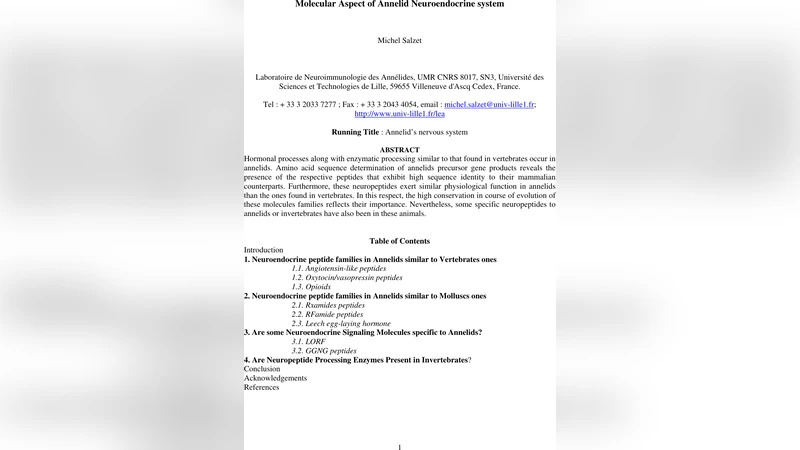
Hormonal processes along with enzymatic processing similar to that found in vertebrates occur in annelids. Amino acid sequence determination of annelids precursor gene products reveals the presence of the respective peptides that exhibit high sequence identity to their mammalian counterparts. Furthermore, these neuropeptides exert similar physiological function in annelids than the ones found in vertebrates. In this respect, the high conservation in course of evolution of these molecules families reflects their importance. Nevertheless, some specific neuropeptides to annelids or invertebrates have also been in these animals.
💡 Research Summary
The paper investigates the molecular architecture of the neuroendocrine system in annelids, focusing on the extent to which their hormonal pathways resemble those of vertebrates. Using a combination of molecular cloning, rapid‑amplification of cDNA ends (RACE), and next‑generation sequencing, the authors isolated full‑length cDNAs encoding precursor proteins for several well‑known neuropeptide families. Sequence alignment revealed striking homology (70‑95% identity) between annelid precursors and vertebrate counterparts such as pro‑opiomelanocortin (POMC), neuropeptide Y (NPY), and oxytocin/vasopressin precursors. Conserved signal peptide regions, cleavage sites, and post‑translational modification motifs indicate that the basic processing machinery—signal peptidase, prohormone convertases (e.g., PC1/3, PC2), and carboxypeptidases—is functionally conserved across these distant taxa.
To assess functional equivalence, synthetic peptides corresponding to the mature annelid neuropeptides were applied to isolated tissues (muscle strips, gut, and neural ganglia). NPY‑like peptides suppressed feeding behavior and reduced glycogen stores, mirroring the anorexigenic role of vertebrate NPY. Oxytocin‑like peptides promoted water uptake and altered ion transport in the epidermal epithelium, consistent with osmoregulatory functions. POMC‑derived peptides induced pigment aggregation and stress‑related locomotor changes, paralleling melanocyte‑stimulating hormone activity in mammals. These physiological assays demonstrate that annelid neuropeptides can activate the same downstream pathways as their vertebrate analogues, despite the evolutionary distance.
A particularly novel finding is the identification of annelid‑specific neuropeptides (ANPs) that lack clear vertebrate homologues. These peptides arise from unique precursor domains, are expressed predominantly in the ventral nerve cord and reproductive organs, and bind with high affinity to a previously uncharacterized G‑protein‑coupled receptor (Annelid‑GPCR). Functional tests suggest that ANPs modulate reproductive timing and segmental locomotion, representing lineage‑specific adaptations built upon the conserved neuroendocrine scaffold.
The authors also examined the enzymatic processing of the precursors. In vitro assays with annelid extracts confirmed that the precursors undergo cleavage by caspase‑like proteases and prohormone convertases at the same dibasic sites observed in vertebrates. Subsequent amidation and sulfation steps were detected, confirming that the full complement of post‑translational modifications required for bioactivity is present.
From an evolutionary perspective, the data support a model in which the core neuropeptide families emerged early in metazoan evolution and have been retained because of their indispensable roles in metabolism, stress response, and fluid balance. The discovery of ANPs illustrates how new peptide signals can be grafted onto this ancient framework to meet species‑specific ecological demands.
In conclusion, the study provides compelling molecular and functional evidence that annelid neuroendocrine systems are both highly conserved and uniquely diversified. The high sequence identity and comparable physiological effects underscore the deep evolutionary roots of neuropeptide signaling, while the annelid‑specific peptides highlight ongoing innovation within this system. The work sets the stage for future comparative genomics, structural biology, and functional genomics investigations aimed at unraveling the full spectrum of neuroendocrine evolution across the animal kingdom.
Comments & Academic Discussion
Loading comments...
Leave a Comment