Descent for quasi-coherent sheaves on stacks
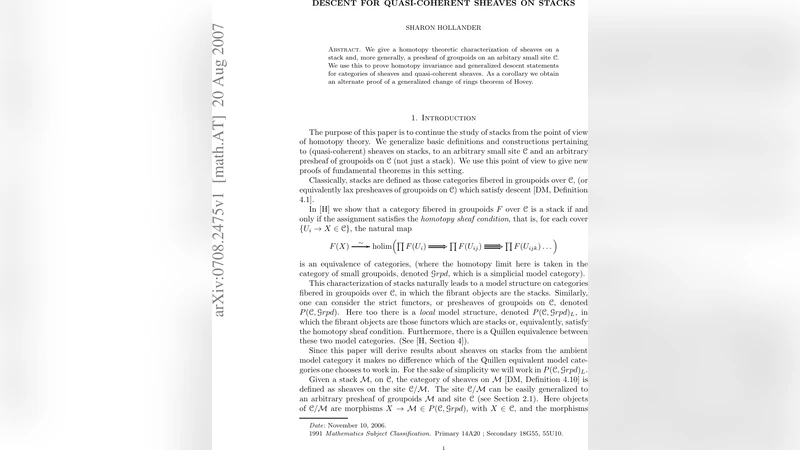
We give a homotopy theoretic characterization of sheaves on a stack and, more generally, a presheaf of groupoids on an arbitary small site C. We use this to prove homotopy invariance and generalized descent statements for categories of sheaves and quasi-coherent sheaves. As a corollary we obtain an alternate proof of a generalized change of rings theorem of Hovey.
💡 Research Summary
The paper develops a homotopy‑theoretic framework for describing sheaves and quasi‑coherent sheaves on stacks, and more generally for presheaves of groupoids on an arbitrary small site C. The authors begin by viewing a presheaf of groupoids 𝓧 as an object in the model category of simplicial presheaves sPre(C). Within this setting they define an “𝓧‑sheaf” (and an “𝓧‑quasi‑coherent sheaf”) as a morphism that respects the weak equivalences and fibrations of the model structure, i.e. a morphism that is a homotopy‑invariant functor from 𝓧 to the category of simplicial sets. This definition replaces the classical Grothendieck‑topos description with one that is stable under homotopy‑theoretic manipulations.
A central result is the homotopy invariance of these sheaf categories: if two presheaves of groupoids 𝓧 and 𝓨 are weakly equivalent in sPre(C), then the corresponding categories of 𝓧‑sheaves and 𝓨‑sheaves are Quillen equivalent. In particular, when 𝓧 is a genuine stack (for example an algebraic stack), the new definition coincides with the classical one, showing that the homotopy‑theoretic approach does not lose any information.
The authors then prove a generalized descent theorem that simultaneously covers Čech descent and hypercover descent. They construct a “hyper‑Čech complex” associated to any hypercover of the site and show that the restriction functor from sheaves on 𝓧 to compatible families on the hypercover is an equivalence of homotopy categories. This result implies that both ordinary sheaves and quasi‑coherent sheaves satisfy effective descent with respect to any hypercover, extending the usual descent statements beyond the realm of representable morphisms. The proof relies on the fact that hypercovers are cofibrant replacements in the model category, and that the sheaf condition can be expressed as a homotopy limit condition.
As an important application, the paper gives a new proof of Hovey’s generalized change‑of‑rings theorem. Hovey’s theorem asserts that for a morphism of rings A→B, the derived category of quasi‑coherent sheaves over Spec B is equivalent to the derived category of modules over B viewed as an A‑algebra, under suitable flatness hypotheses. By interpreting the module categories as sheaf categories over the corresponding affine stacks, the authors apply their homotopy invariance and descent results to obtain a Quillen equivalence between the two derived categories. This proof avoids the intricate homological algebra of the original argument and highlights the conceptual power of the homotopy‑theoretic perspective.
Finally, the paper discusses implications for higher‑stack theory and non‑commutative geometry. The homotopy‑theoretic description of sheaves is naturally compatible with ∞‑stack structures, suggesting that similar descent and invariance results should hold in that broader context. Moreover, the ability to treat quasi‑coherent sheaves via hypercovers opens the door to studying sheaves on non‑commutative spaces modeled by differential graded algebras or spectral stacks. The authors propose several directions for future work, including extending the framework to derived algebraic geometry, investigating descent for more exotic coefficient categories, and exploring connections with motivic homotopy theory.
Comments & Academic Discussion
Loading comments...
Leave a Comment