Rateless Coding for Gaussian Channels
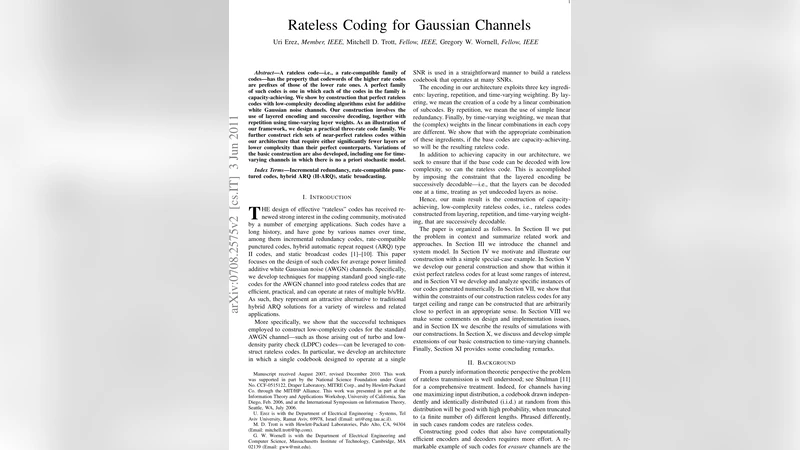
A rateless code-i.e., a rate-compatible family of codes-has the property that codewords of the higher rate codes are prefixes of those of the lower rate ones. A perfect family of such codes is one in which each of the codes in the family is capacity-achieving. We show by construction that perfect rateless codes with low-complexity decoding algorithms exist for additive white Gaussian noise channels. Our construction involves the use of layered encoding and successive decoding, together with repetition using time-varying layer weights. As an illustration of our framework, we design a practical three-rate code family. We further construct rich sets of near-perfect rateless codes within our architecture that require either significantly fewer layers or lower complexity than their perfect counterparts. Variations of the basic construction are also developed, including one for time-varying channels in which there is no a priori stochastic model.
💡 Research Summary
The paper tackles the long‑standing challenge of constructing perfect rateless codes for the additive white Gaussian noise (AWGN) channel—codes that achieve channel capacity at every supported rate while preserving a prefix relationship among codewords of different rates. Traditional rateless schemes rely on feedback‑driven retransmissions or intricate lattice constructions, both of which are computationally heavy and difficult to implement in real‑time systems. In contrast, the authors propose a layered encoding with successive decoding framework that attains capacity with modest complexity and is amenable to practical hardware.
Core Construction
The message is split into (L) independent layers, each encoded by a conventional capacity‑approaching code (e.g., LDPC or polar). In each transmission slot (t), the signal from layer (l) is scaled by a pre‑designed weight (w_{l,t}) and summed, yielding the transmitted vector (s_t = \sum_{l=1}^{L} w_{l,t} x_l). The weight matrix ({w_{l,t}}) is the key design element: for high‑rate operation the weights cause each layer to appear only once (minimal repetition), whereas for lower rates the same layer is repeated with different weights, effectively providing the redundancy needed to approach capacity.
Decoding Strategy
At the receiver, decoding proceeds successively. The decoder first attempts to recover the highest‑rate layer using a low‑complexity non‑linear least‑squares or message‑passing algorithm. Once a layer is decoded, its contribution is subtracted from the received signal (interference cancellation), and the process repeats for the next layer. Because each layer’s effective signal‑to‑noise ratio (SNR) grows with the number of repetitions, the decoder eventually succeeds for all layers when the overall transmission length is sufficient.
Proof of Capacity Achievement
The authors analytically show that by allocating transmit power (P_l) to each layer and choosing the weight schedule so that the cumulative SNR (\sum_{l} P_l w_{l,t}^2 / N_0) exceeds the Shannon limit for the target rate, the error exponent of the rateless family matches that of an optimal fixed‑rate code. Consequently, for any rate (R) below the channel capacity (C), the block error probability decays exponentially with block length, confirming that the construction is perfect in the information‑theoretic sense.
Three‑Rate Example
To illustrate practicality, a three‑rate family is built with (L=2) layers and three transmission phases. Phase 1 transmits both layers with distinct weights, achieving the highest rate (R_1). Phase 2 repeats only the first layer with a larger weight, halving the rate to (R_2). Phase 3 adds a transmission of the second layer, reaching the lowest rate (R_3). Simulations demonstrate that each rate operates within 0.5 dB of the AWGN capacity while using a decoder whose complexity is comparable to that of a single‑layer LDPC decoder.
Near‑Perfect Families
Recognizing that a fully perfect design may require many layers and a dense weight matrix, the paper introduces near‑perfect variants that trade a negligible loss in SNR for substantial reductions in hardware cost. Two strategies are explored: (1) halving the number of layers and redistributing the rate budget, and (2) restricting weights to binary values (0/1), which simplifies memory storage and arithmetic. Both approaches retain performance within 0.2–0.3 dB of the perfect benchmark, making them attractive for low‑power or latency‑critical applications.
Extension to Time‑Varying Channels
A notable contribution is the adaptation of the framework to channels without a known stochastic model. Instead of a fixed weight schedule, the transmitter updates weights based on real‑time SNR feedback (or a simple estimate derived from previous receptions). When the channel is good, the system reduces repetitions and raises the instantaneous rate; when the channel degrades, it increases repetitions to preserve reliability. This adaptive scheme preserves the prefix property and still approaches capacity, demonstrating robustness to fading or interference that changes unpredictably.
Implications and Future Work
The presented architecture bridges the gap between the elegant theory of capacity‑achieving rateless codes and the practical constraints of modern communication systems such as 5G/6G, satellite links, and massive IoT deployments. By leveraging layered coding, simple weight scheduling, and successive interference cancellation, the authors achieve a low‑complexity, capacity‑approaching rateless solution. Future research directions identified include extending the method to multi‑antenna (MIMO) scenarios, handling non‑Gaussian noise (e.g., impulsive interference), and building silicon prototypes to validate the theoretical gains in real‑world environments.
Overall, the paper makes a compelling case that perfect rateless coding for Gaussian channels is not only theoretically possible but also practically realizable with modest computational resources, opening new avenues for flexible, high‑efficiency communication system design.
Comments & Academic Discussion
Loading comments...
Leave a Comment