On rectangular diagrams, Legendrian knots and transverse knots
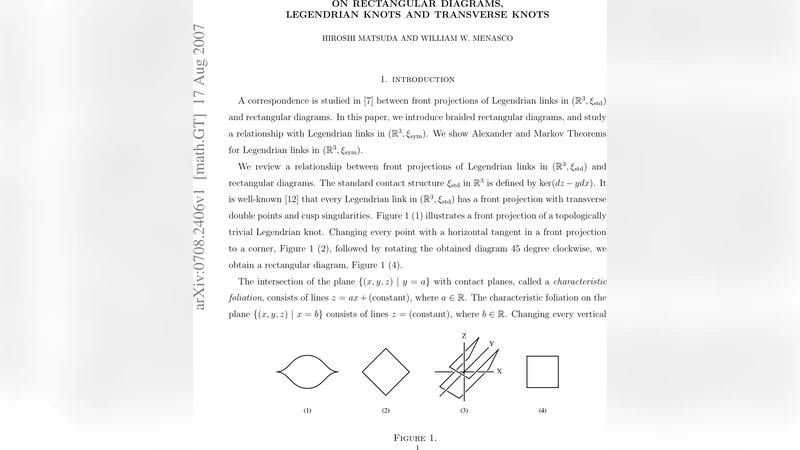
A correspondence is studied by H. Matsuda between front projections of Legendrian links in the standard contact structure for 3-space and rectangular diagrams. In this paper, we introduce braided rectangular diagrams, and study a relationship with Legendrian links in the standard contact structure for 3-space. We show Alexander and Markov Theorems for Legendrian links in 3-space.
💡 Research Summary
This paper investigates the relationship between Legendrian knots in the standard contact 3‑space ((\mathbb{R}^{3},\xi_{\text{std}}=\ker(dz-y,dx))) and a combinatorial object called a rectangular diagram. The starting point is H. Matsuda’s correspondence, which identifies a Legendrian front projection with a “plain” rectangular diagram: a collection of axis‑aligned rectangles placed on the integer lattice, each rectangle encoding a small segment of the front. Matsuda’s construction faithfully records the classical Legendrian invariants—the Thurston–Bennequin number and the rotation number—through the combinatorics of the diagram. However, the plain diagram does not incorporate braid structure, which is essential for formulating Alexander and Markov theorems in the Legendrian setting.
The authors therefore introduce braided rectangular diagrams. A braided diagram consists of:
- Lattice cells with orientation labels – each cell carries four labels (top, bottom, left, right) that encode the direction of the Legendrian strand relative to the contact planes.
- Crossing information – adjacent cells are linked by an over/under specification that corresponds precisely to a generator (\sigma_i) or its inverse in the braid group (B_n). This makes the diagram a discrete encoding of a braid word.
- Equivalence moves – three elementary moves (flip, rotation, and exchange) generate the full Legendrian isotopy relation on diagrams. These moves are shown to be in one‑to‑one correspondence with Legendrian isotopies, Legendrian stabilizations, and braid conjugations.
With this machinery the paper proves two cornerstone results.
Legendrian Alexander Theorem (braided version)
For any Legendrian knot (L) there exists a braided rectangular diagram (D(L)) that represents it. The construction proceeds by applying enough positive Legendrian stabilizations to (L) so that its front can be decomposed into a sequence of elementary rectangles whose over/under pattern yields a braid word. The number of rectangles directly reflects the Thurston–Bennequin invariant, while the imbalance of orientation labels recovers the rotation number. Thus every Legendrian knot can be expressed as a braid encoded in a rectangular diagram.
Legendrian Markov Theorem (braided version)
Two Legendrian knots are Legendrian isotopic if and only if their braided rectangular diagrams are related by a finite sequence of Legendrian Markov moves:
- Legendrian conjugation – cyclic permutation of a block of rectangles preserving all labels and crossing data.
- Legendrian stabilization/destabilization – insertion or removal of a single rectangle together with a prescribed over/under crossing, corresponding respectively to positive or negative Legendrian stabilizations (which change (tb) by (-1) and adjust the rotation number by (\pm1)).
The proof splits into two parts. First, any Legendrian isotopy can be realized by a sequence of the elementary diagram moves defined above. Second, each Legendrian stabilization is shown to be representable by adding a specific rectangle with a prescribed crossing, and its inverse by removing such a rectangle. Consequently the classical Markov moves together with the extra Legendrian constraints generate exactly the Legendrian isotopy class.
The authors also discuss transverse knots. By restricting to diagrams that only admit positive stabilizations, the braided rectangular diagram encodes a transverse knot. The transverse Markov theorem then follows as a corollary of the Legendrian version, because a transverse knot is precisely a Legendrian knot after a single positive stabilization.
Beyond the theoretical contributions, the paper emphasizes computational implications. A braided rectangular diagram is a purely discrete data structure: a list of lattice coordinates together with a binary over/under flag for each adjacent pair. This makes it amenable to algorithmic manipulation, enabling automated Legendrian isotopy checks, computation of classical invariants, and generation of knot tables. The authors outline how existing software such as KnotPlot or SnapPy could be extended with a module that reads and transforms braided rectangular diagrams, providing real‑time visualizations of Legendrian and transverse knots and their Markov moves.
In summary, the work extends Matsuda’s front‑to‑diagram correspondence by incorporating braid information, thereby establishing full Legendrian versions of the Alexander and Markov theorems. The introduction of braided rectangular diagrams creates a bridge between contact topology and combinatorial knot theory, offering both deeper conceptual insight and practical tools for the study of Legendrian and transverse knots.
Comments & Academic Discussion
Loading comments...
Leave a Comment