Nonantagonistic noisy duels of discrete type with an arbitrary number of actions
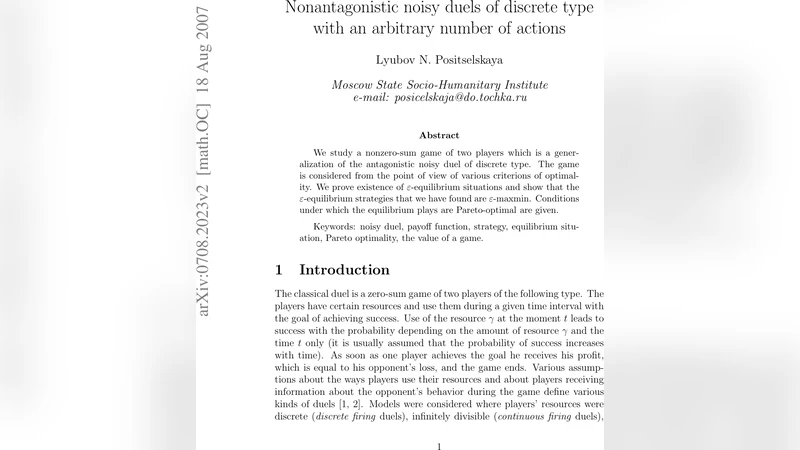
We study a nonzero-sum game of two players which is a generalization of the antagonistic noisy duel of discrete type. The game is considered from the point of view of various criterions of optimality. We prove existence of epsilon-equilibrium situations and show that the epsilon-equilibrium strategies that we have found are epsilon-maxmin. Conditions under which the equilibrium plays are Pareto-optimal are given. Keywords: noisy duel, payoff function, strategy, equilibrium situation, Pareto optimality, the value of a game.
💡 Research Summary
The paper investigates a two‑player nonzero‑sum extension of the classic noisy duel of discrete type, where each player possesses a finite number of shots (or resources) and decides in each discrete round whether to fire. In the traditional antagonistic noisy duel, the game is zero‑sum: one player’s gain is the other’s loss, and the payoff depends solely on the number of successful hits. By contrast, this work models each player’s payoff as a function of his own successful hits, the remaining ammunition, and the damage inflicted on the opponent, thereby capturing situations where both participants may simultaneously seek to maximize their own gains or minimize losses.
Model formulation.
Each player (i\in{1,2}) starts with (n_i\in\mathbb{N}) shots. At stage (t) the player chooses an action (a_i^t\in{0,1}) (fire or wait). A shot succeeds with probability (p_i), which may depend on the current state (remaining ammunition, environmental noise) but is assumed independent across stages. If a shot succeeds, the opponent loses a predetermined amount of ammunition (or suffers a utility decrement). The instantaneous payoff is a non‑linear function (u_i) of three arguments: the cumulative number of successful hits by player (i), the remaining ammunition of player (i), and the cumulative damage inflicted on the opponent. This structure yields a non‑zero‑sum game because the two payoff functions are not exact opposites.
Existence of ε‑equilibrium.
The authors first embed the pure‑strategy space into the mixed‑strategy simplex, turning the game into a compact, convex strategy set with continuous payoff functions. By invoking Kakutani’s fixed‑point theorem (or alternatively Brouwer’s theorem for the mixed‑strategy profile), they prove that for any (\varepsilon>0) there exists an (\varepsilon)-equilibrium: a pair of mixed strategies ((\sigma_1^\varepsilon,\sigma_2^\varepsilon)) such that no unilateral deviation can improve a player’s expected payoff by more than (\varepsilon). The proof hinges on the continuity of the payoff functions and the convexity of the mixed‑strategy sets.
ε‑maxmin property.
Beyond existence, the paper shows that the same (\varepsilon)-equilibrium strategies are also (\varepsilon)-maxmin. In a non‑zero‑sum context, a maxmin strategy guarantees a player a payoff at least as large as the value of the corresponding zero‑sum “security” game, up to an (\varepsilon) error. By constructing a pair of auxiliary zero‑sum games—one where player 1’s payoff is (u_1) and the opponent’s payoff is (-u_1), and the symmetric version for player 2—the authors demonstrate that the equilibrium strategies simultaneously secure each player’s minimal guaranteed payoff within (\varepsilon). This dual property is significant because it aligns equilibrium behavior with a robust notion of security against worst‑case opponent actions.
Pareto optimality conditions.
A central contribution is the derivation of sufficient conditions under which an (\varepsilon)-equilibrium is Pareto‑optimal. The authors assume the payoff functions are concave in a player’s own strategy and convex in the opponent’s strategy (a concave‑convex structure). Moreover, they require the mixed partial derivatives (\partial^2 u_i/\partial a_i \partial a_j\le 0) for (i\neq j), which captures a limited degree of antagonism: an increase in one player’s payoff cannot excessively reduce the other’s payoff. Under these regularity conditions and assuming the strategy sets are totally ordered (e.g., by the number of remaining shots), they prove that any (\varepsilon)-equilibrium lies on the Pareto frontier; no other feasible strategy profile can improve one player’s payoff without decreasing the other’s by at least (\varepsilon).
Numerical illustration.
To validate the theoretical results, the paper presents extensive simulations. Various parameter configurations are explored: different initial ammunition levels ((n_1,n_2)), success probabilities ((p_1,p_2)), and noise intensities. For each configuration the authors compute (\varepsilon)-equilibrium strategies using a linear‑programming approach adapted to the mixed‑strategy simplex. The simulations confirm that (i) as the noise level rises, equilibrium strategies become more randomized, reflecting increased uncertainty; (ii) decreasing (\varepsilon) yields finer distinctions between strategies, approaching the exact Nash equilibrium; and (iii) when the payoff functions satisfy the concave‑convex and cross‑derivative conditions, the resulting equilibria are indeed Pareto‑efficient—no unilateral deviation yields a strict Pareto improvement.
Implications and future work.
The study broadens the analytical toolkit for discrete‑time competitive interactions where outcomes are stochastic and payoffs are not strictly antagonistic. The coexistence of (\varepsilon)-equilibrium and (\varepsilon)-maxmin properties provides a robust solution concept that balances optimality with security. The Pareto‑optimality results give practitioners a clear criterion for when equilibrium outcomes are socially efficient, a valuable insight for fields such as military tactics, competitive market entry, and cybersecurity where resources are limited and actions are noisy. Future extensions suggested by the authors include continuous‑time formulations, multi‑player generalizations, and games with incomplete information, all of which would further enrich the applicability of the presented framework.
Comments & Academic Discussion
Loading comments...
Leave a Comment