Focusing and Polarization in Intuitionistic Logic
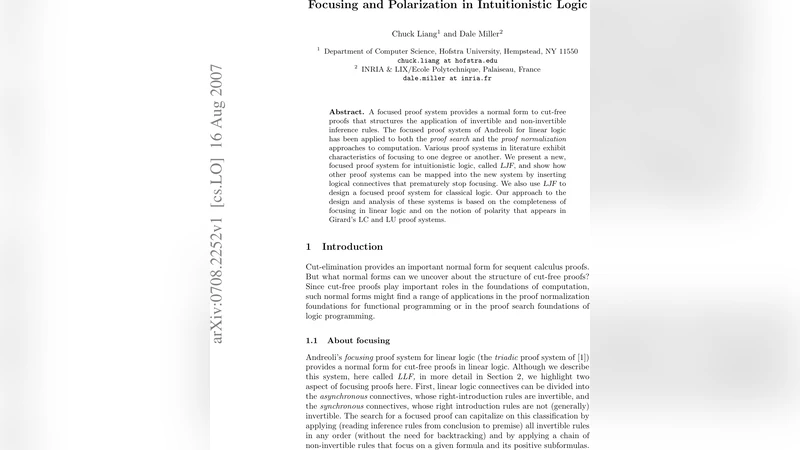
A focused proof system provides a normal form to cut-free proofs that structures the application of invertible and non-invertible inference rules. The focused proof system of Andreoli for linear logic has been applied to both the proof search and the proof normalization approaches to computation. Various proof systems in literature exhibit characteristics of focusing to one degree or another. We present a new, focused proof system for intuitionistic logic, called LJF, and show how other proof systems can be mapped into the new system by inserting logical connectives that prematurely stop focusing. We also use LJF to design a focused proof system for classical logic. Our approach to the design and analysis of these systems is based on the completeness of focusing in linear logic and on the notion of polarity that appears in Girard’s LC and LU proof systems.
💡 Research Summary
The paper introduces LJF, a focused proof system specifically designed for intuitionistic logic, and demonstrates how focusing—a discipline that separates invertible from non‑invertible inference rules—can be systematically applied beyond linear logic. Building on Andreoli’s focused system for linear logic, the authors adopt Girard’s notions of polarity (positive vs. negative formulas) to classify each logical connective in intuitionistic logic. Positive connectives are associated with invertible rules, while negative connectives drive non‑invertible steps. Proof construction therefore proceeds in two alternating phases: a “focus” phase where a chosen negative formula is decomposed using a chain of non‑invertible rules, and an “unfocus” phase where only invertible rules are applied freely. This clear phase separation eliminates unnecessary nondeterminism, yields a normal form for cut‑free proofs, and streamlines proof search.
A major contribution is the demonstration that LJF subsumes a wide range of existing intuitionistic proof systems (such as LJ, LJT, LJQ, and others). The authors show that by inserting specially designed “stop‑focus” connectives—logical constants that force an early exit from the focus phase—any rule set from these older systems can be simulated within LJF. Consequently, LJF is shown to be complete with respect to intuitionistic provability: every intuitionistic proof can be transformed into an LJF proof, and conversely, LJF proofs can be projected back onto the traditional systems. This mapping preserves both the computational content (via the Curry‑Howard correspondence) and the structural properties needed for normalization.
The paper then leverages the same polarity‑based machinery to construct a focused system for classical logic. Classical logic’s characteristic double‑negation symmetry is captured by adjusting polarity assignments and by employing Girard’s polarity‑shift rules from the LC and LU calculi. The resulting classical focused system retains the same two‑phase discipline, proving that focusing is not limited to constructive logics but can be made complete for classical reasoning as well.
Beyond the core technical development, the authors discuss broader implications. Focusing aligns closely with evaluation strategies in functional programming: the focus phase mirrors call‑by‑value or call‑by‑need reductions, while the unfocus phase corresponds to structural rearrangements that do not affect computational behavior. By making evaluation order explicit through polarity, LJF offers a foundation for type systems that can control evaluation strategies, optimize compilation, or enforce resource usage policies. Moreover, the reduction in nondeterministic choices during proof search makes LJF attractive for automated theorem provers, where the search space can be dramatically pruned. The authors suggest integration with SAT/SMT back‑ends and highlight potential for proof‑search heuristics that exploit the deterministic nature of the focus phase.
In summary, the paper presents a unified, polarity‑driven focused proof system (LJF) that:
- Provides a normal form for intuitionistic cut‑free proofs.
- Simulates existing intuitionistic calculi by inserting stop‑focus connectives.
- Extends naturally to a complete focused system for classical logic.
- Bridges proof theory with programming language semantics, offering new avenues for type‑directed compilation and efficient automated reasoning.
The work thus advances the state of the art in proof normalization, proof search, and the interplay between logic and computation, establishing focusing as a versatile tool across both constructive and classical logical landscapes.
Comments & Academic Discussion
Loading comments...
Leave a Comment