Realizing modules over the homology of a DGA
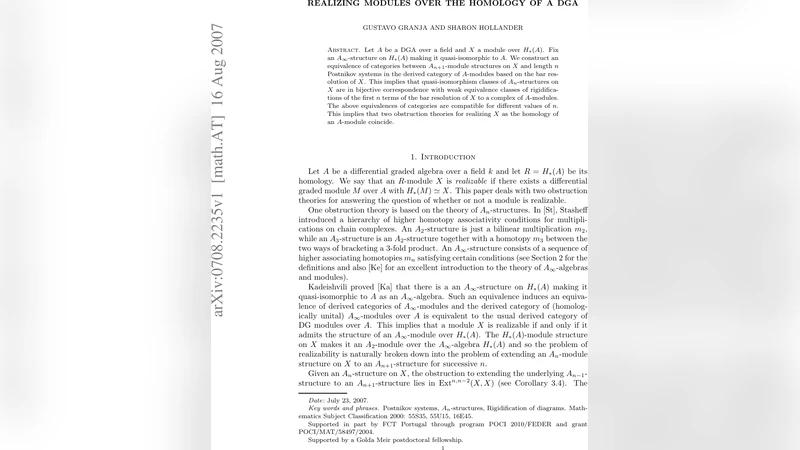
Let A be a DGA over a field and X a module over H_(A). Fix an $A_\infty$-structure on H_(A) making it quasi-isomorphic to A. We construct an equivalence of categories between A_{n+1}-module structures on X and length n Postnikov systems in the derived category of A-modules based on the bar resolution of X. This implies that quasi-isomorphism classes of A_n-structures on X are in bijective correspondence with weak equivalence classes of rigidifications of the first n terms of the bar resolution of X to a complex of A-modules. The above equivalences of categories are compatible for different values of n. This implies that two obstruction theories for realizing X as the homology of an A-module coincide.
💡 Research Summary
The paper addresses the classical problem of “realizing’’ a module over the homology of a differential graded algebra (DGA) as the homology of an actual A‑module. Let A be a DGA over a field k and let H₍₎(A) denote its homology algebra. Although H₍₎(A) is naturally a graded algebra with the induced multiplication μ₂, it does not retain the higher homotopical information of A. Kadeishvili’s theorem guarantees that one can endow H₍*₎(A) with an A∞‑structure (μ₁, μ₂, μ₃, …) making it quasi‑isomorphic to A. The authors fix such an A∞‑structure once and for all.
Given a graded H₍₎(A)‑module X, the goal is to understand all possible ways of lifting X to an A‑module whose homology is X. Two well‑known obstruction theories exist for this task. The first, often called the A∞‑obstruction theory, proceeds by trying to define higher A∞‑module operations λ₁, λ₂, … on X satisfying the A∞‑module relations; each step may produce a cohomology class in H^{n+1}(A;End X). The second, based on the bar resolution, starts from the standard bar resolution B·(X)=A^{⊗·}⊗X of X as an H₍₎(A)‑module and attempts to “rigidify’’ the first n stages of this resolution to an actual complex of A‑modules; the obstruction lives in Ext^{n+1}_A(B_n(X),X).
The central contribution of the paper is to construct a precise equivalence of categories between these two viewpoints. For each integer n≥0 the authors define:
- Aₙ₊₁‑module structures on X – i.e. collections of operations λ₁,…,λₙ₊₁ satisfying the A∞‑module relations up to level n+1.
- Length‑n Postnikov systems in the derived category D(A) built from the bar resolution of X. A length‑n Postnikov system consists of a chain of objects C₀,…,C_n together with maps δ_i: ΣC_i → C_{i‑1} that encode the successive “layers’’ of the truncated bar resolution.
The authors exhibit two functors:
-
F: From an Aₙ₊₁‑module structure to a Postnikov system. The higher operations λ_{i+1} are inserted as correction terms into the differential of the bar complex at stage i, producing a new differential d’i = d_i + (−1)^i (1^{⊗i}⊗λ{i+1}⊗1^{⊗(n‑i)}). The resulting maps δ_i are precisely the connecting morphisms of the Postnikov tower.
-
G: From a Postnikov system to an Aₙ₊₁‑module structure. The connecting morphisms δ_i are decoded to recover the correction terms λ_{i+1}, again using the explicit formula above.
The authors prove that F and G are inverse equivalences, fully faithful and essentially surjective, and that they are natural with respect to morphisms of A‑modules. Moreover, the construction is compatible as n varies; passing to the limit yields an equivalence between full A∞‑module structures on X and complete rigidifications of the entire bar resolution.
From this categorical equivalence the authors deduce a bijection between:
- Quasi‑isomorphism classes of Aₙ‑structures on X (i.e. Aₙ‑modules up to Aₙ‑homotopy), and
- Weak equivalence classes of rigidifications of the first n stages of the bar resolution (i.e. choices of differentials making the truncated bar complex into an actual A‑complex, up to chain homotopy).
Consequently, the two classical obstruction theories coincide: the obstruction class arising from the failure to extend an Aₙ‑module to an Aₙ₊₁‑module is exactly the Ext‑class obstructing the next step of the bar‑resolution rigidification. The paper illustrates this correspondence with concrete calculations for a simple DGA (the algebra k
Comments & Academic Discussion
Loading comments...
Leave a Comment