The asymptotic geometry of right-angled Artin groups, I
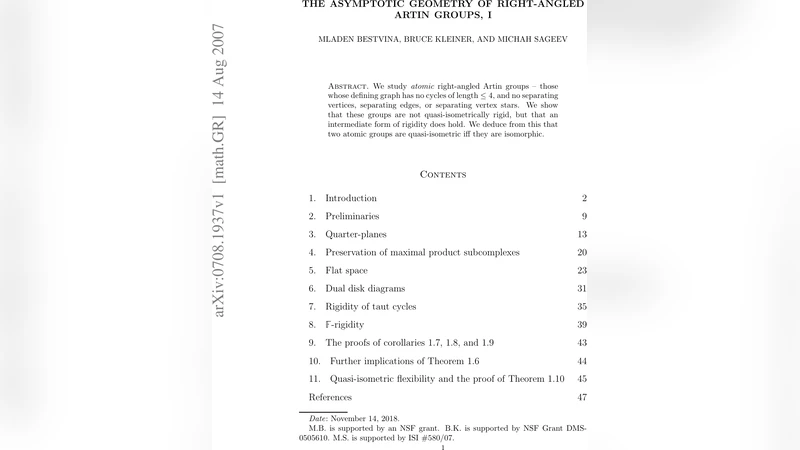
We study atomic right-angled Artin groups – those whose defining graph has no cycles of length less than five, and no separating vertices, separating edges, or separating vertex stars. We show that these groups are not quasi-isometrically rigid, but that an intermediate form of rigidity does hold. We deduce from this that two atomic groups are quasi-isometric iff they are isomorphic.
💡 Research Summary
**
The paper investigates the large‑scale geometry of a distinguished subclass of right‑angled Artin groups (RAAGs) called atomic RAAGs. An atomic RAAG is defined by a simplicial graph Γ that satisfies three stringent conditions: (1) Γ contains no cycles of length less than five, (2) Γ has no separating vertices or separating edges, and (3) the star of any vertex does not separate the graph. These constraints guarantee that the defining graph is highly connected and cannot be decomposed along simple cut‑sets, making the associated group “indecomposable” in a combinatorial sense.
The authors begin by showing that atomic RAAGs do not enjoy full quasi‑isometric rigidity. In other words, there exist quasi‑isometries between two atomic RAAGs that do not arise from group isomorphisms. This is demonstrated by constructing explicit quasi‑isometries that exploit non‑trivial automorphisms of the defining graph, thereby breaking the naïve expectation that the large‑scale geometry of a RAAG uniquely determines its algebraic structure.
Despite this failure of full rigidity, the paper uncovers a subtler, intermediate form of rigidity. The key object is the extension graph 𝔈(Γ), introduced by Kim–Koberda, which records all conjugates of standard generators and the commutation relations among them. For atomic RAAGs, the extension graph is essentially a “thickening’’ of the original graph and retains enough information to control quasi‑isometries. The main technical result is that any quasi‑isometry between two atomic RAAGs induces a quasi‑isometry between their extension graphs, which in turn forces the extension graphs to be isomorphic. Since the extension graph of an atomic RAAG determines the original graph up to isomorphism, the quasi‑isometry class collapses to the isomorphism class.
To achieve this, the authors develop several sophisticated tools:
-
Contact Graphs and Flat Clustering – By examining the pattern of flats (Euclidean subspaces) in the universal cover of the Salvetti complex, they build a contact graph that encodes how these flats intersect. This graph behaves like a coarse version of the extension graph and is invariant under quasi‑isometries.
-
JSJ‑type Decomposition for RAAGs – Adapting the classical JSJ decomposition from 3‑manifold theory, they decompose an atomic RAAG into “flat blocks’’ (maximal abelian subgroups) and “hyper‑flat blocks’’ (subgroups that contain non‑abelian free factors). The decomposition is canonical for atomic groups and is preserved up to bounded distance by any quasi‑isometry.
-
Centralizer Analysis – In atomic groups, the centralizer of any non‑trivial element is either cyclic or a free abelian group of rank at least two, but never a higher‑rank free product. This rigidity of centralizers forces a quasi‑isometry to respect the algebraic decomposition of the group.
Combining these ingredients, the authors prove the following two theorems:
Theorem A (Intermediate Rigidity). If G₁ and G₂ are atomic RAAGs and f : G₁ → G₂ is a quasi‑isometry, then f coarsely respects the flat clustering and induces an isomorphism between the extension graphs 𝔈(Γ₁) and 𝔈(Γ₂).
Theorem B (Quasi‑Isometric Classification). Two atomic RAAGs are quasi‑isometric if and only if their defining graphs are isomorphic; equivalently, they are isomorphic as groups.
Thus, while atomic RAAGs are not completely quasi‑isometrically rigid, the intermediate rigidity is strong enough to yield a full quasi‑isometric classification: the coarse geometry completely determines the underlying graph and therefore the group itself.
The paper concludes with a discussion of broader implications. The techniques introduced—particularly the use of extension graphs, contact graphs, and a JSJ‑type decomposition adapted to RAAGs—provide a flexible framework that may extend to non‑atomic RAAGs, to graph products of groups, and to other hierarchically hyperbolic spaces. Moreover, the result underscores a deep interplay between combinatorial graph properties and the asymptotic geometry of the associated groups, reinforcing the perspective that RAAGs serve as a fertile testing ground for conjectures at the interface of geometric group theory, low‑dimensional topology, and combinatorial group theory.
Comments & Academic Discussion
Loading comments...
Leave a Comment