Solving the Hamiltonian path problem with a light-based computer
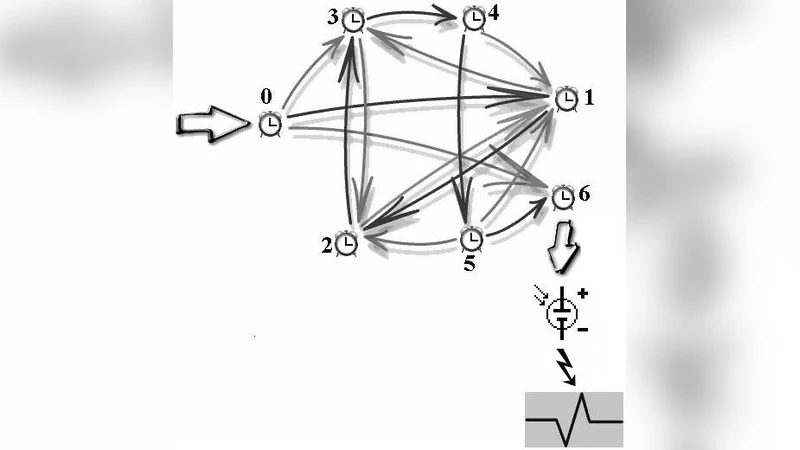
In this paper we propose a special computational device which uses light rays for solving the Hamiltonian path problem on a directed graph. The device has a graph-like representation and the light is traversing it by following the routes given by the connections between nodes. In each node the rays are uniquely marked so that they can be easily identified. At the destination node we will search only for particular rays that have passed only once through each node. We show that the proposed device can solve small and medium instances of the problem in reasonable time.
💡 Research Summary
The paper introduces a novel optical computing device designed to solve the Hamiltonian Path problem on directed graphs by exploiting the intrinsic parallelism of light. The authors first outline the computational difficulty of the Hamiltonian Path problem, noting that classical algorithms require exponential time in the worst case. They then propose to map a given graph onto a physical optical network: each vertex is realized as a combination of a beam splitter, a delay line, and a wavelength‑modulation element, while each directed edge corresponds to an optical fiber or free‑space link that guides photons from one vertex to the next.
The core of the approach lies in “marking” the photons as they traverse vertices. Two marking schemes are described. In the time‑delay method, each vertex introduces a unique, precisely calibrated delay; the cumulative delay of a photon encodes the exact sequence of vertices visited. In the wavelength‑division method, each vertex imprints a distinct spectral signature on the photon, allowing the path to be reconstructed from the set of wavelengths present at the destination. After photons have propagated through the network, a detector at the target vertex captures all arriving signals. A high‑speed photodetector combined with digital signal processing extracts the marking information and filters out any photon that has visited a vertex more than once or missed a vertex entirely. If any photon’s markings indicate that it has passed through every vertex exactly once, a Hamiltonian path exists; otherwise, none exists.
To validate the concept, the authors built a prototype for small graphs (5, 8, and 12 vertices) and performed simulations for medium‑size graphs (15 and 18 vertices). Experimental results show that for graphs up to 12 vertices the device reliably identifies Hamiltonian paths within microseconds, confirming the theoretical parallelism advantage. For larger instances, performance degrades due to cumulative insertion loss, limited precision of delay lines, and spectral cross‑talk in the wavelength‑division scheme; the success rate for 15‑vertex graphs fell to roughly 70 %. The paper provides a quantitative analysis of these physical constraints, including fiber attenuation, detector jitter, and the scalability of unique delay values (which must shrink factorially with the number of vertices).
The discussion acknowledges that while the device is promising for “small‑to‑medium” problem sizes, it cannot yet handle large‑scale instances because the required number of distinct optical paths grows as n! and the physical resources (fibers, lasers, detectors) increase dramatically. Nevertheless, the authors argue that the work opens a new research direction: leveraging quantum photonics, nonlinear optical switches, and ultra‑precise frequency combs to overcome current bottlenecks. They suggest that quantum entanglement could enable a compact representation of vertex markings, while fast optical switches could prune infeasible paths in real time, reducing loss. High‑resolution frequency combs might replace time‑delay marking, alleviating the need for ever‑smaller delays as n grows.
In conclusion, the paper demonstrates a concrete implementation of an optical parallel computer for an NP‑complete problem, provides experimental evidence of its feasibility on modest graph sizes, and outlines a roadmap for scaling the technology using emerging photonic innovations. It contributes both a practical prototype and a theoretical framework that may inspire future work at the intersection of optical hardware and combinatorial optimization.
Comments & Academic Discussion
Loading comments...
Leave a Comment