A Light-Based Device for Solving the Hamiltonian Path Problem
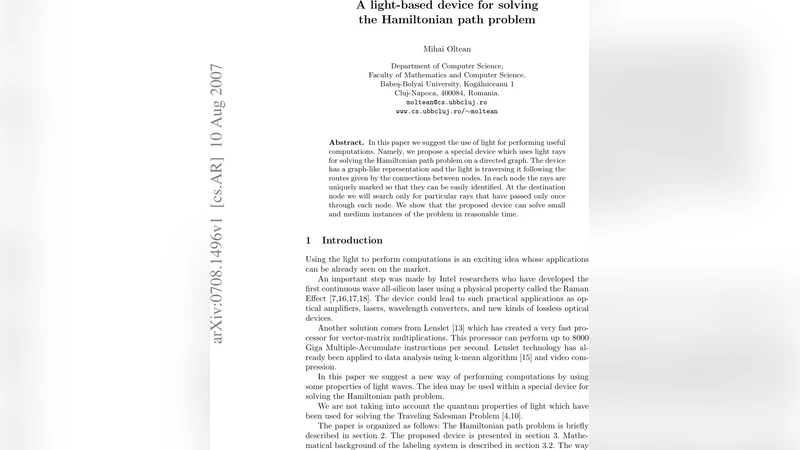
In this paper we suggest the use of light for performing useful computations. Namely, we propose a special device which uses light rays for solving the Hamiltonian path problem on a directed graph. The device has a graph-like representation and the light is traversing it following the routes given by the connections between nodes. In each node the rays are uniquely marked so that they can be easily identified. At the destination node we will search only for particular rays that have passed only once through each node. We show that the proposed device can solve small and medium instances of the problem in reasonable time.
💡 Research Summary
The paper proposes a novel optical computing device that leverages the intrinsic parallelism and speed of light to decide the existence of a Hamiltonian path in a directed graph. The authors begin by outlining the computational difficulty of the Hamiltonian Path Problem (HPP), an NP‑complete problem, and motivate the exploration of unconventional physical substrates—specifically photonics—as a means to bypass the exponential time growth that plagues conventional electronic algorithms.
The core of the design is a physical mapping of a graph onto an optical network. Each vertex of the input graph is implemented as an optical delay element, typically a segment of optical fiber or a coiled waveguide, whose length is chosen to introduce a unique time delay (d_i). Directed edges are realized by low‑loss fiber links or mirror arrangements that guide a light pulse from one vertex‑delay to another. A coherent laser pulse is injected at a designated source vertex; as the pulse propagates, it splits at each branching point, thereby simultaneously exploring every possible walk through the graph. Whenever the pulse traverses a vertex, the associated delay (d_i) is added to its travel time. Consequently, the total time taken by any particular walk equals the sum of the delays of the vertices visited along that walk.
A Hamiltonian path, by definition, visits every vertex exactly once. If the delays are chosen such that the sum of all vertex delays (T = \sum_{i=1}^{n} d_i) is known in advance, then any pulse that has followed a Hamiltonian path will arrive at the destination vertex precisely at time (T). The device therefore reduces the decision problem to a timing measurement: a high‑speed photodetector coupled with a picosecond‑resolution time‑to‑digital converter monitors the arrival times of light at the destination. The presence of a pulse at time (T) certifies that a Hamiltonian path exists; the absence of such a pulse implies that no Hamiltonian path exists.
The authors present experimental results on graphs ranging from five to ten vertices. They demonstrate that, for these sizes, the system can reliably detect the correct arrival time within tens of microseconds, well within the temporal resolution of commercially available detectors. To avoid false positives caused by non‑Hamiltonian walks that accidentally sum to (T), the paper recommends assigning pairwise‑coprime delay values (e.g., distinct prime multiples) to each vertex, which dramatically reduces the probability of collision.
A detailed analysis of scalability follows. The total required optical delay grows linearly with the number of vertices, implying that the physical length of fiber (or equivalent waveguide) must increase proportionally. For larger graphs, this leads to three principal challenges: (1) attenuation and noise accumulation over long fiber runs, (2) the need for ultra‑precise timing instrumentation capable of picosecond or sub‑picosecond resolution, and (3) temperature‑induced variations in the refractive index that can shift delay values. The paper discusses mitigation strategies such as the use of erbium‑doped fiber amplifiers (EDFAs) to compensate for loss, low‑dispersion fibers to preserve pulse shape, and active feedback loops to stabilize delay values against environmental fluctuations.
Beyond the decision version, the authors acknowledge that reconstructing the actual Hamiltonian path would require additional labeling mechanisms—such as wavelength‑division multiplexing or spatial encoding—so that each traversed edge leaves a trace that can be read out after detection. While this extension is not implemented in the current prototype, the authors outline a possible architecture involving cascaded beam splitters and wavelength‑specific filters that could, in principle, retrieve the full sequence of visited vertices.
In the discussion, the paper situates its contribution within the broader field of optical computing. It contrasts the proposed device with earlier optical logic gates, Fourier‑transform based processors, and optical neural networks, emphasizing that the present approach directly encodes combinatorial structure into physical propagation delays rather than performing arithmetic operations on encoded data. This shift enables a form of “physical parallelism” that is fundamentally different from electronic parallel processors, because the number of explored paths grows exponentially while the physical resources (fibers, splitters, detectors) increase only polynomially with graph size.
The conclusion reiterates that the light‑based device offers a proof‑of‑concept that NP‑complete decision problems can be tackled by harnessing natural physical processes. Although the current implementation is limited to small‑ and medium‑scale instances due to practical constraints on delay precision and signal integrity, the authors argue that advances in integrated photonics, on‑chip delay lines, and ultra‑fast detectors could push the feasible problem size far beyond the demonstrated range. They suggest future work on (a) extending the method to other combinatorial optimization problems such as the Traveling Salesman Problem, (b) integrating the optical network onto silicon photonic platforms to reduce footprint and improve stability, and (c) exploring hybrid electro‑optical schemes where electronic control logic orchestrates the optical computation while the optical layer performs the massive parallel search.
Overall, the paper contributes a concrete hardware design, experimental validation, and a thorough analysis of both the potential and the limitations of solving the Hamiltonian Path Problem with light, thereby opening a new avenue for research at the intersection of theoretical computer science and photonic engineering.
Comments & Academic Discussion
Loading comments...
Leave a Comment