Classifying finite localizations of quasi-coherent sheaves
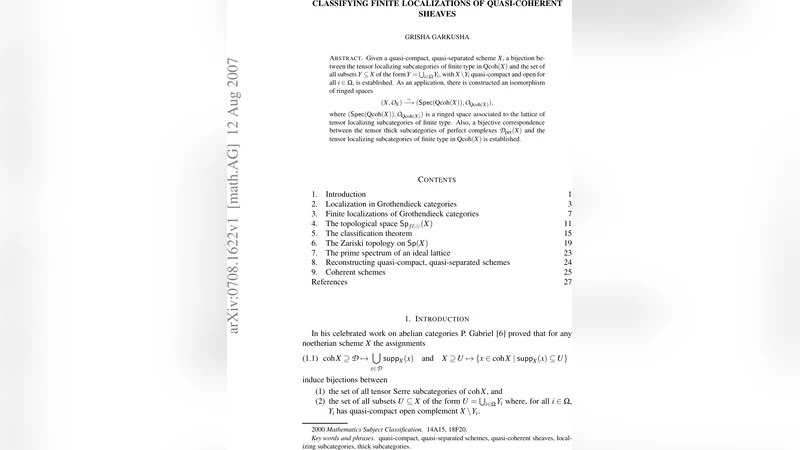
Given a quasi-compact, quasi-separated scheme X, a bijection between the tensor localizing subcategories of finite type in Qcoh(X) and the set of all subsets $Y\subseteq X$ of the form $Y=\bigcup_{i\in\Omega}Y_i$, with $X\setminus Y_i$ quasi-compact and open for all $i\in\Omega$, is established. As an application, there is constructed an isomorphism of ringed spaces (X,O_X)–>(Spec(Qcoh(X)),O_{Qcoh(X)}), where $(Spec(Qcoh(X)),O_{Qcoh(X)})$ is a ringed space associated to the lattice of tensor localizing subcategories of finite type. Also, a bijective correspondence between the tensor thick subcategories of perfect complexes $\perf(X)$ and the tensor localizing subcategories of finite type in Qcoh(X) is established.
💡 Research Summary
The paper investigates the structure of the category of quasi‑coherent sheaves Qcoh (X) on a quasi‑compact, quasi‑separated scheme X, focusing on a special class of subcategories called tensor localizing subcategories of finite type. A tensor localizing subcategory is an abelian subcategory closed under subobjects, quotients, extensions, direct limits, and stable under the tensor product with any object of Qcoh (X). The “finite type’’ condition means that the subcategory is generated by a set of finitely presented objects.
The first major result establishes a bijective correspondence between these subcategories and a distinguished family of subsets of the underlying topological space of X. Precisely, let Y⊂X be a union of complements of quasi‑compact open subsets, i.e.
Y = ⋃{i∈Ω}(X \ U_i) with each U_i quasi‑compact and open.
For such a Y define
Qcoh_Y (X) = { F ∈ Qcoh (X) | Supp(F) ⊂ Y }.
The authors prove that Qcoh_Y (X) is a tensor localizing subcategory of finite type, and conversely, for any tensor localizing subcategory T of finite type set
Y_T = ⋃{F∈T} Supp(F).
Then Y_T is of the above form and the assignments Y ↦ Qcoh_Y (X) and T ↦ Y_T are inverse to each other. Moreover, this correspondence respects the lattice operations (intersection and sum), so the collection L_f(X) of all tensor localizing subcategories of finite type becomes a complete lattice isomorphic to the lattice of such subsets Y.
Having identified the lattice L_f(X), the authors construct a spectral space Spec (Qcoh (X)) in the sense of Hochster. Its points are the “prime’’ tensor localizing subcategories (those that are proper and satisfy a primality condition with respect to the tensor product). The basic open sets are D(I) = { P ∈ Spec (Qcoh (X)) | I ⊈ P } for I∈L_f(X). The topology obtained coincides with the original Zariski topology on X under the bijection described above.
Next, a structure sheaf 𝒪_{Qcoh (X)} is defined on Spec (Qcoh (X)). For each basic open D(I) the ring of sections is taken to be the endomorphism ring of the unit object in the localized category Qcoh (X)/I, i.e. the centre of the quotient. Gluing these rings yields a sheaf of commutative rings, turning (Spec (Qcoh (X)), 𝒪_{Qcoh (X)}) into a locally ringed space. The authors then prove a canonical isomorphism of ringed spaces
(X, 𝒪_X) ≅ (Spec (Qcoh (X)), 𝒪_{Qcoh (X)}).
Thus the scheme X can be completely recovered from the categorical data of Qcoh (X) together with its tensor product. This result can be viewed as a categorical analogue of Gabriel’s reconstruction theorem, enriched by the tensor structure.
In the final part the paper connects the above classification with Balmer’s tensor‑triangular geometry. Let Perf (X) denote the triangulated category of perfect complexes on X, equipped with the derived tensor product. A tensor thick subcategory of Perf (X) is a triangulated subcategory closed under direct summands and under tensoring with arbitrary perfect complexes. The authors show that assigning to a tensor thick subcategory its support (the union of the supports of its objects) yields a bijection onto the same family of subsets Y described earlier. Consequently there is a natural bijection
{tensor thick subcategories of Perf (X)} ↔ {tensor localizing subcategories of finite type in Qcoh (X)}.
This bridges the abelian world of quasi‑coherent sheaves and the triangulated world of perfect complexes, confirming that both categorical frameworks encode the same geometric information about X.
Overall, the paper makes three substantial contributions: (1) a precise classification of tensor localizing subcategories of finite type in Qcoh (X) via unions of complements of quasi‑compact opens; (2) the construction of a spectral space and a structure sheaf from the lattice L_f(X), yielding a reconstruction of the original scheme; and (3) a demonstration that the tensor thick subcategories of Perf (X) correspond exactly to the same lattice, thereby unifying the abelian and triangulated approaches to tensor‑triangular geometry. These results deepen our understanding of how categorical data determine geometric objects and open avenues for extending the theory to non‑commutative or derived settings.
Comments & Academic Discussion
Loading comments...
Leave a Comment