The periodic table of n-categories for low dimensions I: degenerate categories and degenerate bicategories
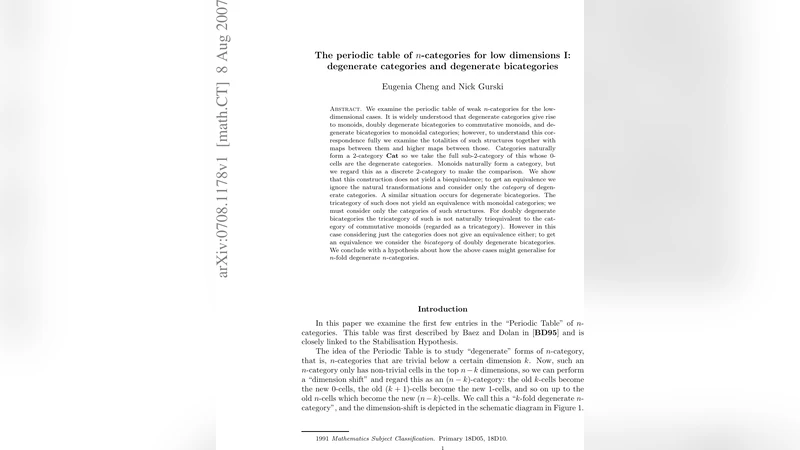
We examine the periodic table of weak n-categories for the low-dimensional cases. It is widely understood that degenerate categories give rise to monoids, doubly degenerate bicategories to commutative monoids, and degenerate bicategories to monoidal categories; however, to understand this correspondence fully we examine the totalities of such structures together with maps between them and higher maps between those. Categories naturally form a 2-category {\bfseries Cat} so we take the full sub-2-category of this whose 0-cells are the degenerate categories. Monoids naturally form a category, but we regard this as a discrete 2-category to make the comparison. We show that this construction does not yield a biequivalence; to get an equivalence we ignore the natural transformations and consider only the {\it category} of degenerate categories. A similar situation occurs for degenerate bicategories. The tricategory of such does not yield an equivalence with monoidal categories; we must consider only the categories of such structures. For doubly degenerate bicategories the tricategory of such is not naturally triequivalent to the category of commutative monoids (regarded as a tricategory). However in this case considering just the categories does not give an equivalence either; to get an equivalence we consider the {\it bicategory} of doubly degenerate bicategories. We conclude with a hypothesis about how the above cases might generalise for n-fold degenerate n-categories.
💡 Research Summary
The paper investigates the “periodic table” of weak n‑categories in the lowest dimensions, focusing on how degenerate categories and bicategories correspond to familiar algebraic structures such as monoids, commutative monoids, and monoidal categories. The authors adopt a categorical‑higher‑dimensional viewpoint: they do not merely compare objects and 1‑morphisms, but also include the natural transformations (2‑cells) and higher modifications (3‑cells) that exist in the ambient 2‑category Cat and its higher analogues.
First, a degenerate category is defined as a category with a single object and only its identity endomorphisms. Inside the 2‑category Cat, such categories form a full sub‑2‑category whose 1‑cells are functors and whose 2‑cells are natural transformations. By forgetting the 2‑cells and considering only the underlying ordinary category of degenerate categories, one recovers precisely the category of monoids. However, when the full 2‑categorical structure is retained, the resulting 2‑category is not biequivalent to the discrete 2‑category obtained from monoids (monoids regarded as a category with only identity 2‑cells). The obstruction is that natural transformations introduce extra higher‑dimensional data that have no counterpart in the algebraic notion of a monoid.
Second, the authors turn to degenerate bicategories: bicategories with a single object and a single 1‑cell, but with possibly many 2‑cells. These are known to correspond to monoidal categories. Again, the full tricategory of such bicategories (including 3‑cells, i.e., modifications) fails to be triequivalent to the tricategory of monoidal categories. By discarding the 3‑cells and working with the ordinary category of degenerate bicategories (objects are the bicategories, morphisms are homomorphisms of bicategories, 2‑cells are ignored), a triequivalence is restored. The pattern mirrors the first case: the highest‑dimensional cells must be suppressed to obtain an equivalence.
Third, the paper examines the doubly degenerate bicategory: a bicategory with exactly one object and one 1‑cell, but with a non‑trivial collection of 2‑cells. Such a structure encodes a commutative monoid: the horizontal and vertical compositions of 2‑cells coincide and satisfy the Eckmann–Hilton argument, yielding a commutative binary operation. When the full tricategory of doubly degenerate bicategories is compared with the tricategory obtained from commutative monoids (viewed as a discrete tricategory), no triequivalence exists. Interestingly, simply dropping the 3‑cells does not suffice; the resulting category still fails to be equivalent to the category of commutative monoids. The authors discover that one must retain the 2‑cells (the transformations) while discarding the 3‑cells, thereby forming a bicategory of doubly degenerate bicategories. This bicategory is biequivalent to the bicategory obtained from commutative monoids (again regarded as a bicategory with only identity higher cells). Thus, for the doubly degenerate case the correct level of truncation is one dimension lower than in the previous examples.
The authors then propose a general conjecture for n‑fold degenerate n‑categories. Roughly, an n‑fold degenerate n‑category (i.e., a weak n‑category with exactly one k‑cell for each k < n) should correspond to an (n‑1)‑fold algebraic structure (e.g., an (n‑1)‑monoid, a commutative (n‑2)‑monoid, etc.). However, the full (n + 1)‑categorical structure of these degenerate objects will not be (n + 1)‑equivalent to the corresponding algebraic structure. To obtain an equivalence one must truncate at the appropriate level: keep the cells up to dimension n − 1 and discard the top‑dimensional cells. The precise truncation level may shift depending on how many “degeneracies” are present, as illustrated by the doubly degenerate case where one retains 2‑cells but discards 3‑cells.
Methodologically, the paper constructs explicit models for each case, writes down the relevant functors, homomorphisms, natural transformations, and modifications, and then checks the coherence conditions required for biequivalence or triequivalence. The failure of equivalence is demonstrated by exhibiting non‑trivial higher cells that have no algebraic counterpart, while the successful equivalences are proved by constructing inverse equivalences after the appropriate truncation.
In conclusion, the paper clarifies that the familiar identifications—degenerate categories ↔ monoids, degenerate bicategories ↔ monoidal categories, doubly degenerate bicategories ↔ commutative monoids—hold only after a careful handling of higher‑dimensional morphisms. The work highlights the subtle role of higher cells in categorical equivalences and offers a roadmap for extending these insights to higher n, suggesting that the periodic table of n‑categories must be interpreted with an awareness of which levels of morphisms are essential and which must be ignored to achieve true equivalence.
Comments & Academic Discussion
Loading comments...
Leave a Comment