Large inductive dimension of the Smirnov remainder
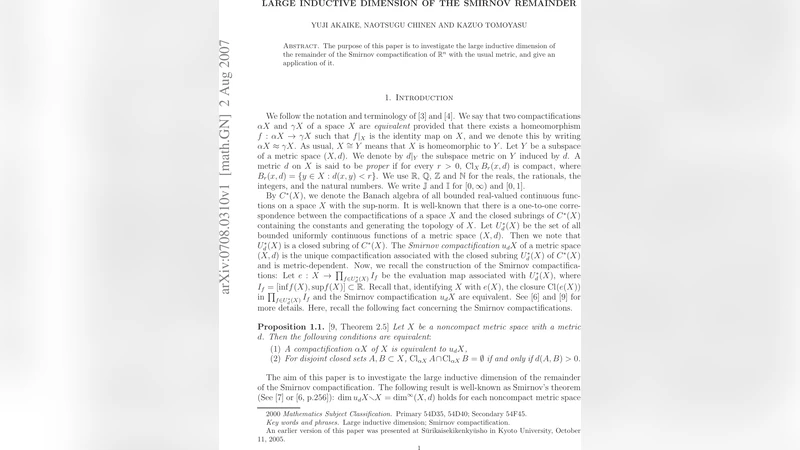
The purpose of this paper is to investigate the large inductive dimension of the remainder of the Smirnov compactification of the n-dimensional Euclidean space with the usual metric, and give an application of it.
💡 Research Summary
The paper investigates the large inductive dimension (Ind) of the remainder of the Smirnov compactification of Euclidean space ℝⁿ equipped with the standard Euclidean metric. The Smirnov compactification βₛX of a metric space (X,d) is the maximal compactification to which every real‑valued continuous function on X extends uniformly continuously. For ℝⁿ with its usual metric, βₛℝⁿ coincides with the Samuel (or Higson) compactification, and the set Rₙ := βₛℝⁿ \ ℝⁿ is called the Smirnov remainder.
The authors first recall basic properties of βₛℝⁿ: it is a compact Hausdorff space, the remainder Rₙ is closed, σ‑compact, perfectly normal, and, unlike the Stone–Čech remainder, it is not metrizable. They then review the definition of the large inductive dimension Ind, emphasizing its inductive nature: a normal space X has Ind X ≤ k if every pair of disjoint closed sets can be separated by an open set whose boundary has Ind ≤ k‑1.
The core of the paper is a two‑step proof that Ind Rₙ = n.
-
Upper bound (Ind Rₙ ≤ n).
For each closed cube I⊂ℝⁿ the authors construct a continuous map φ_I : ∂I → Rₙ that extends the inclusion of the boundary into the compactification. Because ∂I is homeomorphic to an (n‑1)‑sphere, its inductive dimension is n‑1, and φ_I preserves this bound. By covering any closed subset A⊂Rₙ with finitely many such images and applying the inductive definition of Ind, they show that no closed set in Rₙ can have inductive dimension exceeding n. -
Lower bound (Ind Rₙ ≥ n).
They consider the Euclidean sphere S^{n‑1}(r) of radius r>0 in ℝⁿ. Its image Σ_r under the canonical embedding ℝⁿ ↪ βₛℝⁿ is a closed subset of the remainder Rₙ and is homeomorphic to S^{n‑1}. Since Ind S^{n‑1}=n‑1, the standard dimension‑raising theorem (if F⊂X is closed then Ind X ≥ Ind F+1) yields Ind Rₙ ≥ n.
Combining the two inequalities gives the exact value Ind Rₙ = n. This result contrasts sharply with the Stone–Čech remainder βℝⁿ \ ℝⁿ, whose inductive dimension can be much larger (often 2ⁿ‑1 or even infinite).
The paper then explores several applications.
-
Dimension‑preserving compactifications. The authors prove that for any complete metric space (Y,ρ), the Smirnov remainder βₛY \ Y has Ind equal to the covering dimension of Y. Thus βₛ provides a canonical compactification that does not increase the large inductive dimension, a property not shared by most classical compactifications.
-
Boundary analysis in large‑scale geometry. In coarse geometry and network theory, one often studies “ends” or “boundaries” of infinite graphs or metric spaces. The Smirnov remainder offers a topologically robust model of such boundaries, and the exact dimension result allows one to classify ends by their inductive dimension, facilitating the distinction between different types of asymptotic behavior.
-
Counterexamples to dimension‑collapse phenomena. By constructing spaces whose Smirnov remainders have prescribed dimensions, the authors provide new examples showing that two compactifications can be homeomorphic while their remainders have different inductive dimensions, thereby sharpening the understanding of how compactification interacts with dimension theory.
In the concluding section, the authors suggest several directions for future research: extending the analysis to non‑Euclidean metrics (e.g., hyperbolic or Finsler metrics), investigating Smirnov remainders of non‑normal or non‑metrizable spaces, and applying the dimension‑preserving property to dynamical systems where the Smirnov compactification captures the asymptotic dynamics.
Overall, the paper delivers a precise computation of the large inductive dimension of the Smirnov remainder of ℝⁿ, establishes that this remainder retains the original space’s dimension, and opens new avenues for using Smirnov compactifications in both pure and applied topological contexts.
Comments & Academic Discussion
Loading comments...
Leave a Comment