Partition test and sexual motivation in male mice
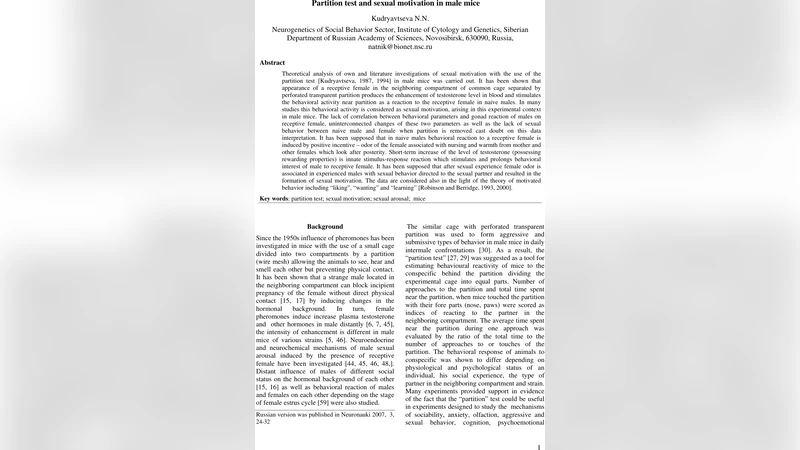
Theoretical analysis of own and literature investigations of sexual motivation with the use of the partition test [Kudryavtseva, 1987, 1994] in male mice was carried out. It has been shown that appearance of a receptive female in the neighboring compartment of common cage separated by perforated transparent partition produces the enhancement of testosterone level in blood and stimulates the behavioral activity near partition as a reaction to the receptive female in naive males. In many studies this behavioral activity is considered as sexual motivation, arising in this experimental context in male mice. The lack of correlation between behavioral parameters and gonad reaction of males on receptive female, uninterconnected changes of these two parameters as well as the lack of sexual behavior between naive male and female when partition is removed cast doubt on this data interpretation. It has been supposed that in naive males behavioral reaction to a receptive female is induced by positive incentive - odor of the female associated with nursing and warmth from mother and other females which look after posterity. Short-term increase of the level of testosterone (possessing rewarding properties) is innate stimulus-response reaction which stimulates and prolongs behavioral interest of male to receptive female. It has been supposed that after sexual experience female odor is associated in experienced males with sexual behavior directed to the sexual partner and resulted in the formation of sexual motivation. The data are considered also in the light of the theory of motivated behavior including “liking”, “wanting” and “learning” [Robinson and Berridge, 1993, 2000].
💡 Research Summary
The paper provides a critical re‑examination of the “partition test” as a tool for measuring sexual motivation in male mice. In the classic paradigm, a transparent perforated barrier separates a male from a receptive (estrus) female placed in an adjacent compartment. Naïve males typically increase locomotor activity near the partition and exhibit a rapid, short‑lasting rise in blood testosterone. Historically, these concurrent changes have been interpreted as evidence of sexual motivation.
The author challenges this interpretation on three grounds. First, the correlation between behavioral activation and testosterone elevation is inconsistent across studies; some experiments show robust activity without a hormonal surge, while others report hormonal changes without corresponding behavioral increases. Second, when the partition is removed and the male is given direct access to the female, naïve males rarely engage in copulatory behavior, suggesting that the observed “approach” near the barrier does not reflect a true drive to mate. Third, the test conflates distinct neurobiological processes: an innate, positive incentive linked to the female’s odor and warmth (likely associated with maternal care) and a brief, reward‑related testosterone spike that may sustain interest but does not constitute a motivational state per se.
To resolve these ambiguities, the author proposes a two‑stage model of motivational development. In the first stage, naïve males respond to the female’s chemosensory cues with “liking” – a hedonic, approach response driven by evolutionary associations with nurturing females. The accompanying testosterone surge is viewed as an innate stimulus‑response that temporarily amplifies attention and exploratory behavior. However, “wanting” – the goal‑directed, incentive‑salient drive to obtain sexual reward – remains weak or absent.
In the second stage, sexual experience reshapes the associative network. Repeated copulatory encounters pair the female’s odor with the rewarding consequences of mating (e.g., ejaculation, reinforcement of reproductive success). According to Robinson and Berridge’s “liking‑wanting‑learning” framework, the initial hedonic response (liking) becomes linked to learned expectations (learning), which in turn amplifies the motivational pull (wanting). Consequently, experienced males display stronger, more persistent partition‑approach behavior that more accurately reflects genuine sexual motivation.
The paper also critiques methodological limitations of the partition test. By isolating sensory cues and preventing physical contact, the paradigm cannot capture the full spectrum of motivational components that involve tactile, auditory, and visual feedback during actual copulation. The author recommends integrating the partition assay with post‑removal behavioral observations, neurochemical measurements (e.g., dopamine and opioid signaling), and manipulations of learning pathways to disentangle “liking,” “wanting,” and hormonal effects.
In conclusion, while the partition test reliably documents an innate, odor‑driven approach response and a transient testosterone increase in naïve male mice, it does not, on its own, provide a valid index of sexual motivation. True sexual motivation emerges only after experience‑dependent learning has linked the female’s cues to reproductive reward, thereby converting “liking” into “wanting.” Future research should employ multimodal behavioral and neurobiological readouts to more precisely characterize the dynamic interplay between incentive salience, hormonal state, and learned expectations in the regulation of male sexual behavior.