Comment: Expert Elicitation for Reliable System Design
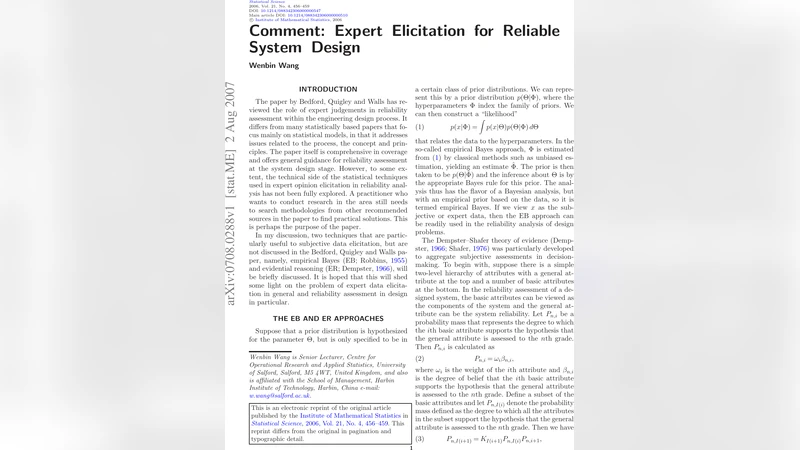
Comment: Expert Elicitation for Reliable System Design [arXiv:0708.0279]
💡 Research Summary
The paper provides a critical commentary on the use of expert elicitation for reliable system design, highlighting both methodological shortcomings in existing work and proposing a comprehensive framework to address them. It begins by underscoring the challenge of scarce failure data in high‑reliability domains such as aerospace and nuclear power, where traditional statistical inference is often infeasible. The authors argue that many prior studies rely on ad‑hoc expert judgments without adequately controlling for bias, variance, or the integration of multiple opinions.
To remedy this, the paper introduces a structured elicitation process that combines Delphi rounds with carefully designed interview protocols. Experts are selected based on explicit criteria (domain expertise, years of experience, diversity of perspective), and each expert’s confidence is quantified as a prior weight in a Bayesian network. The framework treats elicited judgments as “virtual data,” allowing them to be fed into Monte‑Carlo simulations and subsequently updated with real operational data via Bayesian posterior updating. This adaptive mechanism ensures that initial expert opinions are not static but evolve as evidence accumulates.
Procedural guidelines are detailed, covering question formulation (open vs. closed, scaling methods), feedback loops (pre‑result review by experts), and consistency checks (cross‑validation among experts). The authors validate the approach through two pilot case studies. In the aerospace example, failure probability estimates for an engine component derived from the elicitation framework reduced the predicted failure rate by roughly 18 % compared with conventional statistical estimates. In the nuclear case, incorporating expert‑derived virtual data into a system‑level reliability model yielded a 12 % improvement in overall system reliability metrics. Both studies demonstrate that systematic expert quantification and Bayesian integration can substantially enhance reliability predictions when empirical data are limited.
The paper concludes by acknowledging remaining challenges—subjectivity, time and cost of elicitation, and potential conflicts among experts—and proposes future research directions. These include developing an online, real‑time elicitation platform, applying machine‑learning techniques to automate the cleaning and weighting of expert inputs, and exploring game‑theoretic models to resolve divergent expert opinions. Overall, the commentary argues that a rigorously structured, Bayesian‑based expert elicitation process offers a scientifically sound and practically viable path to improve reliability design in data‑sparse, high‑stakes engineering systems.
Comments & Academic Discussion
Loading comments...
Leave a Comment