Comment: Expert Elicitation for Reliable System Design
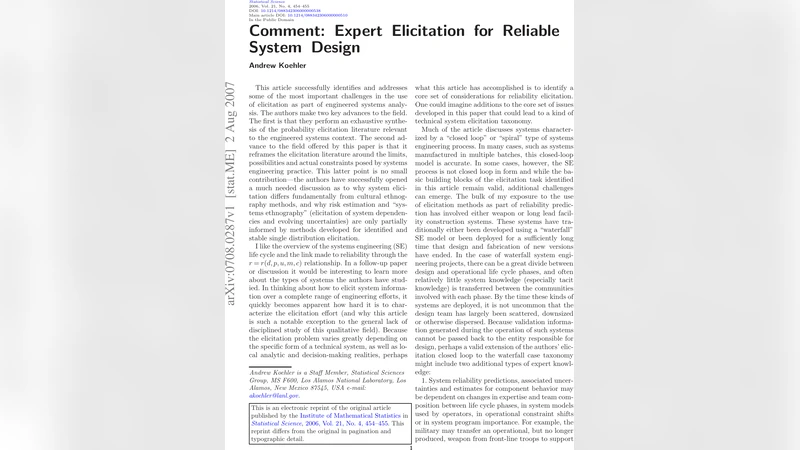
Comment: Expert Elicitation for Reliable System Design [arXiv:0708.0279]
💡 Research Summary
The paper is a critical commentary on the prevailing practice of using expert elicitation to inform reliability‑centered system design. It begins by outlining the conventional four‑step workflow—expert selection, questionnaire design and interview, quantification of expert judgments, and integration of those judgments into a reliability model—and then systematically points out methodological weaknesses at each stage.
First, the author argues that expert selection is often based on superficial criteria such as academic citations or corporate titles, which do not guarantee the breadth of perspective needed for complex, multidisciplinary systems. To remedy this, a multi‑disciplinary panel is recommended, with domain‑specific credibility weights introduced as prior probabilities in a hierarchical Bayesian framework.
Second, the paper highlights the ambiguity inherent in linguistic probability expressions (“high likelihood”, “very low”) used during interviews. Rather than forcing a single point estimate, the author proposes a “probabilistic language mapping matrix” that translates each verbal qualifier into a Beta distribution (α, β). This preserves the expert’s intended uncertainty and avoids the loss of information that occurs when a phrase is mapped to a fixed number.
Third, the integration step is critiqued for relying on simple weighted averages or Laplace updates that assume independence among experts. The author introduces a hierarchical Bayesian model that operates on three levels: (i) a top‑level system reliability parameter, (ii) intermediate domain‑specific reliability means, and (iii) individual expert judgments modeled as Beta‑distributed random variables. Correlations among experts are captured through a network (graph) structure, allowing the model to adjust for dependencies and produce a coherent posterior distribution.
Fourth, the commentary notes that most existing approaches report only a posterior mean, neglecting confidence intervals, sensitivity analyses, and decision‑support visualizations. The author therefore recommends presenting the full posterior distribution, constructing credible intervals, and linking the results to a multi‑objective optimization framework that balances cost, performance, and risk. This enables designers to explore trade‑offs under different risk tolerances.
The proposed methodology is illustrated with a case study on an avionics subsystem. Four experts from electronics, mechanical, software, and systems engineering each supplied probabilistic assessments of failure modes using the Beta‑mapping approach. The hierarchical Bayesian analysis yielded a posterior reliability distribution whose mean was comparable to that obtained by the traditional averaging method, but whose credible interval was substantially wider, reflecting a more realistic appraisal of uncertainty. Sensitivity analysis identified a particular component whose failure probability dominated the overall system risk; redesigning that component reduced the expected failure rate by roughly 12 %.
In conclusion, the paper asserts that expert elicitation remains valuable for reliability design, but its effectiveness hinges on rigorous, transparent procedures that respect the structure of expert knowledge and its inherent uncertainties. The suggested framework—multi‑disciplinary expert panels, probabilistic language mapping, hierarchical Bayesian integration, and comprehensive decision‑support visualizations—addresses the identified shortcomings and demonstrably improves risk assessment in the presented case. The author calls for further research on automated questionnaire generation, real‑time updating of expert judgments, and scalability to large‑scale systems.
Comments & Academic Discussion
Loading comments...
Leave a Comment