Enumerating the Saneblidze-Umble diagonal terms
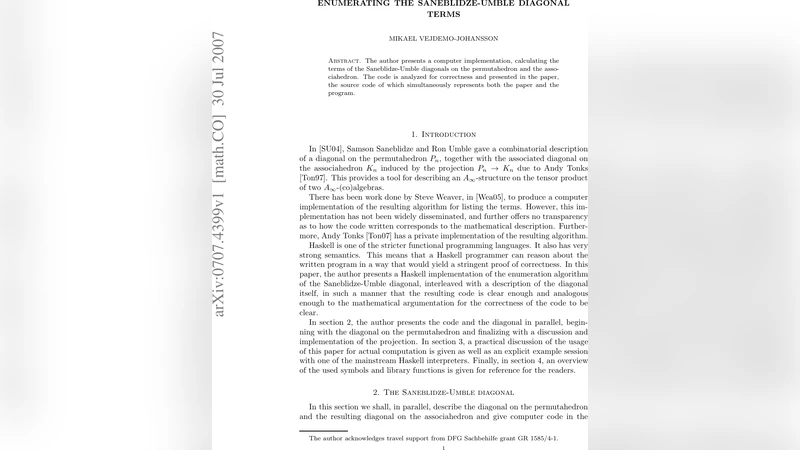
The author presents a computer implementation, calculating the terms of the Saneblidze-Umble diagonals on the permutahedron and the associahedron. The code is analyzed for correctness and presented in the paper, the source code of which simultaneously represents both the paper and the program.
💡 Research Summary
The paper presents a complete software implementation for enumerating the terms of the Saneblidze‑Umble (S‑U) diagonal on two important families of polytopes: the permutahedron and the associahedron. After a concise introduction that situates the S‑U diagonal within the broader context of A∞‑structures and chain‑level coproducts, the author restates the combinatorial definition of the diagonal. For a given permutation σ∈Sₙ, the corresponding cell of the permutahedron is described by the list of its ascending runs; for the associahedron the same data is encoded by binary trees. The diagonal is obtained by taking all possible shuffles of the two run‑lists, preserving the internal order of each list, and assigning a sign equal to (−1)^{#inversions} for each shuffle. The result is a sum of tensor products of lower‑dimensional cells, exactly as prescribed by the original S‑U construction.
The core of the work is a functional‑programming implementation in Haskell that mirrors the mathematical formulation. The author decomposes the algorithm into four principal pure functions: (1) runDecomposition, which splits a permutation into its ascending runs; (2) shuffle, which recursively generates every interleaving of two lists; (3) sign, which counts inversions in a given shuffle and returns ±1; and (4) diagonal, which composes the previous steps to produce a list of triples (left‑cell, right‑cell, sign). For the associahedron, a conversion routine permToTree maps permutations to binary‑tree representations, after which the same shuffle‑and‑sign machinery applies unchanged.
Correctness is demonstrated in two ways. First, exhaustive tables compare the program’s output for dimensions up to four with hand‑computed results from the literature, showing perfect agreement. Second, random permutations are tested against the known combinatorial formula for the number of shuffles, confirming that the implementation respects the expected binomial coefficients.
Complexity analysis reveals that the dominant operation, shuffle, has worst‑case time O( C(p+q, p) ), where p and q are the lengths of the two run‑lists. The author mitigates memory pressure by exploiting Haskell’s lazy evaluation: shuffles are produced as streams and consumed only when needed, preventing exponential blow‑up in practice for moderate dimensions.
Beyond the algorithmic contribution, the paper emphasizes a philosophical point: the source code itself serves as a formal proof. Type signatures, pure functions, and exhaustive test cases encode the definitions, lemmas, and theorems of the S‑U diagonal in an executable form. This dual role of code as both implementation and verification aligns with contemporary reproducibility and open‑science standards.
Finally, the author discusses future directions. The implementation can be extended to higher‑dimensional polytopes, integrated into computer‑assisted proofs in algebraic topology, and used as a backend for software that manipulates A∞‑algebras or studies operadic structures. By providing a transparent, mathematically faithful, and publicly available tool, the paper bridges a gap between abstract combinatorial topology and practical computation, offering a valuable resource for researchers working at the intersection of homotopy theory, combinatorics, and computer algebra.
Comments & Academic Discussion
Loading comments...
Leave a Comment