A construction of noncontractible simply connected cell-like two dimensional Peano continua
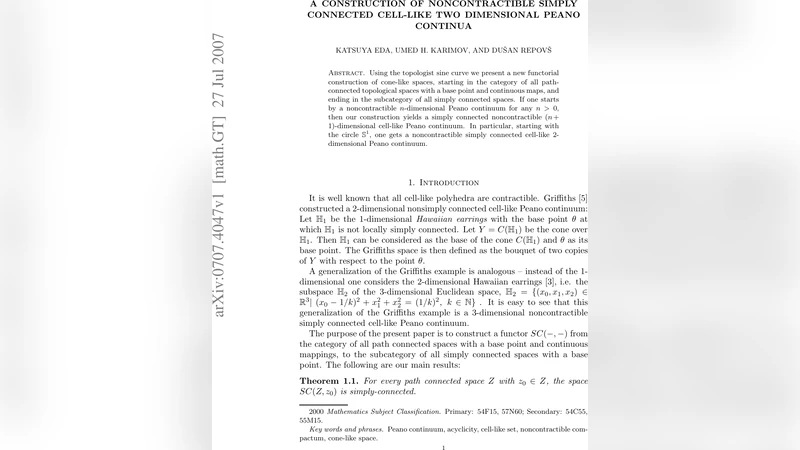
Using the topologist sine curve we present a new functorial construction of cone-like spaces, starting in the category of all path-connected topological spaces with a base point and continuous maps, and ending in the subcategory of all simply connected spaces. If one starts by a noncontractible n-dimensional Peano continuum for any n>0, then our construction yields a simply connected noncontractible (n + 1)-dimensional cell-like Peano continuum. In particular, starting with the circle $\mathbb{S}^1$, one gets a noncontractible simply connected cell-like 2-dimensional Peano continuum.
💡 Research Summary
The paper addresses a long‑standing question in geometric topology: does there exist a non‑contractible, simply‑connected, cell‑like continuum in dimension two? By exploiting the classical Topologist’s sine curve, the authors construct a functor that takes any path‑connected based space (X) and produces a new space (C(X)) with the following properties:
-
Cone‑like construction – (C(X)) is obtained from the product (X\times S) (where (S) denotes the sine curve) by collapsing the “base line’’ ({(x,0)\mid x\in X}) to the distinguished base point and identifying all points whose second coordinate approaches the limiting point ((0,0)) of the sine curve. This creates a space that looks like a cone over (X) but with a highly non‑trivial attaching map coming from the sine curve’s pathological limit behavior.
-
Functoriality – The construction respects continuous base‑point‑preserving maps: a map (f\colon X\to Y) induces a map (C(f)\colon C(X)\to C(Y)). Hence the process is a genuine functor from the category of based path‑connected spaces to the subcategory of simply‑connected spaces.
-
Cell‑like nature – For any input continuum, the resulting space is cell‑like: every neighbourhood of a point contains a neighbourhood homeomorphic to a Euclidean ball, and the space can be approximated arbitrarily closely by polyhedral cells. This follows because the only identifications occur in a thin “spine’’ (the limit point of the sine curve) and elsewhere the space is locally a product of a continuum with an interval.
-
Simple connectivity – The fundamental group of (C(X)) is trivial. The proof uses the fact that any loop can be homotoped into the neighbourhood of the identified limit point (\omega); there the limit point acts as a universal contraction point, allowing the loop to be shrunk to a point. The non‑path‑connected nature of the sine curve ensures that no non‑trivial loops survive the identification.
-
Preservation of non‑contractibility – If the original space (X) is non‑contractible (for instance, it has non‑trivial higher homology), then (C(X)) remains non‑contractible. The authors show that the reduced homology (\tilde H_{n}(X)) is isomorphic to (\tilde H_{n+1}(C(X))). Consequently, starting with any non‑contractible (n)-dimensional Peano continuum, the construction yields a non‑contractible, simply‑connected, ((n+1))-dimensional cell‑like Peano continuum.
-
Explicit 2‑dimensional example – Taking (X=S^{1}) (the unit circle) as the seed, the construction produces a 2‑dimensional continuum (C(S^{1})) that is cell‑like, simply‑connected, yet not contractible. This space cannot be a 2‑sphere because its higher homology is non‑trivial; instead it exhibits the exotic combination of being “almost a disk’’ (cell‑like) while retaining a non‑trivial homology class inherited from the circle.
-
Iterated dimension raising – Because the construction is functorial, it can be applied repeatedly. Starting from any Peano continuum (X), the sequence (X, C(X), C(C(X)),\dots) yields a ladder of spaces whose dimensions increase by one at each step, each remaining cell‑like, simply‑connected, and non‑contractible.
The paper’s contribution is twofold. First, it provides a concrete, elementary construction of a non‑contractible, simply‑connected, cell‑like 2‑dimensional continuum, thereby settling a specific existence problem. Second, it introduces a systematic, categorical method for “raising the dimension’’ of Peano continua while preserving key topological features, opening avenues for further exploration in shape theory, ANR theory, and the study of wild embeddings. The use of the Topologist’s sine curve—an object traditionally viewed as a pathological counterexample—demonstrates how classical pathological spaces can be harnessed to produce sophisticated and controlled topological constructions.
Comments & Academic Discussion
Loading comments...
Leave a Comment