Superintegrability on sl(2)-coalgebra spaces
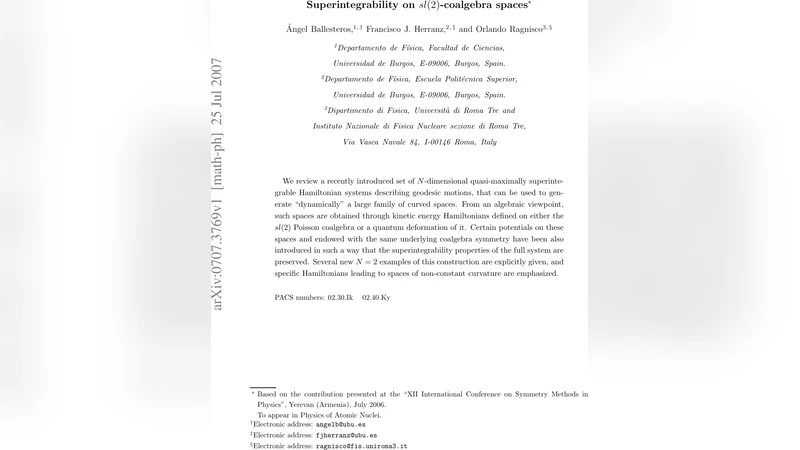
We review a recently introduced set of N-dimensional quasi-maximally superintegrable Hamiltonian systems describing geodesic motions, that can be used to generate “dynamically” a large family of curved spaces. From an algebraic viewpoint, such spaces are obtained through kinetic energy Hamiltonians defined on either the sl(2) Poisson coalgebra or a quantum deformation of it. Certain potentials on these spaces and endowed with the same underlying coalgebra symmetry have been also introduced in such a way that the superintegrability properties of the full system are preserved. Several new N=2 examples of this construction are explicitly given, and specific Hamiltonians leading to spaces of non-constant curvature are emphasized.
💡 Research Summary
The paper presents a unified algebraic framework for constructing N‑dimensional quasi‑maximally superintegrable (QMS) Hamiltonian systems whose kinetic terms generate a wide variety of curved spaces. The core of the construction is the sl(2) Poisson coalgebra ((\mathfrak{sl}(2),\Delta)). Its three generators (J_{+}, J_{-}, J_{0}) satisfy the usual sl(2) Poisson brackets ({J_{0},J_{\pm}}= \pm 2J_{\pm},; {J_{+},J_{-}}=4J_{0}). The coproduct (\Delta) allows one to build global invariants (J_{\alpha}^{(N)}) for an N‑particle system by repeatedly applying (\Delta). Any scalar function (\mathcal{F}) of these invariants yields a Hamiltonian \
Comments & Academic Discussion
Loading comments...
Leave a Comment