Generalized Differential Galois Theory
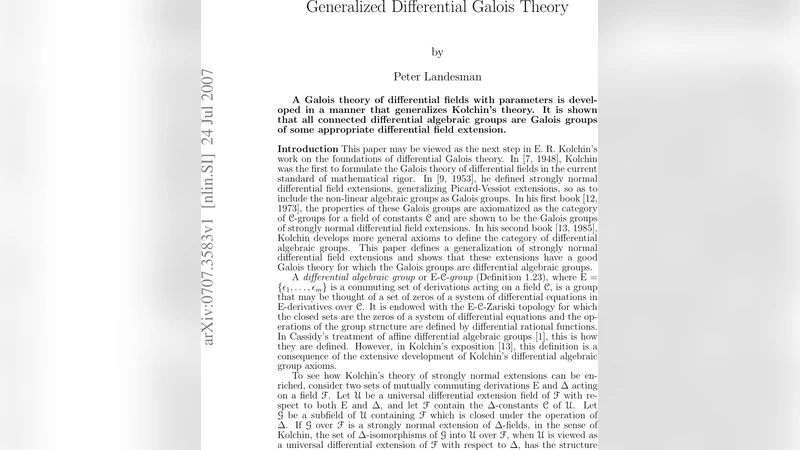
A Galois theory of differential fields with parameters is developed in a manner that generalizes Kolchin’s theory. It is shown that all connected differential algebraic groups are Galois groups of some appropriate differential field extension.
💡 Research Summary
The paper presents a comprehensive extension of Kolchin’s differential Galois theory to encompass differential fields equipped with additional parameters. The author begins by identifying the limitation of the classical theory: it treats differential equations over a base field with a single set of derivations and assumes that the field of constants is algebraically closed. In many modern applications—such as families of differential equations depending on external parameters, q‑difference equations, or mixed difference‑differential systems—this framework is insufficient. To remedy this, the author introduces the notion of a parameterised differential field (K, Δ, Π), where Δ denotes the primary derivations governing the differential equations and Π denotes a commuting set of derivations that act on the parameters. This dual‑derivation structure leads to the definition of a Δ‑Π‑differential algebraic group, a group defined by polynomial equations that are invariant under both Δ and Π.
Section 2 develops the algebraic foundations required for the new setting. The author revisits differential algebraic groups, emphasizing connectedness, the Lie algebra associated with a group, and the concept of Δ‑Π‑dimension, which measures the size of a group simultaneously with respect to both derivation sets. This dimension theory generalises Kolchin’s differential dimension and provides a crucial invariant for later constructions.
In Section 3 the paper proves a parameterised Picard‑Vessiot (PV) theorem. Classical PV theory guarantees the existence of a minimal differential field extension L/K whose group of Δ‑automorphisms is a linear algebraic group, provided the constants are algebraically closed. The new theorem relaxes this hypothesis: even when the constants carry a Π‑structure, there exists a minimal Δ‑extension L that is also Π‑stable, and the group of Δ‑automorphisms that commute with Π is a linear Δ‑Π‑algebraic group. The proof hinges on constructing a Δ‑Π‑linear system whose solution space generates L, and on establishing Δ‑Π‑regularity (a mixed analogue of separability) for the extension.
Section 4 contains the central result, the global realisation theorem: every connected differential algebraic group G over the base field K occurs as the Galois group GalΔ(L/K) of some parameterised differential field extension L/K. The construction proceeds by first selecting a faithful linear representation of G, then writing down a Δ‑Π‑linear differential system whose coefficient matrix encodes the Lie algebra of G. The solution space of this system yields a Δ‑extension L that is Π‑stable; the author then shows that the Δ‑automorphisms of L fixing K and commuting with Π are exactly G. The argument uses the Δ‑Π‑dimension to verify that no extra symmetries appear, and it extends Kolchin’s original realisation theorem by incorporating the Π‑derivations.
Section 5 illustrates the theory with several concrete examples. The first example treats a family of linear differential equations depending on a parameter t, showing how the parameterised Galois group captures the t‑dependence. The second example analyses a mixed q‑difference‑differential equation, demonstrating that the same framework simultaneously handles difference and differential symmetries. The third example deals with a nonlinear differential equation that can be linearised via a change of variables; the resulting linearised system’s Galois group is computed using the parameterised theory, revealing a connected differential algebraic group that would be invisible to the classical theory.
The conclusion summarises the contributions: a unified Galois correspondence for differential fields with parameters, a proof that every connected differential algebraic group is realisable, and a suite of tools for analysing complex dynamical systems with mixed symmetries. The author outlines future directions, including the treatment of non‑connected groups, infinite‑dimensional differential algebraic groups, and algorithmic aspects such as effective computation of parameterised Galois groups. Overall, the paper significantly broadens the scope of differential Galois theory, providing a robust algebraic language for modern problems in differential equations, mathematical physics, and control theory.