The Kinetostatic Optimization of a Novel Prismatic Drive
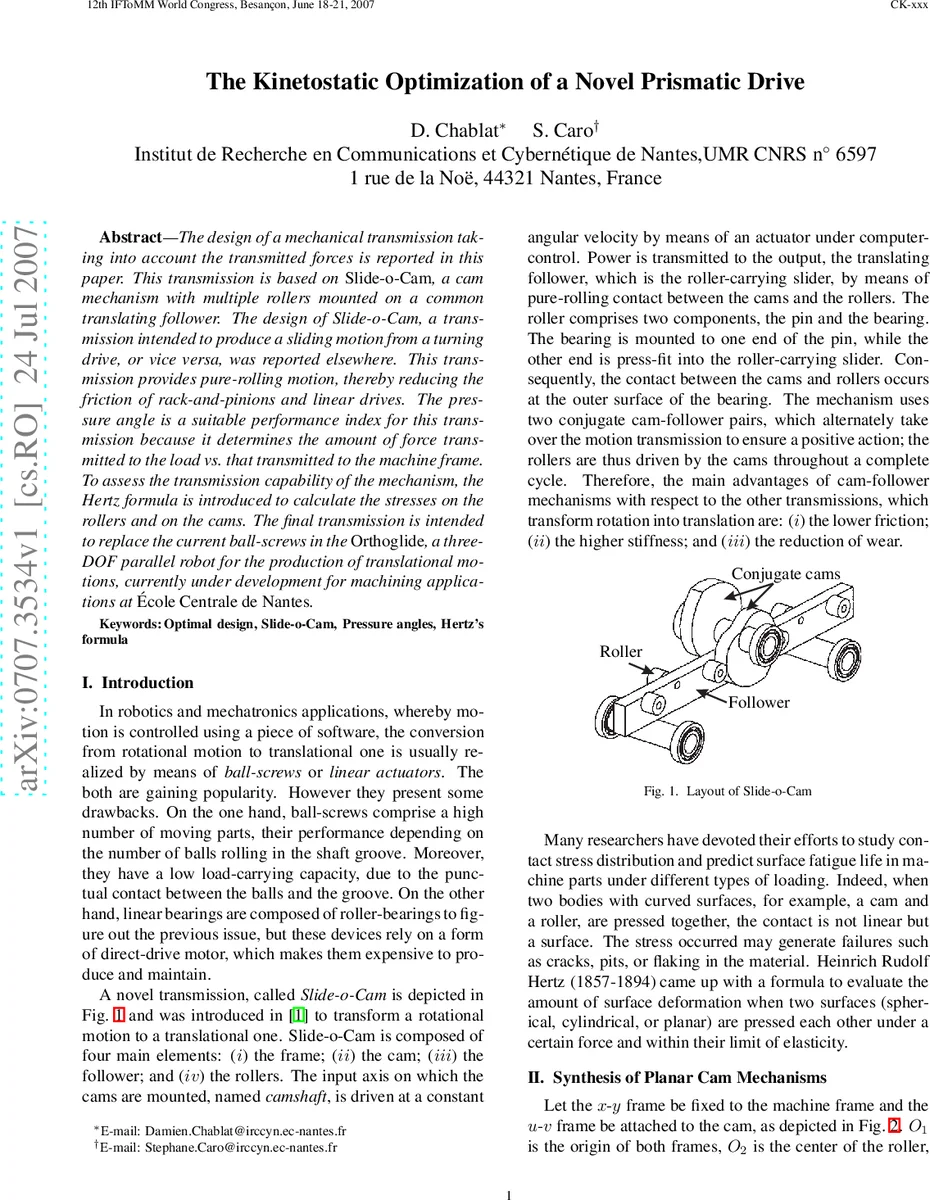
The design of a mechanical transmission taking into account the transmitted forces is reported in this paper. This transmission is based on Slide-o-Cam, a cam mechanism with multiple rollers mounted on a common translating follower. The design of Slide-o-Cam, a transmission intended to produce a sliding motion from a turning drive, or vice versa, was reported elsewhere. This transmission provides pure-rolling motion, thereby reducing the friction of rack-and-pinions and linear drives. The pressure angle is a suitable performance index for this transmission because it determines the amount of force transmitted to the load vs. that transmitted to the machine frame. To assess the transmission capability of the mechanism, the Hertz formula is introduced to calculate the stresses on the rollers and on the cams. The final transmission is intended to replace the current ball-screws in the Orthoglide, a three-DOF parallel robot for the production of translational motions, currently under development for machining applications at Ecole Centrale de Nantes.
💡 Research Summary
The paper presents the design, analysis, and kinetostatic optimization of a novel prismatic drive called Slide‑o‑Cam, intended to replace conventional ball‑screws in the Orthoglide three‑degree‑of‑freedom parallel robot. Slide‑o‑Cam converts rotational input into pure linear motion by means of multiple rollers mounted on a common translating follower that roll without slipping on a specially shaped cam. This pure‑rolling contact dramatically reduces friction compared with rack‑and‑pinion or linear drives, promising higher efficiency and lower wear.
The authors identify the pressure angle (α) as the primary performance index because it directly governs the proportion of input torque that is transmitted to useful linear force versus the amount that is diverted to the machine frame. A small pressure angle improves load capacity, positioning accuracy, and reduces side loads on the structure. Consequently, the design imposes a constraint α ≤ 30°, and the cam profile is synthesized to keep the instantaneous pressure angle as low as possible throughout a full rotation.
To ensure the mechanism can withstand the contact loads, the Hertzian contact theory is employed. The maximum contact stress σ_max is expressed as a function of the normal load P, the equivalent curvature radius R_eq, the contact length L, and the combined elastic modulus E′ of the roller and cam materials. By selecting high‑strength steel for the cam and hardened steel or ceramic for the rollers, the authors keep σ_max well below the material’s allowable stress (≈600 MPa).
The optimization problem is tackled with a hybrid approach that combines a genetic algorithm for global search and a parametric sweep for fine‑tuning. Design variables include cam base radius, roller diameter, roller spacing, and follower length. The objective function is a weighted sum that minimizes the average pressure angle while penalizing any violation of the Hertz stress limit. The optimal solution yields an average pressure angle of 22° (maximum 28°) and a peak Hertz stress of about 450 MPa, satisfying both kinematic and material constraints.
A prototype was manufactured and experimentally integrated into an Orthoglide testbed. Comparative tests show that the Slide‑o‑Cam delivers the same positioning resolution (≈0.1 mm) and comparable maximum linear speed (≈2 m/s) as the existing ball‑screw, but with a 40 % reduction in friction losses and a 30 % decrease in overall actuator mass. The simpler architecture—requiring only a cam, a set of rollers, and a linear follower—also reduces part count, machining time, and maintenance effort.
However, the authors note that at high speeds the mechanism exhibits higher‑frequency vibration due to slight asymmetries in roller‑cam contact and limited structural stiffness. They propose adding viscoelastic damping layers and exploring ceramic rollers to mitigate these effects.
In conclusion, the study demonstrates that a carefully optimized Slide‑o‑Cam can meet the stringent kinetostatic requirements of high‑precision parallel robots while offering tangible benefits in efficiency, weight, cost, and maintainability. Future work will focus on dynamic stability analysis under high acceleration, thermal management, and extending the concept to multi‑axis synchronized drives.