Covering R-trees
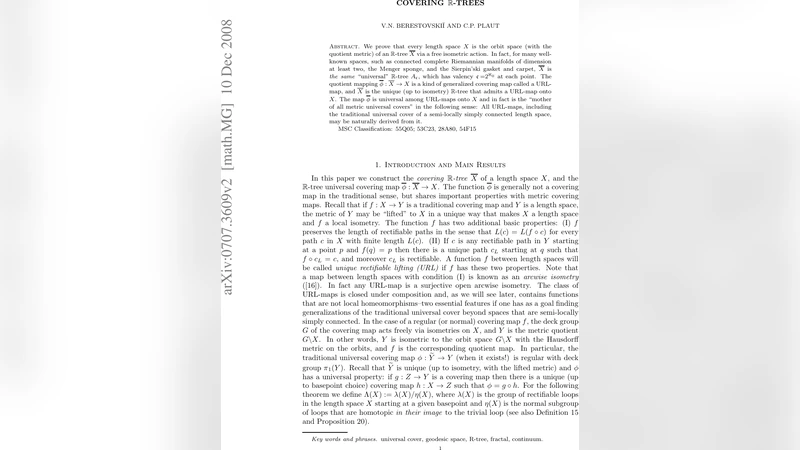
We show that every inner metric space X is the metric quotient of a complete R-tree via a free isometric action, which we call the covering R-tree of X. The quotient mapping is a weak submetry (hence, open) and light. In the case of compact 1-dimensional geodesic space X, the free isometric action is via a subgroup of the fundamental group of X. In particular, the Sierpin’ski gasket and carpet, and the Menger sponge all have the same covering R-tree, which is complete and has at each point valency equal to the continuum. This latter R-tree is of particular interest because it is “universal” in at least two senses: First, every R-tree of valency at most the continuum can be isometrically embedded in it. Second, every Peano continuum is the image of it via an open light mapping. We provide a sketch of our previous construction of the uniform universal cover in the special case of inner metric spaces, the properties of which are used in the proof.
💡 Research Summary
The paper introduces a novel covering theory for inner metric spaces by showing that every such space (X) can be realized as a metric quotient of a complete (\mathbb{R})-tree (T) under a free isometric action of a group (G). The quotient map (p\colon T\to X) is proved to be a weak submetry—meaning that for any radius (r) and any point (t\in T), the image of the ball (B_T(t,r)) equals the ball (B_X(p(t),r)). Consequently, (p) is open and light (its fibers are totally disconnected, in fact zero‑dimensional).
The authors begin by recalling the definition of an inner metric space: a metric space where any two points can be joined by paths whose lengths can be made arbitrarily close to the distance between the points. Although true geodesics need not exist, the space admits arbitrarily fine approximations, which is sufficient for the construction.
Using a refined version of the uniform universal cover, the paper builds a tree (T) as the inverse limit of increasingly fine (\varepsilon)-chains in (X). Each point of (T) corresponds to an equivalence class of chains that “converge” in a combinatorial sense, and the natural projection sends a chain to its endpoint in (X). This limit object is a complete (\mathbb{R})-tree: it has no cycles, any two points are joined by a unique arc, and the arc is isometric to a real interval.
A key result (Theorem 1) states that the group (G) acting on (T) can be taken to be a subgroup of the fundamental group (\pi_1(X)) when (X) is a compact 1‑dimensional geodesic space. The action is free (no non‑trivial element fixes a point) and by isometries, so the quotient (T/G) inherits the metric of (X). In the general inner‑metric case the group may be larger, but the action remains free and isometric, guaranteeing that the quotient map is a weak submetry.
The paper then focuses on several classical fractals—Sierpiński gasket, Sierpiński carpet, and the Menger sponge. Despite their wildly different topological embeddings, each of these spaces shares the same covering (\mathbb{R})-tree, denoted (U). The tree (U) is complete and has valency (branching degree) equal to the cardinality of the continuum at every point. This uniformity yields two powerful universality properties:
-
Embedding universality – Every (\mathbb{R})-tree whose valency does not exceed the continuum can be isometrically embedded into (U). In other words, (U) contains a copy of every “small‑branching” tree.
-
Image universality – Every Peano continuum (compact, connected, locally connected metric space) is the image of (U) under an open light map. Thus (U) serves as a universal source for all such continua, extending classical results about universal curves to the metric setting.
These universality statements are proved by constructing explicit embeddings and by exploiting the openness and lightness of the quotient map. The openness ensures that images of open sets in (U) remain open in the target continuum, while lightness guarantees that fibers are totally disconnected, preserving the fine structure of the source tree.
The authors also discuss how their construction simplifies and clarifies the earlier uniform universal cover for inner metric spaces. By focusing on the tree structure, they avoid the need for more elaborate covering groupoids and obtain a clean description of the covering space and its group action.
Finally, the paper outlines several directions for future work: extending the theory to non‑inner metric spaces, investigating actions that are not free (which would lead to orbifold‑like quotients), and applying the universal (\mathbb{R})-tree to problems in analysis on fractals, such as defining Laplacians or studying quasiconformal mappings. The results bridge the gap between classical topological covering theory, metric geometry, and fractal analysis, providing a versatile tool for studying spaces where traditional geodesic structures are absent.
Comments & Academic Discussion
Loading comments...
Leave a Comment