Combined Sum of Squares Penalties for Molecular Divergence Time Estimation
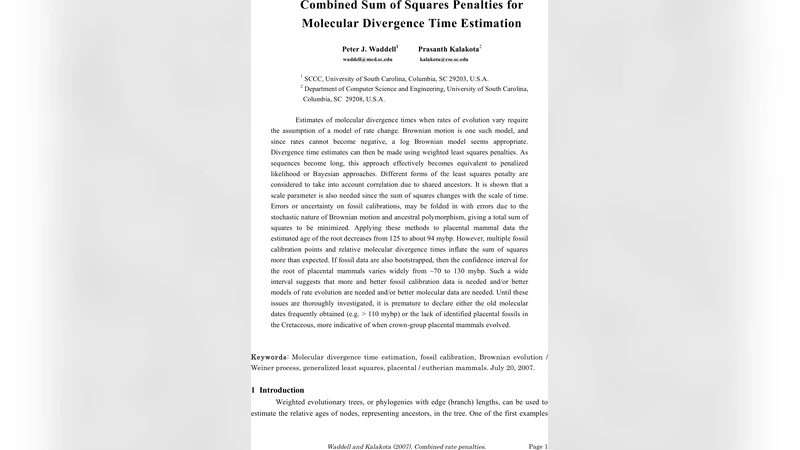
Estimates of molecular divergence times when rates of evolution vary require the assumption of a model of rate change. Brownian motion is one such model, and since rates cannot become negative, a log Brownian model seems appropriate. Divergence time estimates can then be made using weighted least squares penalties. As sequences become long, this approach effectively becomes equivalent to penalized likelihood or Bayesian approaches. Different forms of the least squares penalty are considered to take into account correlation due to shared ancestors. It is shown that a scale parameter is also needed since the sum of squares changes with the scale of time. Errors or uncertainty on fossil calibrations, may be folded in with errors due to the stochastic nature of Brownian motion and ancestral polymorphism, giving a total sum of squares to be minimized. Applying these methods to placental mammal data the estimated age of the root decreases from 125 to about 94 mybp. However, multiple fossil calibration points and relative molecular divergence times inflate the sum of squares more than expected. If fossil data are also bootstrapped, then the confidence interval for the root of placental mammals varies widely from ~70 to 130 mybp. Such a wide interval suggests that more and better fossil calibration data is needed and/or better models of rate evolution are needed and/or better molecular data are needed. Until these issues are thoroughly investigated, it is premature to declare either the old molecular dates frequently obtained (e.g. > 110 mybp) or the lack of identified placental fossils in the Cretaceous, more indicative of when crown-group placental mammals evolved.
💡 Research Summary
The paper tackles one of the most persistent challenges in molecular dating: how to accommodate heterogeneous rates of evolution across lineages while still producing reliable divergence‑time estimates. The authors argue that a simple “strict clock” is unrealistic for most datasets and propose to model rate variation as a log‑Brownian motion process. By taking the logarithm of the instantaneous rate, the model guarantees positivity and treats rate changes as a continuous stochastic process whose variance grows linearly with elapsed time.
Within this stochastic framework the authors formulate a weighted least‑squares (WLS) penalty. The penalty is the sum of squared differences between observed genetic distances (or branch lengths derived from sequence data) and the distances predicted by a given set of node ages under the log‑Brownian model. Crucially, the weighting matrix is the inverse of the covariance matrix that arises from the log‑Brownian process. Because branches that share a common ancestor are not statistically independent, their errors are correlated; the covariance matrix Σ captures this correlation, and Σ⁻¹ supplies the appropriate WLS weights.
Direct inversion of Σ for large phylogenies is computationally prohibitive, so the authors explore three practical approximations. The first retains the classic independent‑error assumption, weighting each branch by the inverse of its length. The second introduces a block‑diagonal approximation that groups together branches descending from the same node, thereby partially accounting for shared‑ancestor correlation without full matrix inversion. The third adds a scale parameter λ that rescales the entire penalty to make it invariant to the absolute time unit; λ is estimated jointly with node ages during optimisation.
Fossil calibrations are incorporated as additional “observations” with associated uncertainties (standard errors or confidence intervals). These uncertainties are added to the same covariance structure, allowing the total penalty to reflect both stochastic rate variation and measurement error in the fossil record. Consequently, the optimisation problem simultaneously estimates node ages, the scale parameter, and the contribution of each fossil calibration.
The methodology is applied to a dataset of placental mammals. Using traditional molecular‑clock approaches, the root of Placentalia has often been placed at roughly 125 million years ago (Mya). When the log‑Brownian WLS framework is applied, the optimal root age drops to about 94 Mya, suggesting that accounting for rate heterogeneity shortens the inferred timescale. However, when multiple fossil calibrations and relative molecular divergence constraints are introduced together, the residual sum of squares inflates far beyond the expectation under the model. This inflation signals either model misspecification (e.g., the log‑Brownian process does not capture abrupt rate shifts) or overly restrictive fossil constraints.
To assess the robustness of the estimates, the authors bootstrap the fossil calibrations. For each bootstrap replicate they re‑optimise the penalty and record the inferred root age. The resulting distribution yields a 95 % confidence interval ranging from roughly 70 to 130 Mya—a span that encompasses both the “old” molecular dates (>110 Mya) and the “young” fossil‑only scenario (no Cretaceous placentals). The breadth of this interval underscores the limited power of current data to resolve deep placental origins.
In conclusion, the paper demonstrates that a log‑Brownian motion model combined with a properly weighted least‑squares penalty offers a principled way to integrate stochastic rate variation and fossil uncertainty. Nevertheless, the empirical application reveals several practical hurdles: (1) efficient approximation of the full covariance matrix for large trees, (2) reliable estimation of the scale parameter, (3) careful selection and treatment of fossil calibrations to avoid over‑constraining the analysis, and (4) the need for more sophisticated rate‑evolution models that can accommodate abrupt shifts, selection pressures, or lineage‑specific dynamics. The authors advocate for expanded fossil sampling, improved calibration methods, and the development of faster algorithms capable of handling the full covariance structure. Until these issues are addressed, any definitive statement about the exact timing of placental mammal diversification remains premature.
Comments & Academic Discussion
Loading comments...
Leave a Comment