Complex cobordism and algebraic topology
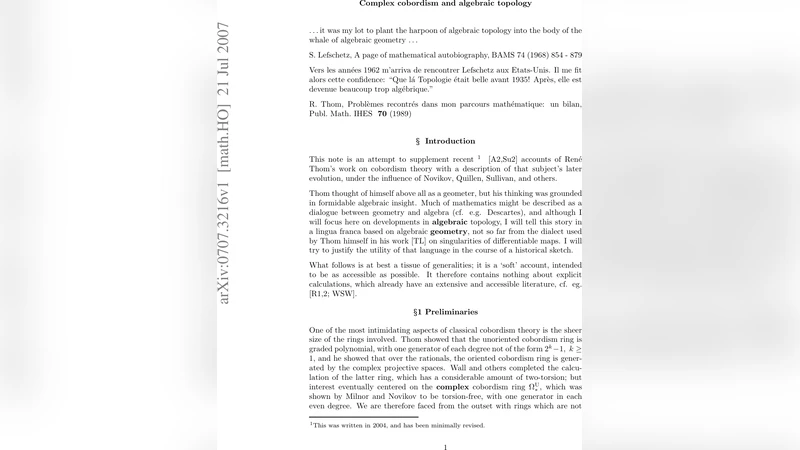
This is a historical survey, beginning where Atiyah and Sullivan leave off…
💡 Research Summary
The paper presents a comprehensive historical and technical survey of complex cobordism and its profound influence on algebraic topology, beginning where the pioneering work of Michael Atiyah and Dennis Sullivan left off. It starts by revisiting Atiyah’s early attempts to relate K‑theory to cobordism and Sullivan’s insights on formal group laws, establishing the conceptual gap that complex cobordism (MU) would later fill. The author then details the construction of the MU spectrum, emphasizing its role as the universal complex-oriented cohomology theory: MU_* is a graded polynomial ring on generators of even degree, and every complex-oriented theory receives a unique map from MU preserving Chern classes.
A central pillar of the exposition is Quillen’s 1971 theorem, which identifies the coefficient ring MU_* with the Lazard ring, the universal object classifying one‑dimensional commutative formal group laws. The paper explains how Quillen’s proof, originally phrased in terms of cobordism classes of smooth projective varieties, can be reinterpreted through modern stable homotopy language, making clear the deep algebraic structure underlying MU. This identification immediately yields a bridge between algebraic geometry (formal groups, elliptic curves) and stable homotopy theory.
Building on Quillen’s insight, the survey examines Landweber’s Exact Functor Theorem and its refinement, the Exact Functor Theorem, which give precise criteria for when a MU‑module defines a homology theory. The author works through classical examples: the Brown–Peterson spectrum BP, complex K‑theory, and various Johnson–Wilson theories E(n). For each, the paper shows how the “Landweber exactness” condition translates into algebraic constraints on the associated formal group law (e.g., the height filtration) and how these constraints guarantee convergence of the Adams–Novikov spectral sequence (ANSS). Detailed calculations illustrate how the ANSS, built from MU_*‑comodules, recovers low‑dimensional stable homotopy groups of spheres more efficiently than the classical Adams spectral sequence.
The survey then compares MU with other cobordism spectra such as MO, MSO, and MSpin, highlighting the special feature of MU: its complex orientation provides Chern class data that is unavailable in purely real cobordism theories. This orientation enables richer power operations and a finer analysis of characteristic numbers, which in turn leads to stronger computational tools. The author discusses how MU‑based techniques have been used to resolve longstanding problems, such as the determination of the image of J, the existence of exotic spheres, and the detection of v_n‑periodic families.
In the final sections, the paper turns to contemporary developments where complex cobordism remains central. Elliptic cohomology and topological modular forms (TMF) are presented as natural extensions of MU, obtained by imposing an elliptic formal group law on the universal one. The author explains how TMF inherits its modularity from the geometry of elliptic curves, yet its construction fundamentally relies on the MU‑based machinery of formal groups, Landweber exactness, and the ANSS. The survey also outlines emerging research directions: relaxing exactness conditions to produce new cohomology theories, exploring higher‑dimensional formal group laws, and deepening the interaction between chromatic homotopy theory, arithmetic geometry, and derived algebraic geometry.
Overall, the paper convincingly argues that complex cobordism is not merely a historical artifact but a living, universal framework that unifies formal group law theory, stable homotopy, and modern algebraic geometry, and continues to drive forward the frontiers of algebraic topology.
Comments & Academic Discussion
Loading comments...
Leave a Comment