Molecular Synchronization Waves in Arrays of Allosterically Regulated Enzymes
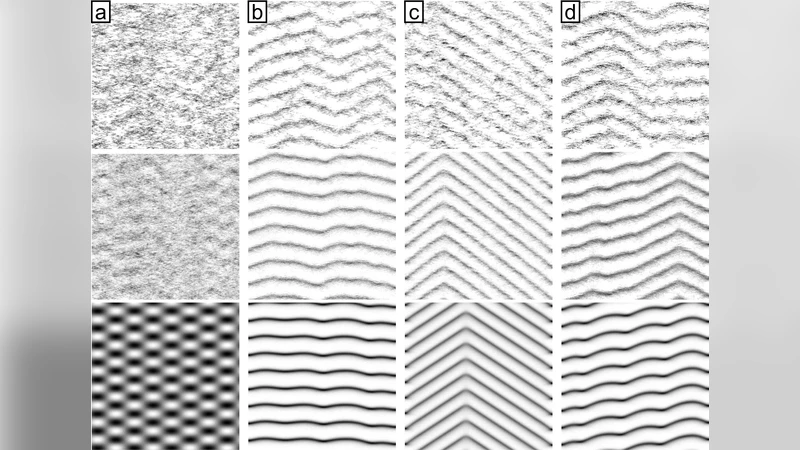
Spatiotemporal pattern formation in a product-activated enzymic reaction at high enzyme concentrations is investigated. Stochastic simulations show that catalytic turnover cycles of individual enzymes can become coherent and that complex wave patterns of molecular synchronization can develop. The analysis based on the mean-field approximation indicates that the observed patterns result from the presence of Hopf and wave bifurcations in the considered system.
💡 Research Summary
**
The paper investigates how a product‑activated enzymatic reaction, when carried out by a dense array of allosterically regulated enzymes, can give rise to spontaneous spatiotemporal patterns. The authors begin by constructing a minimal stochastic model of a single enzyme that switches between an inactive and an active conformational state. The transition rates are modulated by the local concentration of the reaction product, which acts as an allosteric activator. Enzymes are placed on a two‑dimensional lattice; the product diffuses through the lattice and binds to neighboring enzymes, thereby providing a feedback loop that couples the catalytic cycles of distant molecules without any direct physical interaction.
Using Gillespie‑type kinetic Monte‑Carlo simulations, the authors explore systems containing from a few thousand up to several tens of thousands of enzymes. At low enzyme concentrations the turnover events are essentially Poissonian and uncorrelated. However, when the enzyme density exceeds a critical threshold, the stochastic trajectories reveal a striking emergence of coherence: individual enzymes begin to fire in a regular rhythm, and the phase of this rhythm propagates across the lattice as a wave. The authors term these structures “molecular synchronization waves.” The waves possess a well‑defined wavelength and propagation speed that depend on the diffusion coefficient of the product and on the strength of the allosteric coupling. Importantly, the wave patterns are not imposed externally; they arise spontaneously from the intrinsic reaction‑diffusion dynamics.
To rationalize the simulation results, the authors develop a mean‑field description. They replace the discrete enzyme and product populations by continuous concentration fields and write down coupled nonlinear reaction‑diffusion equations. Linear stability analysis of the homogeneous steady state yields two distinct bifurcations. First, a Hopf bifurcation appears when the product‑mediated activation is strong enough, giving rise to temporal oscillations of the enzyme activity. Second, when spatial diffusion is taken into account, a wave (or Turing‑Hopf) bifurcation emerges at a finite wavenumber, indicating that oscillations can become spatially modulated. The coexistence of these bifurcations explains why the system can simultaneously exhibit temporal coherence and spatial wave propagation.
Parameter sweeps reveal a narrow “critical window” in which synchronization waves are sustained. Strong allosteric binding (high K_a) is required to overcome stochastic fluctuations, but overly strong binding leads to a globally synchronized state without spatial structure. The diffusion coefficient must be moderate: too low prevents the product from reaching distant enzymes, while too high washes out phase differences. The catalytic turnover rate (k_cat) controls the intrinsic oscillation frequency; faster turnover yields higher‑frequency waves. Within this window, the mean‑field predictions for wavelength, phase velocity, and oscillation frequency match the stochastic simulations quantitatively.
The study thus identifies a novel mechanism of pattern formation distinct from classic Turing or wave‑reaction systems. Here, the product itself serves as a mobile allosteric regulator, coupling the catalytic cycles of many enzymes and enabling a self‑organized, wave‑like synchronization of molecular activity. The findings have broad implications: they suggest that intracellular enzyme networks could exploit similar feedback to coordinate metabolic fluxes over micrometer scales, and they provide design principles for synthetic enzyme arrays or nanoreactors where controlled spatiotemporal signaling is desired. By linking stochastic enzyme kinetics, diffusion, and allosteric regulation, the work opens a new avenue for understanding and engineering collective biochemical dynamics.
Comments & Academic Discussion
Loading comments...
Leave a Comment