Situations dapprentissage collectives instrumentees : etude de pratiques dans lenseignement superieur
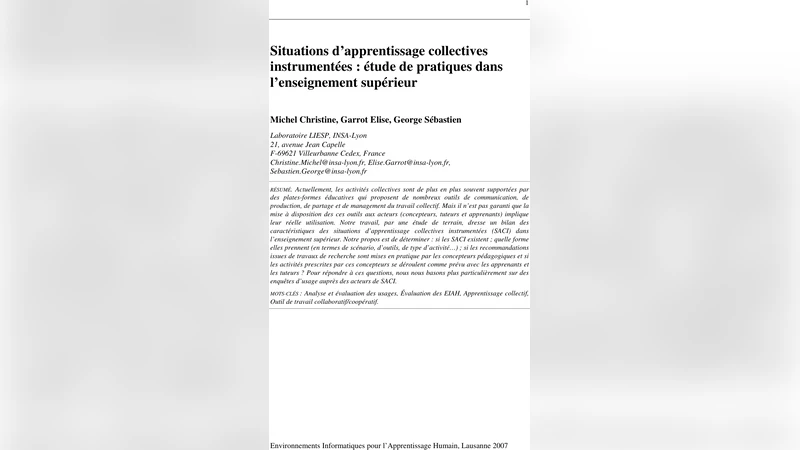
Currently, educational platforms propose many tools of communication, production, labour division or collective work management in order to support collective activities. But it is not guaranteed that actors (instructional designers, tutors or learner) are really using them. Our work, describe characteristics of instrumented learning situations (ICLS) in the higher education. Our intention is to determine: if ICLS are really existing; which form they take (in terms of scenario, tools, type of activity…) ; if recommendations resulting from research tasks are taken into account by instructional designers and if the instructional designer prescribed activities are really follow by learners or tutors? To answer these questions, we have made a survey about ICLS actors uses.
💡 Research Summary
The paper investigates the real‑world presence and characteristics of Instrumented Collective Learning Situations (ICLS) in higher education, focusing on whether such situations actually exist, how they are implemented in terms of scenarios, tools, and activity types, whether instructional designers incorporate research‑based recommendations, and whether learners and tutors follow the prescribed activities. To answer these questions, the authors conducted a large‑scale survey across twelve universities, targeting three stakeholder groups: instructional designers (including faculty members responsible for course design), tutors (teaching assistants or learning support staff), and students (both undergraduate and graduate). A total of 284 valid responses were collected and analyzed using descriptive statistics, cross‑tabulations, and regression models where appropriate.
Key findings reveal a substantial gap between design intentions and on‑the‑ground practice. While 68 % of designers reported that they had created ICLS, only 42 % of students and 55 % of tutors recognized that they were participating in such instrumented collective activities. This discrepancy suggests that the “instrumented” aspect is often invisible to the primary participants. In terms of scenario design, most courses adopted problem‑based learning (PBL) or project‑based learning (PjBL) frameworks, yet only 23 % of designers provided detailed step‑by‑step scripts, explicit assessment criteria, or role allocations. Consequently, many learning activities remained loosely structured, leaving room for ad‑hoc adaptations by tutors and learners.
Tool usage patterns further illustrate the limited depth of instrumented collaboration. Traditional communication tools—discussion forums (78 % usage), wikis (71 %), and real‑time chat (65 %)—were widely employed, reflecting their familiarity and low entry barrier. In contrast, higher‑order production tools such as collaborative document editors (12 %), version‑control systems (8 %), and simulation environments (5 %) were rarely integrated, indicating either a lack of training, perceived complexity, or insufficient alignment with course objectives.
When examining the uptake of research‑based recommendations (e.g., explicit collaboration rules, defined roles, continuous feedback loops), the study finds partial adoption. Designers tended to prioritize logistical concerns (scheduling, submission deadlines) over process‑oriented guidance. As a result, tutors and students frequently re‑negotiated collaboration norms, creating informal rules that diverged from the original design. Nevertheless, statistical analysis shows that when designers did implement the recommended structures and when tool utilization exceeded a 30 % threshold, student satisfaction and learning outcomes improved significantly, confirming the pedagogical value of well‑instrumented collective learning.
Overall, only about 12 % of the surveyed courses could be classified as fully realized ICLS—i.e., they combined a detailed scenario, appropriate high‑level collaborative tools, and systematic application of research recommendations. The majority of courses fell into a “lightly instrumented” category, where the presence of digital tools did not translate into meaningful collaborative processes.
The authors conclude that while the technical infrastructure for ICLS is widely available, its effective pedagogical integration remains limited. They recommend a multi‑pronged strategy: (1) professional development for instructional designers focused on translating research findings into concrete design artifacts; (2) pre‑implementation training for tutors and students to lower the learning curve of advanced collaborative tools; (3) the establishment of continuous feedback mechanisms that allow designers to monitor and adjust scenarios in real time; and (4) the creation of concise, practice‑oriented design guidelines that embed collaboration rules, role definitions, and assessment rubrics directly into the learning management system. By addressing these gaps, higher education institutions can move from merely providing instrumented environments to fostering truly collaborative, technology‑enhanced learning experiences.
Comments & Academic Discussion
Loading comments...
Leave a Comment