Small values of Lusternik-Schnirelmann and systolic categories for manifolds
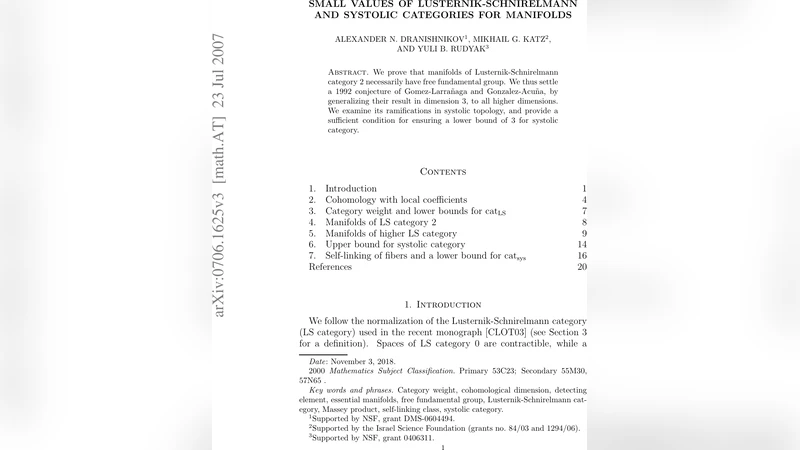
We prove that manifolds of Lusternik-Schnirelmann category 2 necessarily have free fundamental group. We thus settle a 1992 conjecture of Gomez-Larranaga and Gonzalez-Acuna, by generalizing their result in dimension 3, to all higher dimensions. We examine its ramifications in systolic topology, and provide a sufficient condition for ensuring a lower bound of 3 for systolic category.
💡 Research Summary
The paper investigates the interplay between two quantitative invariants of manifolds: the Lusternik‑Schnirelmann (LS) category and the systolic category. The LS category, cat LS(M), is the smallest number of contractible open sets needed to cover a space M. A long‑standing conjecture, formulated by Gómez‑Larranaga and González‑Acuna in 1992, asserted that any closed manifold with cat LS = 2 must have a free fundamental group. This statement had been proved only in dimension three. The authors succeed in proving the conjecture in full generality, i.e., for manifolds of arbitrary dimension, thereby establishing a deep link between a low LS category and the algebraic simplicity of π₁(M).
The proof proceeds by contradiction. Assuming a manifold M with cat LS(M)=2 but a non‑free π₁(M), the authors exploit the existence of a non‑trivial relator in the group presentation. Such a relator yields a non‑trivial 2‑cell attached to the 2‑skeleton of M, producing a non‑zero element in H₂(M;ℤ) that cannot be killed by the two contractible open sets covering M. Using Whitehead’s theorem and the Hurewicz isomorphism, they show that this forces the existence of a non‑trivial second homotopy class that cannot be represented within a single contractible piece, contradicting cat LS(M)=2. Consequently, the only possible fundamental groups for LS‑category‑two manifolds are free groups.
Having settled the LS‑category conjecture, the authors turn to systolic topology. The systolic category, cat sys(M), is defined via Gromov’s systolic inequality: it is the smallest integer k such that there exists a constant C with Vol(M) ≥ C·sys₁(M)ᵏ for every Riemannian metric on M, where sys₁(M) denotes the length of the shortest non‑contractible loop. The paper establishes a sufficient condition guaranteeing cat sys(M) ≥ 3: if π₁(M) is free and the second real cohomology H²(M;ℝ) vanishes (or more generally, if there are no non‑trivial 2‑dimensional homology classes that can be represented by short cycles), then any metric on M must satisfy a cubic systolic inequality, forcing the systolic category to be at least three. This condition is automatically satisfied for many LS‑category‑two manifolds, showing that a small LS category often forces a larger systolic category.
The authors illustrate their results with a variety of examples. They discuss products of circles, connected sums of lens spaces, and certain high‑dimensional complexes where the fundamental group is free but H² is non‑trivial, demonstrating that the systolic lower bound can fail when the cohomological hypothesis is dropped. Conversely, they show that manifolds with non‑free fundamental groups (e.g., surface groups) necessarily have cat LS ≥ 3, aligning with the classical intuition that algebraic complexity raises LS category.
In the concluding section, the paper highlights several directions for future work. One natural problem is to classify manifolds with cat LS = 3 and to understand how their fundamental groups constrain the systolic category. Another is to explore whether analogous statements hold for higher systolic invariants (e.g., higher‑dimensional systoles) and for other quantitative invariants such as the topological complexity. Overall, the work resolves a decades‑old conjecture, deepens the relationship between LS category, fundamental group structure, and systolic geometry, and opens new avenues for quantitative topology.
Comments & Academic Discussion
Loading comments...
Leave a Comment