Application of probabilistic PCR5 Fusion Rule for Multisensor Target Tracking
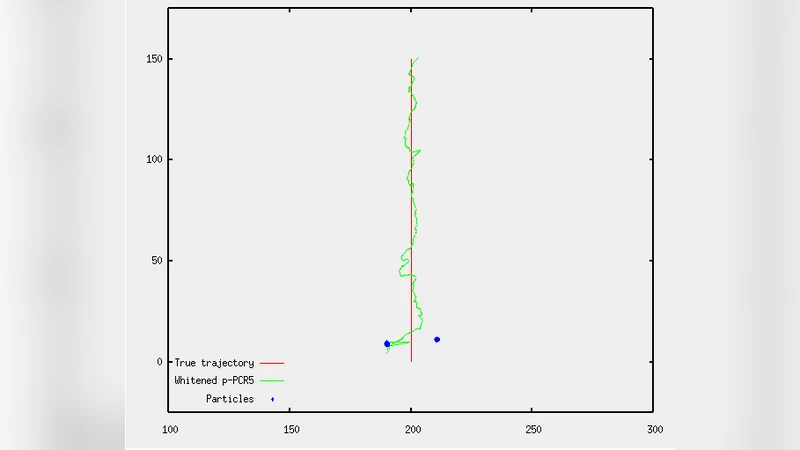
This paper defines and implements a non-Bayesian fusion rule for combining densities of probabilities estimated by local (non-linear) filters for tracking a moving target by passive sensors. This rule is the restriction to a strict probabilistic paradigm of the recent and efficient Proportional Conflict Redistribution rule no 5 (PCR5) developed in the DSmT framework for fusing basic belief assignments. A sampling method for probabilistic PCR5 (p-PCR5) is defined. It is shown that p-PCR5 is more robust to an erroneous modeling and allows to keep the modes of local densities and preserve as much as possible the whole information inherent to each densities to combine. In particular, p-PCR5 is able of maintaining multiple hypotheses/modes after fusion, when the hypotheses are too distant in regards to their deviations. This new p-PCR5 rule has been tested on a simple example of distributed non-linear filtering application to show the interest of such approach for future developments. The non-linear distributed filter is implemented through a basic particles filtering technique. The results obtained in our simulations show the ability of this p-PCR5-based filter to track the target even when the models are not well consistent in regards to the initialization and real cinematic.
💡 Research Summary
The paper introduces a non‑Bayesian fusion rule, termed probabilistic PCR5 (p‑PCR5), for combining probability density functions (PDFs) generated by local nonlinear filters in a multisensor target‑tracking scenario. The rule is derived by restricting the Proportional Conflict Redistribution rule no 5 (PCR5), originally formulated within the Dezert‑Smarandache Theory (DSmT) for belief assignments, to a strict probabilistic framework. The authors first describe how each sensor runs an independent particle filter, producing a set of weighted particles that approximate its posterior PDF. From these particle sets, two PDFs, f₁(x) and f₂(x), are obtained.
In the classic Bayesian approach, the PDFs would be merged by a weighted average (e.g., a Kalman‑type fusion) or by multiplication, which inevitably collapses multimodal structures and can be highly sensitive to model mismatches. PCR5, by contrast, treats the “conflict” – the probability mass that does not overlap between the two PDFs – as a quantity to be redistributed proportionally to the contributing densities. The p‑PCR5 algorithm proceeds as follows: (1) compute the conflict mass C = ∫
Comments & Academic Discussion
Loading comments...
Leave a Comment