OA@MPS - a colourful view
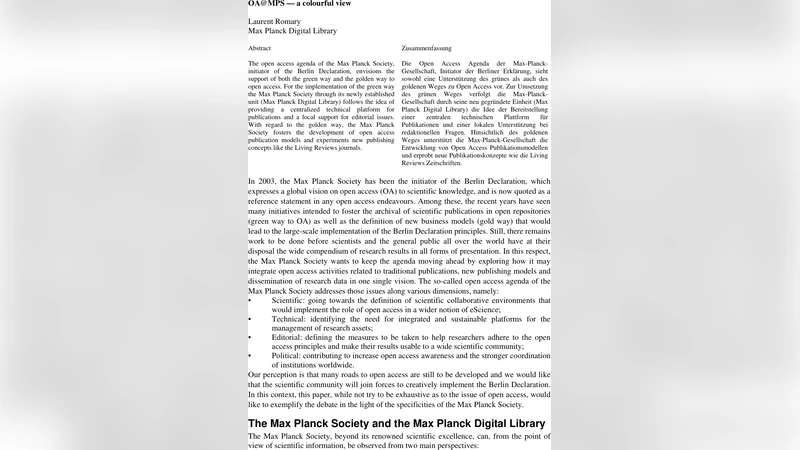
The open access agenda of the Max Planck Society, initiator of the Berlin Declaration, envisions the support of both the green way and the golden way to open access. For the implementation of the green way the Max Planck Society through its newly established unit (Max Planck Digital Library) follows the idea of providing a centralized technical platform for publications and a local support for editorial issues. With regard to the golden way, the Max Planck Society fosters the development of open access publication models and experiments new publishing concepts like the Living Reviews journals.
💡 Research Summary
The paper “OA@MPS – a colourful view” presents a comprehensive overview of the Max Planck Society’s (MPS) open‑access (OA) strategy, which is built on two complementary pathways: the “green way” (self‑archiving) and the “golden way” (OA publishing). As a founding signatory of the Berlin Declaration, MPS positions itself as a leader in the global OA movement and has translated that ambition into concrete institutional structures, technical platforms, and policy incentives.
Green Way – Centralized Repository and Technical Infrastructure
MPS has created the Max Planck Digital Library (MPDL) as a single, institution‑wide repository that serves as the technical backbone for green OA. MPDL integrates metadata harvesting, DOI minting, and licensing selection (CC‑BY, CC‑BY‑NC, etc.) into a seamless workflow. By linking directly with ORCID, the system automatically resolves author identities, while Crossref integration ensures that deposited items are discoverable through standard citation networks. The platform also provides a unified dashboard for librarians and research managers to monitor deposit rates, usage statistics, and compliance with funder mandates. This centralization contrasts with the fragmented, department‑level repositories that many other research organizations still operate, and it reduces the administrative overhead for researchers who simply upload their accepted manuscripts, supplementary data, and code.
Golden Way – OA Publishing Models and Innovative Journals
On the publishing side, MPS pursues a multi‑pronged golden OA approach. First, it negotiates “Open Choice” agreements with traditional subscription publishers, allowing authors to make individual articles OA for a fee covered by institutional budgets. Second, MPS has launched its own OA journals, most notably the “Living Reviews” series. These journals are designed as living documents: each article is continuously updated, versioned, and assigned a new DOI, thereby preserving a clear citation trail while delivering the most up‑to‑date synthesis of a field. The Living Reviews model also bundles article text, underlying data, and source code into a single, openly licensed package, embodying the principles of open science.
A third, experimental component is the “Plaza Model,” which treats OA publishing costs as a line item in research project budgets rather than as ad‑hoc article processing charges (APCs). Under this model, the institution centrally contracts with publishers, streamlines invoicing, and eliminates the need for individual authors to negotiate APCs. This reduces financial friction and aligns publishing costs with the overall research funding flow.
Policy, Incentives, and Cultural Change
Beyond infrastructure and contracts, MPS actively cultivates an OA culture. It runs regular author workshops, provides editorial support for manuscript preparation, and integrates OA performance metrics—such as download counts, citation impact, and compliance rates—into its faculty evaluation system. By rewarding OA contributions in promotion and tenure decisions, MPS creates a strong incentive structure that encourages researchers to choose OA pathways voluntarily. The Society also participates in international OA standard‑setting bodies, ensuring that its policies remain aligned with evolving best practices.
Impact and Transferability
The paper concludes that MPS’s integrated strategy—combining a robust technical platform, diversified publishing models, and targeted policy incentives—creates one of the most comprehensive OA ecosystems worldwide. This “three‑pillar” approach (technology, policy, business model) not only accelerates the transition to open science within the Society but also offers a replicable blueprint for other research institutions seeking to balance green and golden OA routes. By demonstrating that centralized repository services, innovative journal formats, and institutional budgeting can coexist harmoniously, MPS sets a benchmark for sustainable, large‑scale OA implementation.