The research area "Virtual Manufacturing (VM)'' is the use of information technology and computer simulation to model real world manufacturing processes for the purpose of analysing and understanding them. As automation technologies such as CAD/CAM have substantially shortened the time required to design products, Virtual Manufacturing will have a similar effect on the manufacturing phase thanks to the modelling, simulation and optimisation of the product and the processes involved in its fabrication. After a description of Virtual Manufacturing (definitions and scope), we present some socio-economic factors of VM and finaly some "hot topics'' for the future are proposed.
Deep Dive into The Virtual Manufacturing concept: Scope, Socio-Economic Aspects and Future Trends.
The research area “Virtual Manufacturing (VM)’’ is the use of information technology and computer simulation to model real world manufacturing processes for the purpose of analysing and understanding them. As automation technologies such as CAD/CAM have substantially shortened the time required to design products, Virtual Manufacturing will have a similar effect on the manufacturing phase thanks to the modelling, simulation and optimisation of the product and the processes involved in its fabrication. After a description of Virtual Manufacturing (definitions and scope), we present some socio-economic factors of VM and finaly some “hot topics’’ for the future are proposed.
Manufacturing is an indispensable part of the economy and is the central activity that encompasses product, process, resources and plant. Nowadays products are more and more complex, processes are highly-sophisticated and use microtechnology and mechatronic, the market demand (lot sizes) evolves rapidly so that we need a flexible and agile production. Moreover manufacturing enterprises may be widely distributed geographically and linked conceptually in terms of dependencies and material, information and knowledge flows. In this complex and evolutive environment, industrialists must know about their processes before trying them in order to get it right the first time. To achieve this goal, the use of a virtual manufacturing environment will provide a computer-based environment to simulate individual manufacturing processes and the total manufacturing enterprise. Virtual Manufacturing systems enable early optimization of cost, quality and time drivers, achieve integrated product, process and resource design and finally achieve early consideration of producibility and affordability. The aim of this paper is to present an updated vision of Virtual Manufacturing (VM) through different aspects. This vision is the result of a survey done within the thematic European Network MANTYS. As, since 10 years, several projects and workshops have dealt with the Virtual Manufacturing thematic, we will first define the objectives and the scope of VM and the domains that are concerned. The expected technological benefits of VM will also been presented. In a second part, we will present the socio-economic aspects of VM. This study will take into account the market penetration of several tools with respect to their maturity, the difference in term of effort and level of detail between industrial tools and academic research. Finally the expected economic benefits of VM will be presented and a focus will be made on SMEs. The last part will describe the trends and exploitable results in machine tool industry (research and development towards the "Virtual Machine Tool"), automotive (Digital Product Creation Process to design the product and the manufacturing process) and aerospace. A brief description of "hot topics" is proposed.
The MANTYS Thematic Network is supported by the European Commission Growth Programme (FP5) and promotes innovation in the field of manufacturing technologies, focusing on machinery. It provides a European platform that enables research and industrial participants to exchange views and research results in technology, socio-economic issues, sustainability and the quality of life in all aspects of manufacturing. It was launched in September 2001 and brings together:
-over 20 European RTD laboratories and research institutes with eminent reputations in manufacturing technologies, -a socio-economic task force composed of various experts from universities, private companies and machine tool builders’ associations, -an Industrial Advisory Committee representing the automotive, aerospace, mechanical and machine building sectors.
The MANTYS Thematic Network has established a framework in which researchers and industrialists communicate and reach common view of technological progress and its opportunities. Potential synergies between different projects are made apparent and co-operation promoted, to enhance the creation of the European Research Area in manufacturing technologies. MANTYS was actually proved to be a very efficient communication platform at the launch of the 6th Framework Programme, by allowing researchers and EC officials to meet one another and discuss proposals for FP6 projects.
Furthermore, the MANTYS Thematic Network promotes the widest exploitation of research results across sectors. Results from over 80 research projects have been so far assessed and used to create Technology Trend Reports on 5 key technological areas: Reliability, Process monitoring -Control; Agility -Flexibility; Process ECO-Efficiency; Precision Engineering and Virtual Manufacturing.
MANTYS is generating insight into the mechanisms that relate technological innovation to socio-economic factors. Building on this, it will identify realistic scenarios based on likely technological and socio-economical developments. These will be used to assess strategic impact. Also, “Technology Road Maps” will be produced, preparing decision makers to orient their activities and to adapt to change.
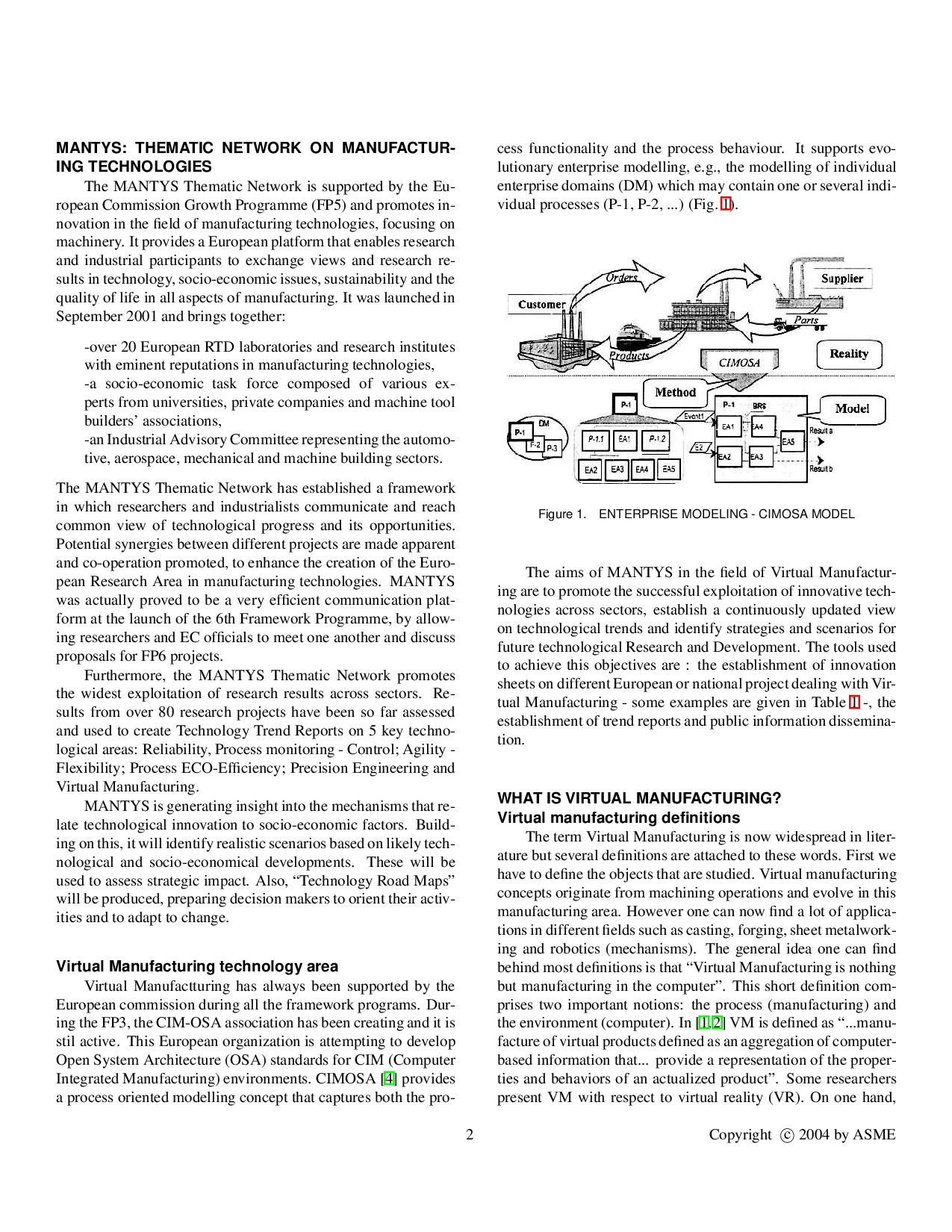
Virtual Manufactturing has always been supported by the European commission during all the framework programs. During the FP3, the CIM-OSA association has been creating and it is stil active. This European organization is attempting to develop Open System Architecture (OSA) standards for CIM (Computer Integrated Manufacturing) environments. CIMOSA [4] provides a process oriented modelling concept that captures both the pro-cess functionality and the process behaviour. It supports evolutionary enterprise modelling, e.g., the modelling of individu
…(Full text truncated)…
This content is AI-processed based on ArXiv data.