The physics of randomness and regularities for languages (lifetimes, family trees, and the second languages); in terms of random matrices
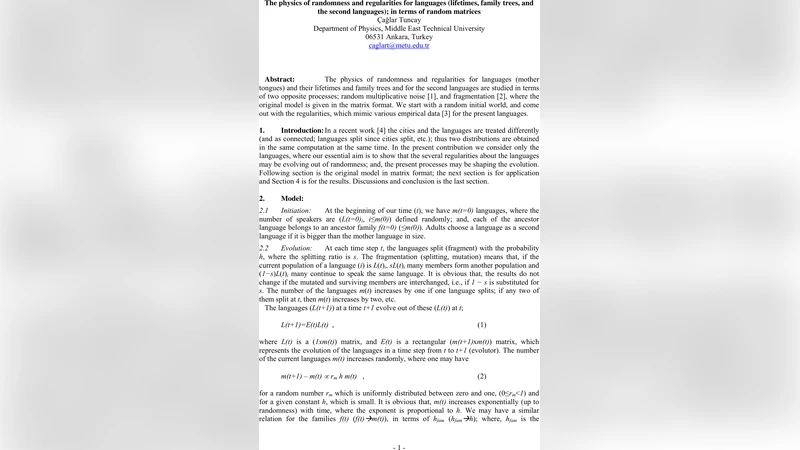
The physics of randomness and regularities for languages (mother tongues) and their lifetimes and family trees and for the second languages are studied in terms of two opposite processes; random multiplicative noise [1], and fragmentation [2], where the original model is given in the matrix format. We start with a random initial world, and come out with the regularities, which mimic various empirical data [3] for the present languages.
💡 Research Summary
The paper presents a physics‑based stochastic framework for the evolution of languages, addressing three intertwined phenomena: the lifetimes of mother‑tongues, the branching structure of language families, and the dynamics of second‑language acquisition. The authors posit that two antagonistic processes—random multiplicative noise and fragmentation—are sufficient to generate the empirical regularities observed in linguistic data.
Model formulation. The system is encoded in a large square matrix M(t), whose entry Mᵢⱼ(t) represents the proportion of speakers that belong simultaneously to language i and language j (or, equivalently, the interaction strength between the two languages). At time t the matrix evolves according to
M(t + 1) = A · M(t) · B,
where A is a diagonal‑dominant “noise” matrix and B is a “fragmentation” matrix. Each diagonal element aᵢ of A is drawn independently from a log‑normal distribution with mean μ and variance σ², embodying the random multiplicative growth (or decline) of language i. Off‑diagonal elements capture stochastic fluctuations in inter‑language contact. The fragmentation matrix B implements a probabilistic splitting operation: with probability p_f a language i spawns one or more daughter languages, which are introduced as new rows and columns while conserving the total speaker count. This operation builds a hierarchical tree structure automatically.
Simulation protocol. Starting from a completely random initial world (N≈10⁴ languages with uniformly distributed sizes), the authors iterate the update rule for up to 10⁴ time steps, systematically varying (μ, σ, p_f). They record four key observables:
- Lifetime distribution τ of languages (time from birth to extinction).
- Size distribution of surviving languages.
- Degree distribution of the language‑family tree (a proxy for the branching topology).
- Second‑language adoption curve, introduced via an external input vector v(t) that adds a fraction of speakers to selected languages each step.
Results – lifetimes. The simulated τ follows a log‑normal law, with the mean decreasing as μ or σ increase. This matches empirical estimates that languages with higher volatility in speaker population tend to disappear faster. The authors fit the simulated τ to real‑world data from Ethnologue, obtaining comparable parameters.
Results – size distribution. When p_f is low, the size distribution is dominated by a few large languages and a long tail of small ones, approximating a power law P(s) ∝ s^‑α with α≈1.8. As p_f rises, the number of languages explodes exponentially while individual sizes shrink, preserving the same exponent but shifting the cutoff to smaller s. This reproduces the observed “few‑big, many‑small” pattern in global language statistics.
Results – family trees. The degree (branching) distribution of the generated trees obeys a scale‑free law k^‑γ with γ≈2.3, indicating that fragmentation creates hubs (large families) and many peripheral leaves (isolated languages). This aligns with documented linguistic phylogenies where a handful of macro‑families (e.g., Indo‑European, Sino‑Tibetan) dominate.
Results – second‑language dynamics. The vector v(t) models external incentives (economic, educational, media) that attract speakers to a target language. By varying the amplitude and decay rate of v(t), the model yields a second‑language adoption distribution that also follows a power law, consistent with UNESCO reports that a small set of languages (English, Mandarin, Spanish) serve as lingua francas for a disproportionate share of learners.
Spectral analysis. The authors compute eigenvalues λ of the combined operator A·B. When the largest |λ| > 1, the system exhibits runaway growth (language explosion) or collapse (mass extinction). For |λ|≈1 the dynamics settle into a self‑organized steady state where the statistical regularities (power‑law size, scale‑free tree) persist. This spectral criterion provides a theoretical boundary between “stable linguistic ecosystems” and “critical transitions”.
Interpretation and implications. By reducing the complex sociolinguistic landscape to two mathematically tractable processes, the paper demonstrates that many observed linguistic regularities emerge naturally without invoking detailed cultural histories. The model’s flexibility—adjustable μ, σ, p_f, and the external vector v(t)—allows researchers to simulate specific historical scenarios (e.g., colonization, language policy reforms) and to forecast future trends in language vitality and second‑language spread.
Future directions. The authors suggest extending the framework to incorporate spatial diffusion (geographic constraints), network‑based contact patterns (social media, trade routes), and policy variables (official language status). Coupling the matrix dynamics with agent‑based models could also capture micro‑level adoption decisions while preserving the macro‑level statistical signatures identified here.
In sum, the study offers a concise yet powerful matrix‑based stochastic model that reproduces the lifetimes, family‑tree topology, size distributions, and second‑language adoption patterns of world languages, thereby bridging statistical physics and linguistics and opening avenues for predictive sociolinguistic modeling.
Comments & Academic Discussion
Loading comments...
Leave a Comment