Interaction of modulated pulses in the nonlinear Schroedinger equation with periodic potential
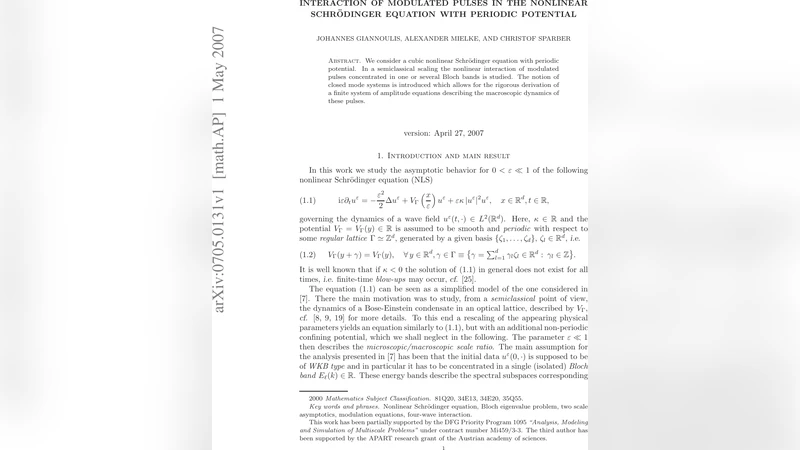
We consider a cubic nonlinear Schroedinger equation with periodic potential. In a semiclassical scaling the nonlinear interaction of modulated pulses concentrated in one or several Bloch bands is studied. The notion of closed mode systems is introduced which allows for the rigorous derivation of a finite system of amplitude equations describing the macroscopic dynamics of these pulses.
💡 Research Summary
The paper investigates the cubic nonlinear Schrödinger equation (NLSE) with a periodic potential in the semiclassical regime, where the small parameter ε → 0 scales the quantum effects. The authors focus on the nonlinear interaction of several wave packets (pulses) that are initially concentrated in one or more Bloch bands of the underlying linear operator H(k)=½(−i∇+k)²+V(x). By assuming that the initial data consist of slowly varying envelopes multiplied by Bloch eigenfunctions and rapidly oscillating phases, they perform a multiscale (WKB‑type) expansion of the solution.
A central contribution is the introduction of the concept of a “closed mode system.” A set of modes (band index and quasi‑momentum) is called closed if every nonlinear interaction term generated by the cubic nonlinearity stays within the same set; in other words, the resonance conditions for wave‑vector and energy conservation never produce a mode outside the chosen collection. This property is expressed mathematically through constraints on the indices of the Bloch functions and ensures that the dynamics does not leak energy to other bands.
Under the closed‑mode assumption, the infinite‑dimensional NLSE can be rigorously reduced to a finite system of coupled amplitude (envelope) equations. The derived equations have the form
i∂ₜ a_ℓ + v_{n_ℓ}(k_ℓ)·∇ₓ a_ℓ = Σ_{i,j,k∈M} C_{ℓijk} a_i a_j \overline{a_k},
where a_ℓ(t,x) are the slowly varying envelopes, v_{n_ℓ}(k_ℓ)=∇kE{n_ℓ}(k_ℓ) is the group velocity of the ℓ‑th Bloch band, and the coefficients C_{ℓijk} are explicit overlap integrals of the Bloch eigenfunctions (including the cubic coupling constant λ). These equations resemble classical nonlinear envelope models such as the Manakov or coupled nonlinear Schrödinger systems, but the presence of the periodic potential is encoded in the band‑dependent velocities and coupling coefficients.
The main theorem (Theorem 3.1) states that, for initial data belonging to a closed mode system and satisfying suitable regularity, the exact solution ψ^ε of the original NLSE remains O(ε) close (in L² norm) to the multiscale ansatz built from the solutions of the amplitude system, uniformly on time intervals of order one. The proof combines energy estimates, semiclassical propagation of the phase, and careful control of the remainder terms arising from the multiscale expansion. It shows that the error does not accumulate faster than ε, confirming the validity of the reduced model in the semiclassical limit.
To illustrate the theory, the authors examine concrete examples: a one‑dimensional Kronig–Penney lattice and a two‑dimensional square lattice. They identify specific pairs and triples of Bloch bands that satisfy the closed‑mode conditions, compute the corresponding coupling coefficients, and perform numerical simulations. The simulations demonstrate excellent agreement between the full NLSE dynamics and the reduced amplitude equations when the closed‑mode hypothesis holds, while in non‑closed configurations energy leaks to other bands, confirming the necessity of the closure condition.
The significance of the work lies in providing a systematic, mathematically rigorous framework for describing multi‑band nonlinear wave propagation in periodic media. Potential applications include nonlinear optics in photonic crystals, Bose–Einstein condensates in optical lattices, and wave dynamics in engineered metamaterials where one wishes to control or exploit inter‑band energy transfer. By designing a closed mode system, one can selectively enable desired nonlinear interactions while suppressing unwanted ones—a concept the authors refer to as “band engineering.”
Finally, the paper outlines future directions: extending the analysis to non‑cubic (e.g., quintic) nonlinearities, incorporating external driving or dissipation, treating quasi‑periodic or disordered potentials, and investigating the existence of infinite‑dimensional closed mode families. The results open a pathway toward a deeper understanding of how periodic structures shape nonlinear wave phenomena in the semiclassical regime.
Comments & Academic Discussion
Loading comments...
Leave a Comment