Separable convex optimization problems with linear ascending constraints
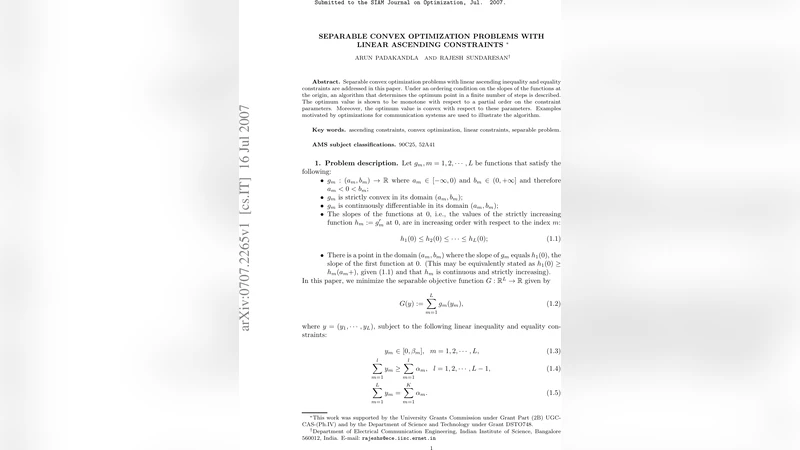
Separable convex optimization problems with linear ascending inequality and equality constraints are addressed in this paper. Under an ordering condition on the slopes of the functions at the origin, an algorithm that determines the optimum point in a finite number of steps is described. The optimum value is shown to be monotone with respect to a partial order on the constraint parameters. Moreover, the optimum value is convex with respect to these parameters. Examples motivated by optimizations for communication systems are used to illustrate the algorithm.
💡 Research Summary
The paper addresses a class of separable convex optimization problems in which the objective function is the sum of n one‑dimensional convex, continuously differentiable functions f_i(x_i). The decision variables x_1,…,x_n are subject to a set of linear “ascending” inequality constraints of the form Σ_{j=1}^i x_j ≤ α_i for i = 1,…,n, together with a single equality constraint Σ_{j=1}^n x_j = β. The parameters α_i are non‑negative and non‑decreasing (α_1 ≤ α_2 ≤ … ≤ α_n), while β is also non‑negative. A key structural assumption is that the slopes of the component functions at the origin are ordered non‑decreasingly: s_i = f_i′(0) satisfies s_1 ≤ s_2 ≤ … ≤ s_n. This ordering reflects a priority among variables – higher‑indexed variables incur a larger marginal cost for the same increase in x_i.
Under these conditions the authors first derive the Karush‑Kuhn‑Tucker (KKT) optimality conditions. They show that each inequality constraint has an associated Lagrange multiplier λ_i ≥ 0, and that λ_i is non‑decreasing in i. When a constraint is active (i.e., the inequality holds with equality), λ_i > 0 and the marginal cost f_i′(x_i) equals λ_i. Because the slopes are ordered, the multipliers inherit the same monotonicity, which forces the optimal solution to exhibit a “water‑filling” structure: variables with smaller slopes are filled first, and once a constraint becomes tight the remaining budget is shifted to variables with larger slopes.
Based on this structural insight the paper proposes a finite‑step algorithm that computes the optimal point in at most n iterations. The algorithm proceeds sequentially from i = 1 to n. Initially all λ_i are set to zero and each x_i is placed at its unconstrained minimizer (typically x_i = 0). For each i the algorithm checks whether the cumulative sum Σ_{j=1}^i x_j exceeds α_i. If it does, λ_i is increased just enough to make the i‑th inequality tight, and x_i is adjusted so that f_i′(x_i) = λ_i. This adjustment may cause later constraints to become active, which is handled by propagating the increase of λ_i forward. Because each step either activates a new constraint or leaves the set of active constraints unchanged, the process terminates after at most n activations, guaranteeing a finite‑step solution. The computational effort per step is essentially solving a one‑dimensional equation, so the overall complexity is linear in n, dramatically lower than generic interior‑point methods for convex programs.
Beyond algorithmic development, the authors study how the optimal value V(α,β) depends on the constraint parameters. They prove two important properties. First, monotonicity with respect to the partial order on α and β: if α′_i ≥ α_i for all i and β′ ≥ β, then V(α′,β′) ≥ V(α,β). Intuitively, loosening the constraints cannot increase the minimal cost. Second, convexity of V as a function of (α,β): for any two feasible parameter vectors (α^1,β^1) and (α^2,β^2) and any θ ∈
Comments & Academic Discussion
Loading comments...
Leave a Comment