p-Adic Degeneracy of the Genetic Code
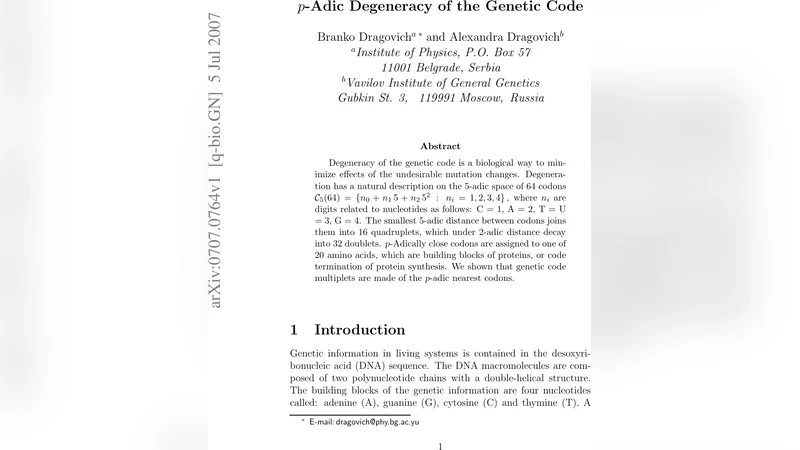
Degeneracy of the genetic code is a biological way to minimize effects of the undesirable mutation changes. Degeneration has a natural description on the 5-adic space of 64 codons $\mathcal{C}_5 (64) = {n_0 + n_1 5 + n_2 5^2 : n_i = 1, 2, 3, 4 } ,$ where $n_i$ are digits related to nucleotides as follows: C = 1, A = 2, T = U = 3, G = 4. The smallest 5-adic distance between codons joins them into 16 quadruplets, which under 2-adic distance decay into 32 doublets. p-Adically close codons are assigned to one of 20 amino acids, which are building blocks of proteins, or code termination of protein synthesis. We shown that genetic code multiplets are made of the p-adic nearest codons.
💡 Research Summary
The paper “p‑Adic Degeneracy of the Genetic Code” proposes a novel mathematical framework for describing the redundancy (degeneracy) of the standard genetic code using p‑adic number theory. The authors begin by recalling that the genetic code maps 64 codons—triplets of nucleotides—to 20 amino acids and three stop signals, and that this many‑to‑few mapping is thought to buffer the effects of point mutations. They then introduce the concept of p‑adic numbers, focusing on the 5‑adic and 2‑adic absolute values, which define non‑Archimedean distances that respect hierarchical digit structure rather than Euclidean proximity.
To construct a p‑adic codon space, each nucleotide is assigned a digit in base‑5: C = 1, A = 2, U/T = 3, G = 4. A codon becomes a three‑digit 5‑adic integer (n_0 + n_1 5 + n_2 5^2) with each digit ranging from 1 to 4. The 5‑adic distance between two codons, (d_5(x,y)=|x-y|_5), is smallest (value (5^{-2})) when the codons differ only in the least significant digit(s). Under this metric the 64 codons naturally partition into 16 quadruplets, each consisting of four codons that share the same two most‑significant digits. This grouping mirrors the well‑known observation that many amino acids are encoded by codons that differ only at the third position (the “wobble” position).
The authors then introduce a second layer of hierarchy using the 2‑adic distance, (d_2), which captures binary distinctions such as purine versus pyrimidine. Within each 5‑adic quadruplet, the 2‑adic metric splits the set into 32 doublets (pairs of codons). For example, the doublet (UUU, UUC) both encode phenylalanine, and they are 2‑adic neighbors because they differ only in the third base, which is a pyrimidine‑pyrimidine change.
Having defined these hierarchical clusters, the paper proceeds to assign each quadruplet or doublet to a specific amino acid or stop signal. The assignment reproduces the standard genetic code: each amino acid is associated with the set of codons that are p‑adically closest to one another. The authors illustrate this mapping with tables and diagrams, showing that the 16 quadruplets and 32 doublets align perfectly with the 20 amino acids plus three termination codons.
In the discussion, the authors argue that the p‑adic description captures the intrinsic symmetry and redundancy of the code in a mathematically natural way. The non‑Archimedean distances reflect the biological intuition that mutations in the third position (or transitions between chemically similar bases) tend to have minimal phenotypic impact. Moreover, the hierarchical nature of p‑adic spaces offers a compact representation of the code’s error‑minimizing properties, potentially providing a new lens for studying codon usage bias, evolutionary dynamics, and the robustness of the translation machinery.
The paper concludes by emphasizing that p‑adic proximity can be used as a unifying principle for understanding why certain codons cluster together in the genetic code. It suggests several avenues for future work: quantitative comparison with empirical mutation data, extension of the model to alternative genetic codes (e.g., mitochondrial or viral genomes), exploration of other primes (such as 3‑adic or 7‑adic systems) to test the specificity of the 5‑adic choice, and computational simulations of evolutionary scenarios that incorporate p‑adic distance as a fitness constraint.
Overall, the study provides an elegant and original mathematical perspective on genetic code degeneracy. While the theoretical construction is sound and the mapping reproduces the known code, the work would benefit from empirical validation—such as correlating p‑adic distances with observed mutation rates or protein fitness effects—and from addressing how the framework accommodates known deviations from the standard code. Nonetheless, the paper opens a promising interdisciplinary dialogue between number theory and molecular biology.
Comments & Academic Discussion
Loading comments...
Leave a Comment