Caracterisation Electromagnetique De Materiaux Geologiques En Vue Du Suivi De LHumidite Des Sols Par Radiometrie Micro-Ondes
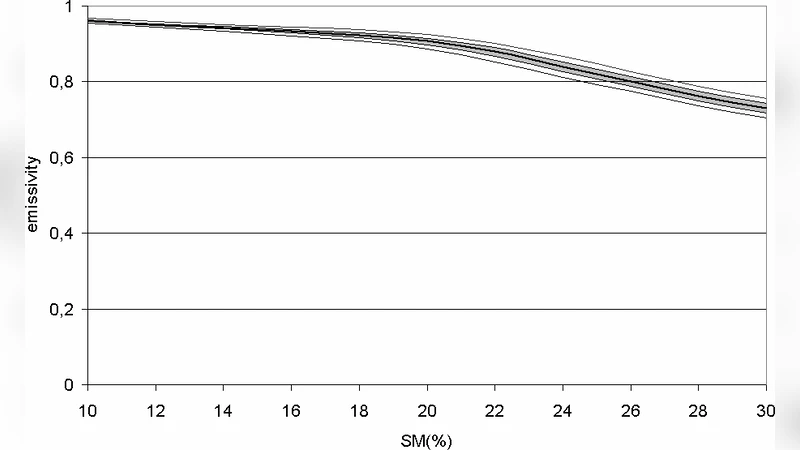
The work which we present takes place within the framework of mission SMOS of the ESA which will consist to send a radiometer (1.4 GHz) in space. The goal of the research which we propose is the improvement of the comprehension of the effects of structures composed of soil and litter. The effects of the litter and heterogeneities of the ground are probably important but still ignored. The objective of this work was to study the dielectric properties of a type of litter and ground in order to integrate these values into an analytical multi layers model of soil. The objective is to characterize the effects of this layer on the total multi layer system. This will make possible to lead to a simple analytical formulation of a model of litter which can be integrated into the calculation algorithm of SMOS in order to collect information on moisture starting from measurements of emissivity
💡 Research Summary
The paper addresses a critical source of error in the ESA SMOS (Soil Moisture and Ocean Salinity) mission: the influence of a surface litter layer and subsurface heterogeneities on the microwave emissivity measured at 1.4 GHz. SMOS retrieves soil moisture by interpreting the brightness temperature (or emissivity) of the Earth’s surface, assuming a relatively homogeneous soil layer. In reality, many landscapes are covered by a thin organic litter layer (dead leaves, twigs, decomposed material) and contain inclusions such as stones, clay lenses, or variable bulk density. These structures modify the dielectric properties of the surface, alter the propagation path of the microwave signal, and consequently bias the moisture retrieval if they are not accounted for.
The authors first performed laboratory measurements of the complex dielectric constant (real part ε′ and loss tangent tan δ) of representative litter and soil samples. Samples were collected from a typical temperate forest site, conditioned to specific moisture contents, bulk densities, and temperatures, and measured using a vector network analyzer coupled with a custom sample holder designed for the SMOS frequency band. By converting the measured S‑parameters through the Nicolson‑Ross–Weir method, they obtained ε* for each moisture level. The results show that while dry litter has a lower ε′ than dry soil, its loss tangent rises sharply with moisture, reaching values 1.5 – 2 times higher than soil at the same water content. Moreover, variations in organic matter fraction and bulk density produce a noticeable spread in ε* even at constant moisture, indicating that site‑specific calibration is required.
To translate these material properties into a radiative‑transfer framework, the authors constructed a two‑layer electromagnetic model. The upper layer represents the litter (thickness d₁, dielectric ε₁*), the lower layer the underlying soil (thickness d₂, dielectric ε₂*). Using the transmission‑matrix (or transfer‑matrix) method, they derived the overall reflection coefficient Γ for a plane wave incident from space at normal incidence. The effective emissivity is then computed from Γ and the known temperature of each layer. By systematically varying d₁, ε₁*, and ε₂* in the model, they quantified the impact of the litter on the observed emissivity. For thin litter (d₁ ≤ 1 cm) the emissivity change is modest (≈0.02 dB), below SMOS’s noise floor, but for thicker litter (d₁ ≥ 3 cm) the change exceeds 0.1 dB, which is comparable to the instrument’s sensitivity and therefore non‑negligible.
The paper also tackles subsurface heterogeneities such as stones or clay lenses. These are modeled as spherical inclusions embedded in the soil matrix, and their effect on the bulk dielectric constant is estimated using effective‑medium theories (Maxwell‑Garnett and Bruggeman mixing formulas). The authors demonstrate that, especially in dry conditions, a 10 % volume fraction of high‑dielectric inclusions can shift the bulk ε′ by 0.5 – 1.0, translating into emissivity variations of 0.05 – 0.1 dB. This reinforces the need for a heterogeneity correction in addition to the litter correction.
The central practical contribution is a compact analytical correction formula that can be inserted directly into the SMOS retrieval algorithm without substantial computational overhead. The proposed expression for the effective complex permittivity of the combined system is:
ε_eff* = ε₂* + (ε₁* − ε₂*) · exp(−α · d₁)
where α is a frequency‑dependent attenuation constant derived from the laboratory measurements, and d₁ is the locally measured litter thickness (which can be obtained from ancillary data such as optical remote sensing or field surveys). This exponential form captures the transition from negligible influence for very thin litter to a saturated effect for thicker layers, and it can be evaluated with a single additional parameter per pixel.
In summary, the study provides (1) a thorough experimental dataset of dielectric properties for litter and soil at the SMOS frequency, (2) a rigorous two‑layer electromagnetic model that quantifies how litter thickness, moisture, and bulk density affect microwave emissivity, (3) an effective‑medium correction for subsurface heterogeneities, and (4) a simple, analytically tractable correction term ready for integration into the operational SMOS processing chain. By incorporating these corrections, the accuracy of satellite‑derived soil moisture products can be significantly improved, especially in forested and semi‑arid regions where litter layers are common and soil heterogeneity is pronounced.
Comments & Academic Discussion
Loading comments...
Leave a Comment