The Scientific Method
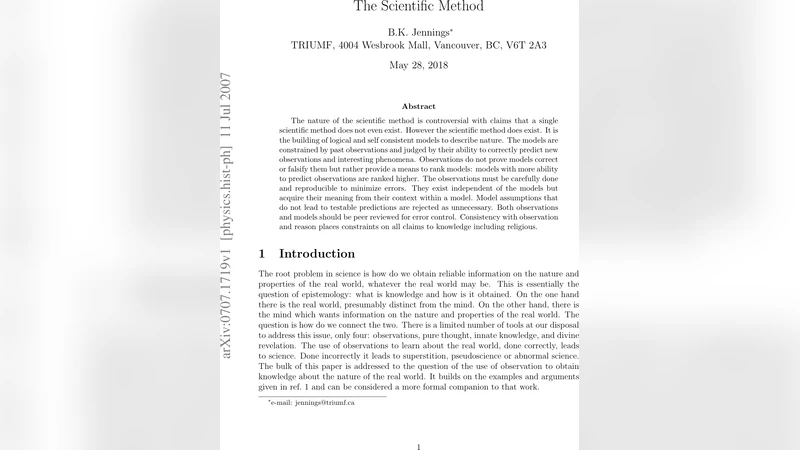
The nature of the scientific method is controversial with claims that a single scientific method does not even exist. However the scientific method does exist. It is the building of logical and self consistent models to describe nature. The models are constrained by past observations and judged by their ability to correctly predict new observations and interesting phenomena. The observations exist independent of the models but acquire meaning from their context within a model. Observations must be carefully done and reproducible to minimize errors. Models assumptions that do not lead to testable predictions are rejected as unnecessary.
💡 Research Summary
The paper tackles the long‑standing debate over whether a single, universal scientific method exists. While many philosophers and scientists argue that the notion of a monolithic method is a myth, the author contends that a coherent method does exist, but it is best understood as a cycle of model building, constraint, and testing rather than a fixed sequence of steps. The central thesis is that science progresses through the construction of logical, self‑consistent models that describe natural phenomena. These models are not arbitrary; they must be anchored to existing observations, which serve as constraints that limit the permissible parameter space and structural assumptions of the model. The author emphasizes that observations themselves exist independently of any model, but they acquire scientific meaning only when placed within a theoretical context. Consequently, the quality of an observation depends on rigorous experimental design, careful measurement, and reproducibility. Reproducibility is highlighted as a non‑negotiable requirement: only data that can be reliably replicated under the same conditions can be trusted as a basis for model validation.
The paper outlines several key criteria for evaluating scientific models. First, internal logical consistency is mandatory; any internal contradictions undermine a model’s credibility. Second, predictive power is the ultimate test: a model must not merely fit past data but also generate novel, testable predictions about phenomena that have not yet been observed. Successful predictions dramatically increase confidence in the model and often guide the design of new experiments. Third, the model’s assumptions must be empirically testable. Assumptions that cannot, even in principle, be subjected to observation or experiment are deemed unnecessary and should be excluded from the model. This stance directly addresses the criticism that scientific theories sometimes incorporate metaphysical or unfalsifiable elements.
The author further argues that the scientific method is inherently iterative. As new observations become available, they either confirm the existing model, prompting minor refinements, or they reveal discrepancies that necessitate substantial revisions or even the abandonment of the current framework. This dynamic process mirrors the historical development of major scientific theories—from Newtonian mechanics to Einstein’s relativity and quantum mechanics—each of which emerged from the tension between existing models and anomalous observations.
In addition to philosophical clarity, the paper discusses practical implications for contemporary research fields such as complex systems, data science, and artificial intelligence. In these domains, the model‑centric approach is especially valuable because massive datasets and sophisticated computational tools enable rapid hypothesis generation and testing. The author suggests that researchers should explicitly treat their algorithms, statistical models, or simulation frameworks as scientific models subject to the same constraints of logical consistency, empirical grounding, and predictive validation.
The conclusion synthesizes the arguments by reaffirming that the “scientific method” is not a rigid checklist but a methodological philosophy centered on model construction and continual empirical testing. Observations provide the raw material, reproducibility guarantees reliability, and predictive success validates the model. By discarding unverifiable assumptions and emphasizing testable predictions, the proposed framework offers a robust, adaptable guide for scientific inquiry across disciplines. This perspective not only resolves the philosophical controversy over the existence of a single method but also provides actionable guidance for modern scientists seeking to navigate the increasingly data‑rich landscape of contemporary research.
Comments & Academic Discussion
Loading comments...
Leave a Comment