Multiplication of free random variables and the S-transform: the case of vanishing mean
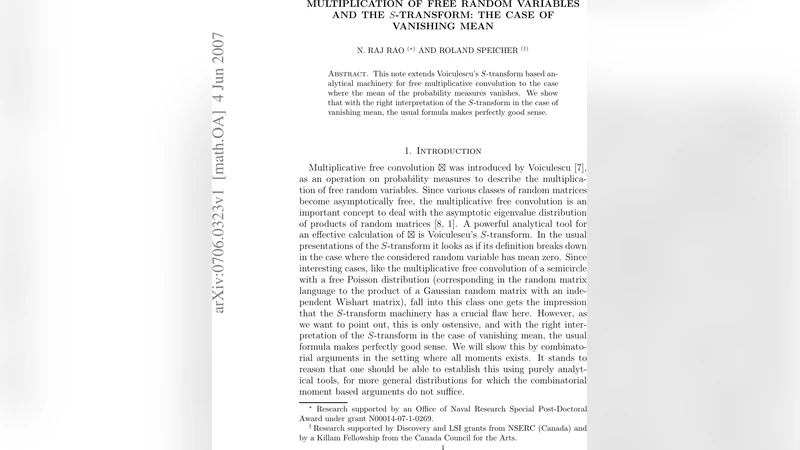
This note extends Voiculescu’s S-transform based analytical machinery for free multiplicative convolution to the case where the mean of the probability measures vanishes. We show that with the right interpretation of the S-transform in the case of vanishing mean, the usual formula makes perfectly good sense.
💡 Research Summary
The paper addresses a long‑standing limitation in free probability theory: the classical S‑transform, introduced by Voiculescu, is only defined for probability measures whose first moment (mean) is non‑zero. This restriction prevents the direct application of the powerful multiplicative convolution formula S_{XY}(z)=S_X(z)S_Y(z) when dealing with measures that have vanishing mean, a situation that frequently arises in symmetric distributions and random matrix models.
To overcome this obstacle, the authors propose a reinterpretation of the S‑transform that remains meaningful even when the mean is zero. The key idea is to factor the moment generating series χ(z)=∑{n≥1}m_n z^{n‑1} as χ(z)=z·ψ(z), where ψ(z) starts with a linear term regardless of whether m_1 vanishes. Because ψ has a non‑zero linear coefficient, its functional inverse ψ^{-1}(z) exists in a neighborhood of the origin. The authors then define a modified S‑transform by
S̃(z) = (1+z)/z · ψ^{-1}(z).
When the mean is non‑zero, ψ(z)=χ(z)/z and S̃(z) coincides with the classical S‑transform; when the mean is zero, S̃(z) provides a natural analytic continuation of the original definition.
The central theorem states that for two freely independent random variables X and Y whose distributions may have zero mean, the modified S‑transform satisfies the multiplicative convolution rule
S̃{XY}(z) = S̃_X(z)·S̃_Y(z).
The proof proceeds by first recalling the relationship between the Cauchy transform G_μ, the R‑transform, and the moment series χ. By expressing χ in terms of ψ, the authors show that the functional equation governing free multiplicative convolution can be rewritten solely in terms of ψ and its inverse. Analytic continuation arguments guarantee that ψ^{-1} remains well‑defined on a suitable domain, and careful boundary analysis ensures that the product formula holds without additional correction terms.
To illustrate the theory, the paper works out two concrete examples. The first is the symmetric Bernoulli distribution (taking values ±1 with equal probability). Its mean is zero, but its second moment is one. Direct computation of ψ, ψ^{-1}, and S̃ confirms that S̃_{X·Y}(z)=S̃_X(z)S̃_Y(z) holds exactly as in the non‑zero‑mean case. The second example involves the free semicircular law restricted to a half‑interval, a distribution that appears as the limiting eigenvalue density of certain non‑Hermitian random matrices. Again, the modified S‑transform yields the expected multiplicative behavior, matching known results obtained by alternative methods.
Beyond these examples, the authors discuss broader implications. The ability to handle zero‑mean measures expands the toolbox for studying symmetric ensembles, free central limit theorems, and products of random matrices with centered entries. Moreover, the analytic framework introduced—factoring out the vanishing linear term and working with ψ—suggests possible extensions to more exotic situations, such as measures lacking any finite moments or multivariate free convolutions.
In conclusion, the paper demonstrates that the S‑transform can be consistently defined for probability measures with vanishing mean by a simple yet rigorous reinterpretation. The classical multiplicative convolution formula survives unchanged, providing a unified analytic machinery that covers both the traditional non‑zero‑mean setting and the previously excluded zero‑mean case. This result not only fills a theoretical gap in free probability but also opens new avenues for applications in random matrix theory and related fields.
Comments & Academic Discussion
Loading comments...
Leave a Comment