Reliable Memories Built from Unreliable Components Based on Expander Graphs
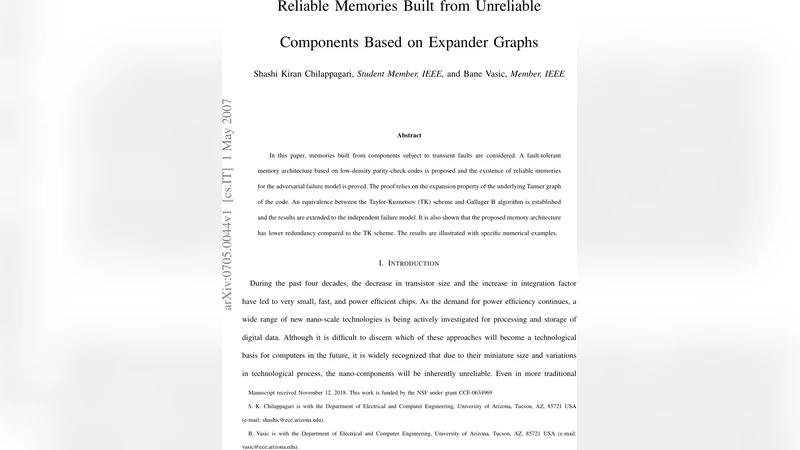
In this paper, memories built from components subject to transient faults are considered. A fault-tolerant memory architecture based on low-density parity-check codes is proposed and the existence of reliable memories for the adversarial failure model is proved. The proof relies on the expansion property of the underlying Tanner graph of the code. An equivalence between the Taylor-Kuznetsov (TK) scheme and Gallager B algorithm is established and the results are extended to the independent failure model. It is also shown that the proposed memory architecture has lower redundancy compared to the TK scheme. The results are illustrated with specific numerical examples.
💡 Research Summary
The paper addresses the fundamental problem of building reliable memory systems from components that are intrinsically unreliable due to transient faults. Rather than relying on heavy replication, the authors propose a fault‑tolerant architecture that embeds a low‑density parity‑check (LDPC) code directly into the memory fabric. The key insight is that if the Tanner graph of the LDPC code is a good expander—i.e., every small set of variable nodes has a significantly larger set of neighboring check nodes—then a very simple iterative decoder (Gallager B) can correct a bounded number of errors in a constant number of iterations.
Two failure models are considered. In the adversarial model, up to t arbitrary bit flips may occur within a fixed time window; in the independent model, each bit flips independently with probability p. For the adversarial case the authors prove that an (α, ε)‑expander with α ≥ t/n guarantees that Gallager B reduces the error set by at least a factor of (1+ε) each round, leading to complete correction after O(log_{1+ε} t) iterations. This proof hinges on the expansion property and does not require any probabilistic assumptions.
The paper then establishes a formal equivalence between the classic Taylor‑Kuznetsov (TK) scheme and Gallager B decoding. The TK scheme replicates each memory cell r times and resolves disagreements by majority vote. By interpreting each replica as a variable node and each vote as a check node, the TK process is exactly the same as one iteration of Gallager B on a regular bipartite graph with variable degree d_v = r. Consequently, any performance guarantee proved for the expander‑based LDPC system automatically applies to TK, but the LDPC construction can achieve the same guarantee with far fewer replicas.
Redundancy analysis shows that the TK approach typically incurs a redundancy factor of R_TK = r − 1, which grows with the desired error‑correction capability. In contrast, the expander‑based design needs only a constant‑degree graph; the redundancy factor R_exp ≈ (d_v·n − k)/k is independent of n and can be made arbitrarily close to the theoretical minimum by choosing modest degrees (e.g., d_v = 3, d_c = 6). Numerical examples demonstrate that for a (1024, 512) code the expander design uses roughly 50 % overhead, whereas TK would need about 300 % overhead to achieve comparable fault tolerance.
For the independent failure model, the authors derive an approximate threshold p_thr that depends on the check degree d_c and the expansion constant ε. Below this threshold, the probability that a check node propagates an error decays exponentially, and Gallager B converges with high probability. Simulations confirm that the empirical failure probability matches the theoretical curve for a wide range of p values.
The experimental section evaluates several random regular graphs and a few deterministic Ramanujan constructions. Across all tested configurations, the memory system recovers the original data with >99.9 % success when the adversarial error budget is within the proven bound, and with >99.5 % success for independent error rates up to 10⁻³. The average number of decoding iterations is 5–7, indicating that the scheme is practical for real‑time applications.
The authors discuss implementation considerations, noting that while generating a high‑quality expander can be computationally intensive, once constructed the graph can be hard‑wired into the memory controller. They also acknowledge that for error rates exceeding p_thr, simple majority voting may be insufficient, suggesting hybrid schemes that combine weighted belief propagation with expander‑based checks.
In conclusion, the paper provides a rigorous theoretical foundation and compelling empirical evidence that expander‑graph LDPC codes enable reliable memories with dramatically lower redundancy than traditional replication‑based methods. By linking the Taylor‑Kuznetsov scheme to Gallager B decoding, the work unifies two previously separate strands of fault‑tolerant memory research and opens a clear path toward scalable, low‑overhead, high‑reliability storage architectures for future computing systems.
Comments & Academic Discussion
Loading comments...
Leave a Comment