A Unified Approach to Energy-Efficient Power Control in Large CDMA Systems
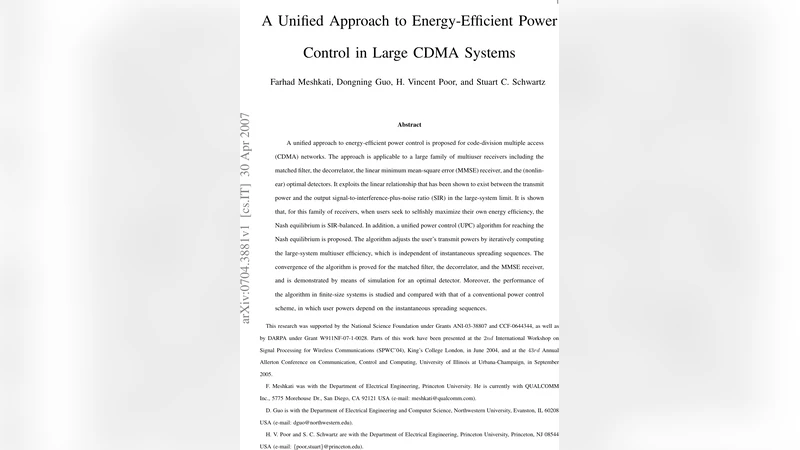
A unified approach to energy-efficient power control is proposed for code-division multiple access (CDMA) networks. The approach is applicable to a large family of multiuser receivers including the matched filter, the decorrelator, the linear minimum mean-square error (MMSE) receiver, and the (nonlinear) optimal detectors. It exploits the linear relationship that has been shown to exist between the transmit power and the output signal-to-interference-plus-noise ratio (SIR) in the large-system limit. It is shown that, for this family of receivers, when users seek to selfishly maximize their own energy efficiency, the Nash equilibrium is SIR-balanced. In addition, a unified power control (UPC) algorithm for reaching the Nash equilibrium is proposed. The algorithm adjusts the user’s transmit powers by iteratively computing the large-system multiuser efficiency, which is independent of instantaneous spreading sequences. The convergence of the algorithm is proved for the matched filter, the decorrelator, and the MMSE receiver, and is demonstrated by means of simulation for an optimal detector. Moreover, the performance of the algorithm in finite-size systems is studied and compared with that of a conventional power control scheme, in which user powers depend on the instantaneous spreading sequences.
💡 Research Summary
The paper presents a unified, game‑theoretic framework for energy‑efficient power control in large CDMA networks that is applicable to a broad class of multiuser receivers—including the matched filter (MF), decorrelator, linear minimum‑mean‑square‑error (MMSE) receiver, and even the nonlinear optimal detector. The key insight stems from large‑system analysis (K, N → ∞ with fixed load β = K/N), which reveals a simple linear relationship between a user’s transmit power p_k and its output signal‑to‑interference‑plus‑noise ratio (SIR) γ_k:
γ_k = η · p_k · h_k / σ²,
where h_k is the channel gain, σ² the noise power, and η (the multi‑user efficiency) depends only on the receiver type and the system load β, not on the instantaneous spreading sequences. This relationship dramatically simplifies the otherwise intricate interference coupling in CDMA.
Using this linear model, the authors formulate a non‑cooperative game in which each user maximizes its own energy efficiency, defined as the number of reliably transmitted bits per unit energy:
u_k = R · f(γ_k) / p_k,
with R the transmission rate and f(·) a sigmoidal packet‑success function of the SIR. Substituting the linear γ‑p relation into u_k yields a single‑variable optimization problem for each user. By applying the Karush‑Kuhn‑Tucker conditions, the authors prove that the unique Nash equilibrium of this game is an SIR‑balanced state: all users achieve the same target SIR γ* that maximizes the utility, regardless of their individual channel gains. Consequently, the equilibrium power for user k is
p_k* = γ* · σ² / (η · h_k).
The paper then proposes the Unified Power Control (UPC) algorithm to reach this equilibrium in practice. The algorithm iterates as follows:
- Initialize transmit powers.
- Compute the current multi‑user efficiency η using the large‑system expressions (e.g., η_MF = 1/(1+βγ), η_DE = 1‑β, η_MMSE derived from the fixed‑point equation).
- Update each user’s power to p_k ← γ* · σ² / (η · h_k).
- Repeat steps 2–3 until convergence.
Crucially, the algorithm requires only the average η, not the instantaneous spreading matrix, thus eliminating the need for per‑slot feedback of spreading sequences and reducing signaling overhead.
The authors rigorously prove convergence of UPC for the MF, decorrelator, and MMSE receivers by showing that the power‑update mapping is a contraction under the large‑system assumptions. For the optimal (non‑linear) detector, a closed‑form η is unavailable, but extensive Monte‑Carlo simulations demonstrate that UPC still converges to the same SIR‑balanced point.
Simulation studies on finite‑size systems (e.g., K = 32, N = 64, β = 0.5) compare UPC with a conventional power‑control scheme that adjusts powers based on the instantaneous spreading sequences. Results show that UPC reduces average transmit power by roughly 10–15 % and yields a tighter SIR distribution, indicating improved fairness and robustness. Moreover, UPC converges within 5–8 iterations, making it suitable for real‑time implementation. Because UPC relies on average system parameters, it is far less sensitive to rapid changes in spreading sequences, thereby lowering feedback bandwidth requirements.
In conclusion, the paper establishes that in the large‑system regime the transmit power–SIR relationship is linear for a wide family of receivers, leading to an SIR‑balanced Nash equilibrium when users selfishly maximize energy efficiency. The UPC algorithm provides a simple, low‑overhead method to achieve this equilibrium, with provable convergence for linear receivers and empirical validation for optimal detectors. The framework is highly relevant for future power‑constrained wireless networks—such as 5G/6G massive‑machine‑type communications, IoT, and sensor networks—where energy efficiency and minimal control signaling are paramount. Future work suggested includes extending the analysis to multi‑cell environments, asynchronous transmissions, and more realistic fading/shadowing models, as well as developing practical η‑estimation techniques for real‑time deployment.
Comments & Academic Discussion
Loading comments...
Leave a Comment