On Energy Efficient Hierarchical Cross-Layer Design: Joint Power Control and Routing for Ad Hoc Networks
In this paper, a hierarchical cross-layer design approach is proposed to increase energy efficiency in ad hoc networks through joint adaptation of nodes' transmitting powers and route selection. The design maintains the advantages of the classic OSI …
Authors: Cristina Comaniciu, H. Vincent Poor
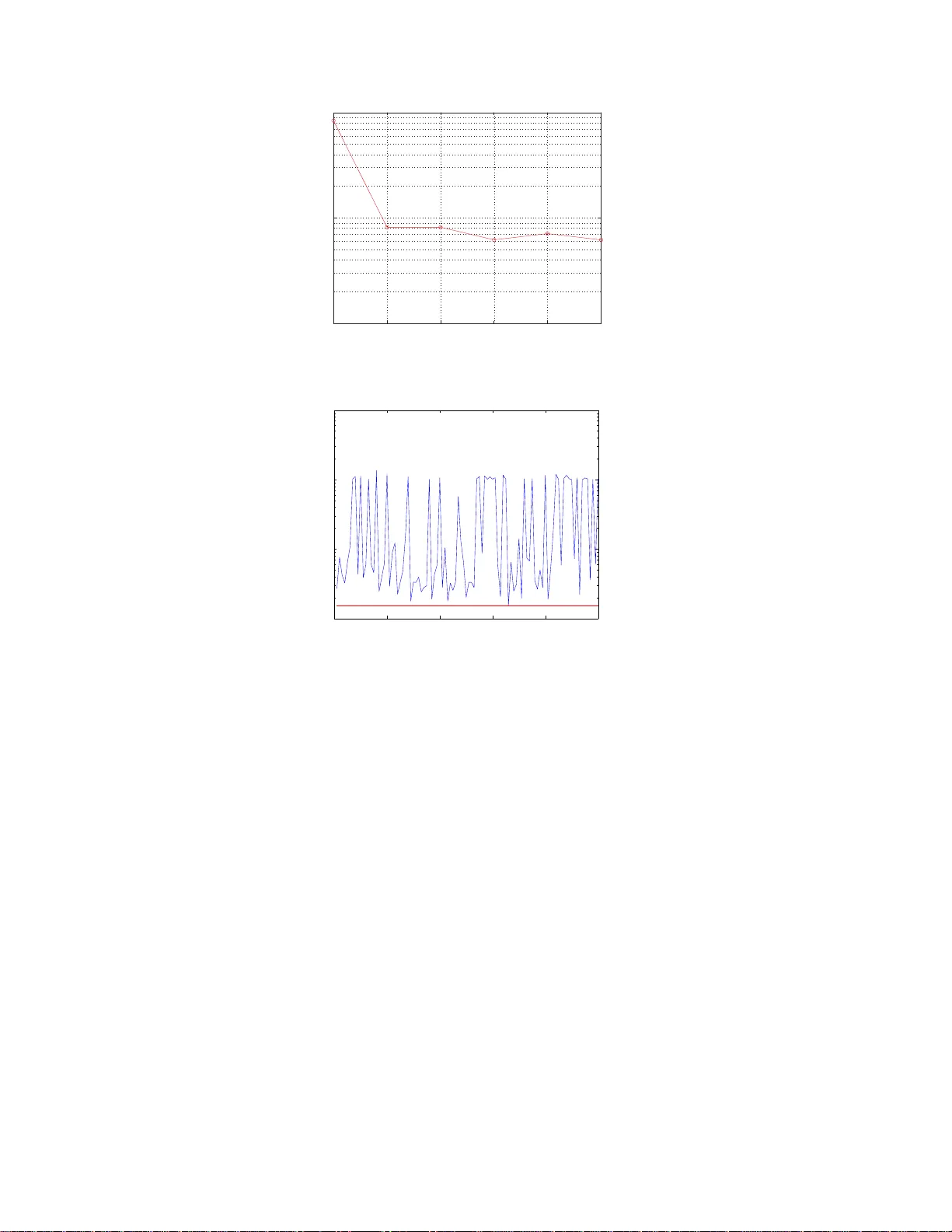
On Energy Efficient Hierar chical Cr oss-Layer Design: Joint P ower Contr ol and Routin g f or Ad Hoc Networks Cristina Comaniciu H. V incent Poor Ste v ens Institute of T echnology Princeton Uni v ersity e-mail: ccomanic@ste v ens.edu poor@princeton.edu Abstract In this paper, a hierarc hical cr oss-layer design approa ch is p roposed to increase energy ef ficiency in ad h oc n etworks thr ough join t adap tation of nodes’ transmitting powers and ro ute selection. The design maintains the advantages of the classic OSI mo del, while ac counting fo r the cr oss-couplin g between layers, throug h inf ormation sharing. The proposed joint po wer control and routing algorithm is sho wn to increase significantly the overall energy effi ciency of the network, at the expense of a mo derate increase in complexity . Perf orman ce enh ancemen t of the joint design using multiuser detection is also in vestigated, an d it is sho wn that the u se of mu ltiuser detection can incr ease the cap acity of th e ad h oc network significantly for a giv en level of energy co nsumption . Keywords: ad hoc networks, power c ontrol, routing, cross-layer This wo rk was presented in part at the 42nd IEEE Con ference on Decision and Control, Maui, HI, December 2003 ; This research was supported by the National Science Foundation under Grants ANI-030 38807 and CCR-02-05214, and by the New Jersey Center for Pervasi v e Information T echn ology . 1 I . I N T RO D U C T I O N A mobile ad hoc network consists o f a group of mobi le nodes that spont aneously form temporary networks wit hout the aid of a fixed i nfrastructure or centralized m anagement. Ad- hoc networks rely on peer to peer communication, where any s ource-destination pair of nodes can either communicate directly or by using intermediate nodes to relay the traf fic. The communication routes are determined by the routing protocol, which finds the best possibl e routes according to so me specified cost criterion. Since, in general, many ad hoc networks will consist of sm all terminals with limited battery lifeti me, routing protocols usi ng ener gy related cost criteria hav e recently been in vestigated in the literature (e.g. [13],[15],[18],[5]). Aside from “ener gy awar e routing”, other interference management techniques have t he potential of i mproving the sy stem p erformance, wit h a direct ef fect on increasing t he network lifetime. For example, joint power control and schedul ing ha ve been proposed i n [8], and power aw are routi ng for networks usin g bli nd mu ltiuser receiv ers h as been analyzed in [5]. The benefits of powe r control for wireless networks have been shown in numerous works (see for example [2], [14], [9], [17]), but only recently hav e its interaction with “energy aw are routing” begun to be addressed [7], [3], [22], [6]. A po wer aw are routing protocol design relies on the current po wer assi gnments at the terminals, and in turn, optim al po wer assignment depends on the current network topology , which is determined by routing. It is app arent that there is a stron g cros s-coupling between po wer control and routin g, due to the fact that they are bo th affe cted by , and act upon, the interference lev el and t he i nterference dist ribution in the network. Gi ven this strong coupling between layers, we expect t hat cross-layer interference m anagement algorit hms will outperform i ndependently designed algo rithms associated with various layers of the protocol stack [10]. On the other hand, a concern associated with crossing the boundaries betw een layers is that m any of t he core advantages of the OSI model, su ch as easy deb ugging and flexibility , easy upgrading, and hierarchical t ime s cale adapt ation, m ay be lost [12]. As a tradeoff between the pros and cons of cross-layer design , we propose a hierarc hical cross- layer design framework, in which the adaptation protocol s at di f ferent layers of the proto col stack are independently desi gned (e.g. po wer cont rol, at the physical layer , and routing, at the n etwork layer), while sharing coupling information across layers. Based o n thi s framew ork we p ropose and analyze a j oint power control and routing algorithm for Code Division Mu ltiple Access (CDMA) ad h oc networks. W e then extend this algorithm to include m ultiuser detection, for a further increase in network performance. The paper is organized as follows: we first present the hierarchical cross-layer design frame work in Section II. W e then propose a joint power control and routing algorit hm in Section III, and we add multiuser detection capabilities for the ph ysical layer in Section IV . Finally , Section V presents the conclus ions. I I . H I E R A R C H I C A L C RO SS - L A Y E R D E S I G N F R A M E W O R K As we hav e already mentioned, a tight coupl ing exists between diffe rent interference management algorit hms implemented at various layers of the prot ocol stack. In this paper we concentrate m ainly on interactions between the physi cal and t he net work layer , namely , we consider power control and recei ver adaptation algorithms at t he p hysical layer , and energy 2 aw are rout ing at the network layer . While p ower cont rol and multiuser det ection are traditional interference management techniques, ener g y a ware routing can also be seen as an eff ectiv e interference m anagement tool, as seeking low energy routes may lead to a better interference distribution in the network. Giv en th e tight cross -coupling among th ese techniques, it bec omes apparent th at a cross- layer so lution th at joint ly optim izes interference management algorithm s across layers is desirable. On the other hand, the OSI classical layered architecture has a n umber of adva ntages such as deployment flexibility and upgradeability , easy debugging, and last but not least, an inherent reduced network overhead by impl ementing adaptability at different time scales. More specifically , fast adaptation can be do ne locally by the physical layer , while large scale eve nts can be handled by changes in routing, which impl ies at least local neighborho od i nformation updates. Our proposed hierarchical cross -layer design frame work seeks to maintain the advantages of the OSI model, by independently optimi zing the interference management algorithms based on information sh aring amon g layers. Figure 1 illustrates t his h ierarchical m odel for the first three layers of the protocol stack: phy sical l ayer , MAC (Data Link) Layer and Network Layer . As protocols at dif ferent layers act independently t o increase the ener gy ef ficiency in the network, the inform ation exchange between layers leads to an iterative adaptation procedure, in which layers take turns to adjust and m inimize the energy con sumption in the network based on the new interfer ence level and distribution. W e note that this hierarchical st ructure raises con ver gence issues on a ve rtical plane, and a key is sue that should be addressed is how to approp riately define the information shared between layers, as well as ho w to incorporate this inform ation s uch that the iterativ e cross-layer adaptation con ver ges, and does not lead t o oscillatory behavior . In what follows, we propose an ener g y aw are hierarchical joint power control and routing design, which w e show is guaranteed to con ver g e across layers. W e t hen study how furt her enhancements at the physical layer (i.e., multius er detection recei vers in CDMA networks) improve t he ov erall network performance. Fig. 1. Hierarchical cross-layer design mode l: interactions amoung Physical, MA C and Network layer . 3 I I I . J O I N T P O W E R C O N T R O L A N D R O U T I N G A. Network Mod el W e consider an ad ho c network consisting of N mobile nodes. For simulati on pu rposes, the nodes are assumed to hav e a uniform stati onary d istribution over a square area of dimension D ∗ × D ∗ , b ut this is not a necessary assum ption for the analysis. The mul tiaccess scheme is sy nchronous d irect-sequence CDMA (DS-CDMA) and all nod es use independent, randomly generated and normalized spreading sequences of length L . The transmitted symbols (assumed to b e binary for the purpos e of exposition) are detected using either a matched filter receiv er or a lin ear mi nimum squ are error recei ver (LM MSE). Each terminal j has a t ransmission power P j which wil l be it erativ ely and distributiv ely adapted according to the current network configuration. The t raf fic can be transm itted directly b etween any two nodes, or it can be relayed through intermediate nodes. It is assumed that each node generates traf fic to be transmitted toward a randomly chosen destination node. If traf fic i s relayed by a particular nod e, the transm issions for different session s at that node are time mu ltiplexed. Also, it i s assumed that a scheduling scheme is ava ilable at the MA C layer to schedule transm ission and reception mi nislots for each node. This has the role of a voiding exccesi ve int erference between the recei ved and transmitted signals at any particular node. The details of the scheduling allocatio n are beyond the scope of this paper . For our desi gn we will u se a s implifyin g worst case assu mption that wil l consider that each node creates interference at all times, whi le in reality , so me of the tim e is d edicated only to receiving. This sim plifying assumption supports our hi erarchical structure, by av o iding interference tracking (routes modification) at the MA C layer tim e scale. W e address the probl em of meeting Quality of Service (QoS) requirements for data, i.e., BER (bit error rate) and minimum energy expenditure for the inform ation bit s transm itted, to conserv e battery power . W e note that for data services, delay i s not of primary concern. The tar get BER requirement can be mapped i nto a target SIR requirement. W e note that an op timal target SIR can be determined (as in [11]) to minimize the energy per bit requi rement, under the ass umption that data is retransmitted u ntil correctly receive d. At a link lev el, for a give n target SIR requirement, the numb er of retransmissions necessary for correct packet reception is characterized by a geometric distribution, whi ch depends o n the corresponding BER-SIR mapp ing. If t he transmissi on rate is fixed for all links, then the ener gy can be mini mized by m inimizin g the transm itted p ower s on each li nk. At the physi cal layer lev el, this is achie ved by power control . Howe ver , the achie vable minim um p ower s will depend on the distribution of the interference in the network, and t hus are i nfluenced b y routing. In turn, routing may use power awar e metrics to m inimize th e ener g y consum ption. The overall cross-layer optimization probl em can be formu lated as follows. minimize P N i =1 P i subject t o S I R ( i,j ) ( p ) ≥ γ ∗ , ∀ ( i, j ) ∈ S r a P i ≥ 0 and r ∈ Υ , (1) where ( p ) is the vector o f all nodes’ powers, S r a is the set of active links for the current routing configuration r , obtained using the routing protocol, and Υ is th e s et of all possible rout es. 4 From (1) we can see that optimal power allocation depends on the current route selection. On the oth er hand, for a give n power all ocation, efficient routing may reduce the interference, thus further decreasing t he required energy-per -bit. W e begin our discussion of the jo int optimization of these tw o ef fects by fir st considering distributed po wer cont rol design for a giv en route assignment, wh ich is a classic di stributed powe r control problem for ad hoc networks. B. Distributed P ower Contr ol In the cellul ar setting, a mi nimal po wer transmission so lution is achieved when all links achi e ve their tar get SIRs with equality . For an ad hoc network, implementati on complexity constraints may restrict t he power cont rol to adapt power levels for each node, as opposed to o ptimizing it for each active outgoin g lin k for the node. If mult iple active transmission li nks start at node i (Figure 2), then the worst l ink must meet the targe t SIR with equality . In our mo del, t hese outgoing li nks correspond to d estinations for various flows relayed by the node, and are us ed in a t ime m ultiplexed fashion. If we denote the set of all outgoing links from node i as S ∗ i , t hen the mi nimal p ower transmissio n conditions become min k ∈ S ∗ i S I R k = γ ∗ , ∀ i = 1 , 2 , ..., N . (2) Fig. 2. Multiple transmissions from node i . W e now express the achie vable SIR for an arbitrary acti ve link ( i, j ) ∈ S r a : S I R ( i,j ) = h ( i,j ) P i 1 L N X k =1 ,k 6 = i,k 6 = j h ( k, j ) P k + σ 2 , (3) where h ( i,j ) is the link gain for link ( i, j ) , and σ 2 is th e background noise powe r . Condition (2) can then b e e xpressed as min ( i,j ) ∈ S ∗ i h ( i,j ) P i 1 L N X k =1 ,k 6 = i,k 6 = j h ( k, j ) P k + σ 2 = γ ∗ . (4) 5 From (4), the power s can be selected as P i = max ( i,j ) ∈ S ∗ i γ ∗ h ( i,j ) 1 L N X k =1 ,k 6 = i,k 6 = j h ( k, j ) P k + σ 2 = ma x ( i,j ) I ( i,j ) ( p ) , (5) where p T = [ P 1 , P 2 , ..., P N ] . It can easi ly be shown that I ( i,j ) ( p ) is a standard interference function, i .e., it satisfies the three properties of a standard int erference functio n: positivity , monotonici ty , and scalability [21]. It was also p roved i n [21] that T i ( p ) = max ( i,j ) I ( i,j ) ( p ) i s also a s tandard interference function. Since T i ( p ) is a standard interference function, for a feasible sys tem, an iterative po wer control algorithm based on P i ( n + 1) = T i ( p ( n )) , ∀ i = 1 , 2 , ..., N , (6) is con ver gent to a mini mal power solution [21], for both synchron ous and asynchronous po wer updates. Since all the information required for the p ower updates can be estimated locally , the power control algorithm can be im plemented distributiv el y . In parti cular , a sample av erage of the square root outputs of the matched filter recei ver for link ( i, j ) will determine t he quantit y E { y 2 ( i,j ) } = 1 L P N k =1 ,k 6 = i,k 6 = j h ( k, j ) P k + h ( i,j ) P i + σ 2 . Further , i f t he l ink gain h ( i,j ) is also estim ated, all info rmation required for power updates at node i i s av ailable lo cally . C. J oi nt P ower Contr ol and Routi ng The pre vio us su bsection has propo sed an optimal power control algorithm, w hich minimizes the total t ransmitted power gi ven SIR constraints for all active links, for a give n network configuration. Howe ver , the performance can be further i mproved by o ptimally choos ing the routes as well . Finding th e optimal rout es to minimize the tot al transmission power ove r all possible configuratio ns is an NP-hard p roblem. W e propo se a suboptimal solution , based on iterative power control and rou ting, which is shown to con verge rapidly to a local minimum ener gy solution. This solution is compatible with our proposed hierarchical cross-layer framew o rk, by pro moting independent protocol updates with information sharing accross layers. Mo re specifically , we propose a joi nt algorithm, that alternates between power control (at the physical layer) and route assig nments (at the network layer), until further im provements in the energy consumption cannot be achieved. At each step of the algorith m, the p ower control optimizes powers based on the current route assign ment, while after power assignment, new min imum energy routes are determi ned based on the current power d istribution of the nodes (see Figure 3). As we have ment ioned in Section IIIA, the optim ization problem that we are solving can be e xpressed as in (1), i.e., we try t o mi nimize the sum of transmission po w ers, subject to SIR constraints, by both po wer control and route assignments. W e note that the tar get SIR requirement is selected such that a BER requirement is met for a fixed p rescribed rate allo cation, determined by a prescribed spreading gain. Thus, in ou r system model the t ransmission rate is fixed. 6 In the previous section, we have described ho w the transmiss ion powers are chosen for each node given a current rout e configuration, and w e have s hown t hat, for our system m odel, they are unique per node, n o matter which flo w is currently relayed by the node. Thus, the information that the network layer sees is the vector of powers for all the nod es, p T = [ P 1 , P 2 , ..., P N ] , which com pletely characterizes the interference distribution in the system, giv en a certain locatio n for the nodes. For routing, we use Dijkstra’ s algorithm [4], [1] with associated costs for the links. In order to try to m inimize further the total transmitt ed po wer i n the network, a natural choice of costs for t he routi ng, would b e b ased on the transmissio n po wer spent by a node sending on a giv en link. Howe ver , for con ver g ence reasons for the cross-layer algo rithm (which will be explained shortly), the cost for an arbitrary link ( i, j ) i s determi ned as c ( i, j ) = ( P i if S I R ( i,j ) ≥ γ ∗ ∞ if S I R ( i,j ) < γ ∗ . (7) The reason for choosi ng the link costs as i n (7) is that we would like t o restrict the pool of links av ail able for rout ing to include only links th at already m eet the tar g et SIR. As we will s ee shortly , this condition will ensure th e con vergence of the algorithm towards a mi nimum energy solution. T o determine a better pos sible rout ing option , we n eed t o ev aluat e the n e w costs for all links, giv en the current di stribution of po wers resulted from the previous p ower cont rol step. In order to determine the routing costs for th e li nks that are not currently activ e, the achiev able SIR for t hese link s must be estim ated. This requires that each n ode i update a routing t able which should contain the esti mated l ink gains t ow ard all the ot her nodes, h ( i,j ) , j = 1 , 2 , ..., N , j 6 = i , the transmitt ed powers of all nodes, P j , j = 1 , 2 , ..., N , and the extended esti mated interference at all the other no des, defined as ˜ I ( i, j ) = P N k =1 ,k 6 = i,k 6 = j h ( k, j ) P k + h ( i,j ) P i , j = 1 , 2 , ..., N , j 6 = i . Hence, t he estimated SIR for li nk ( i, j ) can be expressed as g S I R ( i,j ) = h ( i,j ) P i 1 L ˜ I ( i, j ) − h ( i,j ) P i + σ 2 . (8) W e note that the achiev able SIR on any potential l ink (currently acti ve or n ot) depends only on the current distribution of nodes, and on the current p ower assignm ent, and does not depend on t he current assi gned rou tes, and consequent ly does not change for new route assi gnments. This p roperty is a result of the fact t hat mu ltiple sessi ons are time m ultiplexed at a node, and are all transmit ted wit h the same power , such that the transmitted power for a node i i s fixed and equal to P i . This result can b e s ummarized in the following proposition. Pr oposit ion 1: F or a gi ven distribution of nodes in the network, after the con vergence of the power control algorithm, the achiev able SIR on any arbitray link , depends onl y on the nodes’ transmitted powers and is independent of the current route assignment . W e not e that if sessions are no t time multiplexed at a relayi ng node, t he above proposi tion does not hol d any more (e.g. the total power t ransmitted by a node is additiv e over t he numb er of relayed flows for multi-code transmiss ion, and thus depends o n the routing configurati on), and the con vergence o f the propo sed joint-power control algori thm i s not guaranteed. Howe ver , as a disadvantage for the time multi plexed scheme, th e throughput per session is limited by the 7 number of sess ions relayed by a node. In an extension of this work [20], we also have proposed a cost m odification for the rou ting to account for this effect, which yielded a more uniform distribution of relayed flows per nod e over the entire network. Also , in [16], we h a ve compared the performance o f a t ime multi plexed scheme, with the case in which mu lti-code CDMA i s used for simultaneous transmis sion of all relayed flows (which i ncreases the interference in the system). Starting from an in itial dist ribution of power s and rou tes, and assuming t hat the system i s feasible for the init ial configuratio n, the joint power cont rol and routing al gorithm is summarized in Figure 3. Fig. 3. Joint power control and routing Theor em 1: For a feasible initial network con figuration, t he joint power control and routing algorithm con ver ges to a locall y mi nimal transm itted po w er soluti on. Pr oof: As we pre viously s howed, for a feasibl e i nitial network configuratio n, the power control minim izes the total transmitted power , while ensuring that all activ e links meet their SIR requirements: S I R ( i,j ) ≥ γ ∗ , ∀ ( i, j ) ∈ S r a . After the con vergence of the po wer control algorithm, the lin k costs are estimated and updated according t o (7) and (8), and a minim al cost rout e, equ iv alent to a minimal t ransmitted power rout e, is selected for each s ession. As a consequence, the new routes are selected su ch that the sum of all transmitted powers for all activ e links is minimized, while the SIR constraints are met for all links (from Proposition 1 and (7)). If no power improvements can be achie ved, the algorithm stops. Otherwise, t he sum of transmissi on powers decreases after the route selection. Since all the new activ e links satis fy S I R ( i,j ) ≥ γ ∗ , ∀ ( i, j ) ∈ S r a , the system is feasible, and therefore, the power control algori thm produces a decreasing sequence of power vectors con verging t o a mi nimal po wer solution [21]. Hence, each step of the iteration (po wer control or routing) produces an i mprovement in the total transmitted power , wh ile meeting SIR requirements for all activ e links. Th e algorithm stop s at a locally minim al transm itted power solu tion, where no further d ecrease i n transmi ssion power can b e achieved by the routing protocol. ✷ W e note that t he locally minimal transmit ted power soluti on achie ved b y th e propos ed 8 algorithm depends on the initial network configuration chosen. For initializatio n, we propose an al gorithm simil ar to that whi ch was propos ed in [5]. W e first select an initial di stribution of powers (equal powers or random distribution) and then determine routes by assigning link costs equal to the energy per bit consumption defined in ( ?? ). This approach als o perm its us to quantify the energy requirement imp rovements of the joint optimizati on relative to the i nitial starting point. W e note that the total ener gy requirement depends on the current initializatio n for the powers. T o improve the expanded energy with minimal compl exity increase, the algori thm can b e run sev eral ti mes with di f ferent random power initialization s, and the best ener g y sol ution over all runs can be determined. D. Simulatio ns In this section, we present som e numerical examples for ad hoc networks with 5 5 and 40 nodes, respective ly , uniforml y di stributed over a square area of 200 × 200 meters. The tar get SIR is selected to be γ ∗ = 12 . 5 (whi ch was shown to be an optimal value t hat min imizes ener gy per bit consump tion for an FSK scheme [11]), and the no ise po wer is σ 2 = 10 − 13 , which approximately corresponds to the thermal noi se power for a bandwidth of 1 MHz. W e con sider low rate data users, using a spreading gain of L = 128 . For this particular exa mple, we choose equal initial transmit powers, 70 dB above the noi se floor ( P t = 1 0 − 6 W), and a path loss m odel with p ath lo ss coefficient n = 2 . In Fig ure 4 we show the final distribution of powers after the conv ergence o f the joint power control and routing algorithm. Figures 5 and 6 ill ustrate the performance of the proposed joint optimizatio n algorithm. In Figure 5, it can be seen that t he total transm itted power in the network progressive ly decreases as the proposed algorith m it erativ ely optim izes power and rou tes. The values in Figure 5 represent the total transmitted power obtained over a sequence of iterations: [power control, rou ting, power control, routing, power control ]. In Figure 6, the achiev ed energy- per -bit is compared for the same experiment with the first ener gy va lue, which represents the ener gy-per- bit obtained in the initial state. It can be seen that substantial im provements are achie ved by the propo sed joi nt op timization algorith m. Note t hat, at the end of each iteratio n pair [routing, power control], the ener gy i s further minimized. Howe ver , after new routes are selected, the powe rs are not yet opti mized, so it i s possible that previous routes mig ht ha ve better energy-per -bit performance (for the sam e power allocation, higher SIRs may i mprove t he ener gy consumpt ion). As we ha ve previously mentioned, the actual ener gy results after con ver gence depend on the initial starting point for the algo rithm. In Figure 7, we illus trate the variation in the total transmissio n power ob tained with various i nitializations (100 trials are considered) for an ad hoc network with 40 n odes. W e can s ee th at signi ficant energy improvements can be achiev ed if the algorithm is run repeatedly with different i nitializations and the best configuration is selected. In Figure 8 we show the final distribution o f po wers for t his minimal energy solu tion. E. Uniform ener gy consumption While we saw that the power distribution in Figure 8 gives a very low total ener gy consumption , this solutio n leads to unequal power consum ption among nodes, which u ltimately 9 0 10 20 30 40 50 0 0.5 1 1.5 2 2.5 3 3.5 4 x 10 −7 Distribution of powers Fig. 4. Distribution of po wers after con vergence 1 1.5 2 2.5 3 3.5 4 4.5 5 6 6.5 7 7.5 8 8.5 9 x 10 -5 Iterations Total transmitted power p r p r p Fig. 5. T otal transmission power results i n shorter life span for certain nodes (e.g. node 14 in Figure 8). Note t hat in m obile nodes, this problem is overcome by th e fact that node locations change with time, so in the long run, the power consum ption tends to b e m ore uniform . For fix ed no des, or sl ow m oving ones, we overcome this problem by selectin g a set of alternate “good routes” ( N s routes) and their corresponding power distri butions. The rou tes (and p ower vectors) are then randomly assig ned, such that the p ower consumption v ariance among nodes is minimized. A route i and its correspond ing p ower vector p i are selected from the initial set of “good routes”, with p robability w i . The probabili ties w i , i = 1 , . . . , N s are ass igned to routes such th at the following conditions hold min w k P − P av k 2 2 ; ( 0 ≤ w i ≤ 1 , i = 1 . . . , N s ; P N s j =1 w j = 1 , (9) 10 1 2 3 4 5 6 10 -5 10 - 4 10 - 3 Iterations E b initializa tion p r p r p Fig. 6. Energy per bit 0 20 40 60 80 100 10 −6 10 −5 10 −4 10 −3 number of initializations P t E min Fig. 7. Energy function for different initi alizations where w = [ w 1 , w 2 , . . . , w N s ] , P = [ p 1 , p 2 , . . . p N s ] , and P av is the a verage po wer consumptio n across nodes obtained for t he minimal energy sol ution. Alternative ly , rout es can be assigned determinist ically , such that w i represents the fraction of time route i and its corresponding power vector are selected for transm ission. In Figure 9 we illus trate how th e power distribution changes i n the ad hoc network when N s = 9 “good routes” are selected. These rout es (and t heir corresponding po wer distribution) are selected to be within 10% of t he minimal energy so lution obtained with 100 di ff erent random ini tializations. Comparing t he results from Figure 9 wi th th e ones in Figure 8, we can see a more uniform consumption across all nodes i n the ad hoc network. I V . J O I N T P O W E R C O N T R O L , R O U T I N G A N D M U L T I U S E R D E T E C T I O N T o extend the above described joint power control and routing al gorithm to includ e recei ver optimizatio n we b ui ld on results on iterative , dis tributed, joint power control and mini mum mean square error multiuser detection presented in [19]. In [19] an iterativ e two-step int egrated po wer control and m ultiuser detection algorith m was proposed, for which, in the first s tep, the LM MSE 11 0 5 10 15 20 25 30 35 40 0 0.2 0.4 0.6 0.8 1 1.2 1.4 1.6 1.8 2 x 10 −7 Min Distribution of powers P av Fig. 8. Distribution of po wers for the minimal energy solution 0 5 10 15 20 25 30 35 40 0 0.2 0.4 0.6 0.8 1 1.2 1.4 x 10 −7 Uniform Distribution of powers P av Fig. 9. Energy per bit filter coeffi cients are adjust ed according to the current vector of powers p (equatio n 10), then in th e s econd step, a new po wer vector is selected for the given filter coefficients: • Step 1: Optimize filt er coefficients given the power vector p T = [ P 1 , P 2 , · , P n ] : ˆ c i = q P i ( n ) 1 + P i ( n ) s i T A − 1 i ( p ( n )) s i A − 1 i ( p ( n )) s i , (10) where c i and s i are the filter coefficients vector , and the sig nature sequence vector for user i , respectively , n is the iteration n umber , and A i is defined as A i = P j 6 = i P j h ij s j s j T . • Step 2: Optimize p ower s based on currently s elected filter coef ficients: P i ( n + 1) = γ ∗ i h ii P j 6 = i P j ( n ) h i,j ( ˆ c i T s j ) 2 + σ 2 ˆ c i T ˆ c i ( ˆ c i T s i ) 2 . (11) Giv en the above alg orithm, to extend ou r joint power control and routing scheme to i nclude recei ver optimi zation, we sim ply repl ace the simp le power control adaptat ion at the physical 12 layer , by the above joint power control and multiuser detectio n algorit hm. Simulation results show a very simil ar con ver gence behavior and energy sa v ings for the joint power control, m ultiuser detection and routing alg orithm, compared to t he s olution wit h matched filters (see Figures 10, 11 and 12). W e also note a significant capacity increase when mult iuser detection is employed. W e use as a capacity measure the total t hroughput that can be supp orted by the network such that th e power control is feasible for a target SIR of γ ∗ = 12 . 5 . W e note that the powe r cont rol feasibility depends on the actual network top ology . T o determine the maximum load for the network, we randomly generated 100 different topologies (for the same number of users) and we selected t he maxim um n umber of users (for a given spreading gain) that yielded feasible topolog ies 95 % of t he ti me, for a give n initial power distribution for th e nodes. For the m atched filter case, we s elected L = 128 and t he m aximum nu mber of users t hat met the feasibility condition was determined to be N = 55 . F or t he LMMSE case, since the capacity increases significantly , to reduce the complexity o f the simulati on (the number of nodes), we hav e selected L = 32 , with a resulting capacity of N = 30 . This y ielded a total n ormalized throughput g ain for the LMMSE case of T g ( LM M S E ) = N LM M S E × L M F L LM M S E × N M F = 2 . 18 . (12) T o ill ustrate the performance of the join t po wer control, multi user detection and routing protocol, we hav e considered sim ilar network parameters as before, with the sole differ ence of selecting N = 30 and L = 32 . Random initial transm ission po wers were selected, approxim ately 70 dB above the noise floor. Figure 10 sho ws the initial d istribution of powers, as well as th e optimal po wer control distribution after con ver gence. Figures 11 and 1 2 i llustrate th e performance of t he propo sed joint optimizatio n algorithm with multiuser detection. In Fig. 11, it can be seen that the total t ransmitted po wer in the network progressively decreases as the proposed algorithm iterativ ely optimizes po wer , filter coef ficients, and routes. The va lues i n Fig. 11 represent t he total transmitted power obtained over a sequence of iterations: [power control + MUD , routing, power control+ MUD , routing, power con trol+MUD]. In Fig. 12, the achiev ed ener gy-per-bit is com pared for t he same experiment wit h the initial ener gy value (with randomly selected powers). It can be seen that subst antial im provements are achie ved by t he proposed joint optim ization alg orithm (approximately one order of m agnitude). V . C O N C L U S I O N S In this paper , we have proposed joint power control and routing opti mization for wi reless ad h oc data networks with ener gy const raints. Both energy m inimizatio n and network lifetime maximization hav e been considered as optim ization criteria. W e have s hown that energy savings of an order of magnitude can be obt ained, compared with a fixed transmission power , energy aw are routing scheme. Our proposed algorithm is based on a hierarchical cross-layer framework which maint ains the adv antages of the OSI layered architecture, while all owing for protocol optimizatio n based on informat ion sharin g between l ayers. The network capacity has been 13 0 5 10 15 20 25 30 0 0.1 0.2 0.3 0.4 0.5 0.6 0.7 0.8 0.9 1 x 10 −5 Initial distribution of powers (a) 0 5 10 15 20 25 30 0 0.1 0.2 0.3 0.4 0.5 0.6 0.7 0.8 0.9 1 x 10 −5 Final distribution of powers (b) Fig. 10. Joint power control, multiuser detection and r outing: Distr ibution of po wers versus node number , (a) initially , (b) after con verg ence further enhanced by em ploying mu ltiuser detection, with a sim ilar obtained energy performance. Our sim ulation results sh ow that our distributiv e joint opt imization algorithm con ver ges rapidly tow ards a l ocal mini mum energy . The rapid con ver gence of the power -routing protocol makes it suitable for imp lementation in mobile ad hoc networks. R E F E R E N C E S [1] Bayes Net T oolbox for Matlab. www .cs. berkele y .edu/ murphyk/Bayes/bnt.html. [2] S. Agarwal, R. H. Katz, S. V . Krishnamurthy , and S. K. Dao. Distributed power control in ad-hoc wireless networks. In Pro ceedings of the 12th IEEE P ersonal, Indoor and Mobile Radio Communications Confer ence , pages F–59 –F–66, Sep/Oct 2001. [3] F . Bertochio, P . Bergamo, and M. Zorzi. MA C and routing solution for energy saving in ad hoc netwo rks: Distributed po wer control. In Procee dings of the IEEE Joint Confer ence on Information, Communications and Signal Pr ocessing and F orth P acific R im Confer ence on Multimedia , pages 1061–10 65, Decemb er 2003. [4] D. Bertsekas and R. Gall ager . Data Networks . Prentice Hall, Upper Saddle River , NJ, 1992. 14 1 2 3 6.8 7 7.2 7.4 7.6 7.8 8 8.2 8.4 8.6 8.8 x 10 -5 Iterations Total transmitted power r p+MUD p+MUD Fig. 11. T otal transmission po wer: joint power control, multi user detection and routing 1 1.5 2 2.5 3 3.5 4 10 -5 10 - 4 10 -3 Iterations E b initialization r p + MUD p + MUD Fig. 12. T otal energy consumption: joint po wer control, multiuser detection and routing [5] Z. Cai, M. Lu, and X. W ang;. Minimum av erage transmission power routing in CDMA ad hoc networks util izing the bli nd multiuser detection. In Procee dings of the IEEE International P arallel and Di stributed Pr ocessing Symposium , pages 428 –433, 2002. [6] C. Comaniciu, N. B. Mandayam, and H. V . Poor . W ir eless N etworks: Multi user Detection in Cr oss-Layer Design . Springer , Ne w Y ork, NY , May 2005. [7] C. Comaniciu and H. V . Poor . QoS pro visioning for wireless ad hoc data networks. In Pr oceedings of the 42nd IEEE Confer ence on Decisi on and Contr ol , pages 92–97, Maui, HI, December 2003. [8] T . ElBatt and A. Ephremides. Joint scheduling and po wer control for wireless ad-hoc networks. In Pr oceedings of the 21st IEEE INFOCOM , volume 2, pages 976 –984, New Y ork, NY , 20 02. [9] M. Ettus. System capacity , latency , and power consumption in multihop-routed S S-CDMA wireless networks. In Pr oceedings of the IEEE Radio and W ir eless Confer ence (R A WCON) , pages 55 –58, Colorado Springs, CO, August 1998. [10] A. J. Goldsmith and S. B. W icker . Design challenges for ener gy-constrained ad hoc wireless network s. IEE E W ir eless Communications , 9(4):8–27, August 2002. [11] D. J. Goodman and N. B. Mandayam. Power control for wireless data. IEEE P ersonal Communications , 7(2):48–54 , April 2000. [12] V . Kawadia and P . Kumar . A cau tionary persp ectiv e on cross layer desig n. Univ ersity of Illinois at Urbana-Champaign, 2003. Preprint. [13] D. Kim, J. J. Garcia-Luna-Ace ves, K. Obraczka, J. Cano, and P . Manzoni. Power-a ware routing based on the energy drain rate for mobile ad hoc networks. In Pr oceedings of the IEEE 11th International Confer ence on Computer Communications 15 and Networks , pages 565 –569, Miami, Fl., 2002. [14] T . J. Kwon and M. Gerla. Clustering with power control. In Proc eedings of the IEEE Mil itary Communications Confer ence (MILCOM) , volume 2, pages 1424 –1428, Atlantic City , NJ, 1999. [15] X.-Y . L i, P .-J. W an, Y . W ang, and O. Frieder . Constrained shortest paths in wireless networks. In Procee dings of the IEEE Military Communications Confer ence (MILCOM) , volume 2, pages 884 –893, V i enna, V A, 2001. [16] H. Mahmood and C. Comaniciu. Adaptiv e spreading/codin g gains for energy efficient routing in wireless ad hoc networks. In Pr oceedings of the IE EE V ehicular T echno logy Confer ence (VTC) , Stockholm, Sweden, May-June 2005. [17] F . Meshkati, H. V . Poor, S. C . S chwartz, and N. B. Mandayam. An energy -efficient approach to power control and receiv er design in wireless data networks. IEEE T ransactions on Commu nications , 53(11):1885– 1894, No vember 2005. [18] S. T ragoudas and S. Dimitrova. Routing with energy considerations in mobile ad-hoc network s. In Pr oceedings of the IEEE W ir eless Communica tions and Networking Confer ence (WCNC) , volume 3, pages 1258 –1261, Chicago, IL, 2000. [19] S. Ulukus and R. Y ates. Adapti ve po wer control and multiuser interference suppression. ACM W ir eless Networks , 4(6):489– 496, 1998. [20] Y . Xing, N. Nie, and C . Comaniciu. A voiding throughput bottlenecks for energy efficient joint powe r control and routing in ad hoc wireless networks. In Proc eedings of the Confer ence on Information Sciences and Systems , P rinceton, NJ, March 2004. [21] R. Y ates. A frame work for uplink power control in cellular radio systems. IEEE Jo urnal on Selected A r eas in Communications , 13(7):1341–1 348, September 1995. [22] A. Y ener and S . Kishore. Distributed power control and r outing for clustered CDMA wirel ess ad hoc networks. In Pr oceedings of the IEEE V ehicular T echno logy Confer ence , pages 29 51–2955 , Los Angeles, CA, September 2004.
Original Paper
Loading high-quality paper...
Comments & Academic Discussion
Loading comments...
Leave a Comment