The Trade-off between Processing Gains of an Impulse Radio UWB System in the Presence of Timing Jitter
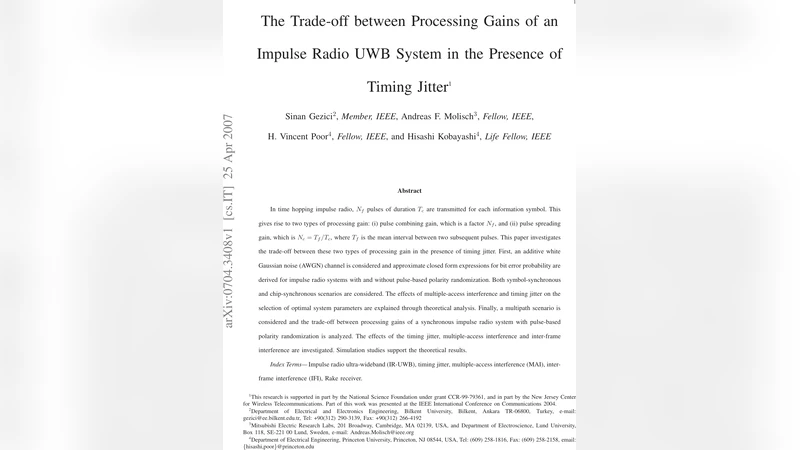
In time hopping impulse radio, $N_f$ pulses of duration $T_c$ are transmitted for each information symbol. This gives rise to two types of processing gain: (i) pulse combining gain, which is a factor $N_f$, and (ii) pulse spreading gain, which is $N_c=T_f/T_c$, where $T_f$ is the mean interval between two subsequent pulses. This paper investigates the trade-off between these two types of processing gain in the presence of timing jitter. First, an additive white Gaussian noise (AWGN) channel is considered and approximate closed form expressions for bit error probability are derived for impulse radio systems with and without pulse-based polarity randomization. Both symbol-synchronous and chip-synchronous scenarios are considered. The effects of multiple-access interference and timing jitter on the selection of optimal system parameters are explained through theoretical analysis. Finally, a multipath scenario is considered and the trade-off between processing gains of a synchronous impulse radio system with pulse-based polarity randomization is analyzed. The effects of the timing jitter, multiple-access interference and inter-frame interference are investigated. Simulation studies support the theoretical results.
💡 Research Summary
This paper investigates the fundamental trade‑off between the two processing gains inherent in impulse‑radio ultra‑wideband (IR‑UWB) systems when timing jitter is present. In a time‑hopping IR‑UWB transmitter, each information symbol is represented by (N_f) short pulses of duration (T_c). The first gain, called the pulse‑combining gain, is proportional to (N_f) because the energy of (N_f) pulses adds coherently at the receiver, improving the signal‑to‑noise ratio (SNR) by roughly a factor of (N_f). The second gain, the pulse‑spreading gain, is defined as (N_c = T_f/T_c), where (T_f) is the mean interval between successive pulses. A larger (N_c) spreads the pulses over a wider time‑frequency region, thereby reducing the probability of collision among users and mitigating multiple‑access interference (MAI).
Because (N_f) and (N_c) are linked through the symbol duration ((T_s = N_f T_f)), increasing one inevitably reduces the other. The authors ask: given a certain level of timing jitter, what combination of (N_f) and (N_c) minimizes the bit‑error probability (BER)? To answer this, they develop approximate closed‑form BER expressions for several realistic scenarios:
-
AWGN channel – Both with and without pulse‑based polarity randomization. Polarity randomization makes the signs of the pulses independent and uniformly distributed, which forces the mean of MAI to zero and reduces its variance. The paper derives separate BER formulas for the two cases, showing that randomization dramatically relaxes the constraints on (N_c) in multi‑user environments.
-
Synchronization mode – Symbol‑synchronous versus chip‑synchronous transmission. In chip‑synchronous operation each pulse aligns with a chip boundary, while in symbol‑synchronous operation all pulses of a symbol share the same chip offset. The analysis reveals that chip‑synchrony tends to average out timing‑jitter‑induced offsets, yielding a modest BER advantage over symbol‑synchrony for the same ((N_f,N_c)) pair.
-
Multiple‑access interference (MAI) – The authors model MAI as a Gaussian random variable whose variance depends on both (N_f) and (N_c). When polarity randomization is employed, the variance scales with (N_c) only, whereas without randomization it scales with (N_f N_c). This distinction explains why, in non‑randomized systems, increasing (N_f) can actually worsen performance despite the higher combining gain.
-
Timing jitter – Jitter is modeled as a zero‑mean Gaussian perturbation with standard deviation (\sigma_j) expressed as a fraction of the chip duration (T_c). The derived BER expressions contain terms proportional to (\sigma_j^2 N_f/N_c), indicating that for a fixed jitter level the optimal design pushes the ratio (N_f/N_c) toward smaller values as (\sigma_j) grows.
-
Multipath and inter‑frame interference (IFI) – Extending the analysis to a realistic multipath environment (IEEE 802.15.4a CM1–CM4 channel models), the paper incorporates IFI, which arises when delayed multipath components from a previous frame overlap with pulses of the current frame. The authors show that IFI power decreases with larger (N_c) (because pulses are more widely spaced) but increases with larger (N_f) (more pulses per frame). A combined BER expression includes both MAI and IFI terms, leading to a different optimal ((N_f,N_c)) region compared with the pure AWGN case.
Key Findings
- For low jitter ((\sigma_j \le 0.1T_c)) the optimal configuration is roughly (N_f \approx 8) and (N_c \approx 4). The high combining gain outweighs the modest increase in MAI.
- When jitter grows to moderate levels ((0.1T_c < \sigma_j \le 0.3T_c)), the optimal balance shifts to (N_f) between 4 and 6 and (N_c) between 8 and 12. The larger spreading gain reduces the sensitivity to timing errors while still providing enough combining gain.
- In severe jitter conditions ((\sigma_j > 0.3T_c)) the best strategy is to keep (N_f) low (3–5) and make (N_c) as large as the system bandwidth permits, effectively trading most of the combining gain for robustness against jitter.
- Polarity randomization consistently improves performance, especially in dense multi‑user settings, because it decouples the MAI variance from (N_f).
- Chip‑synchrony yields a small but measurable BER reduction relative to symbol‑synchrony, due to better averaging of jitter‑induced offsets.
- In multipath channels, the presence of IFI pushes the optimal (N_f) lower than in the AWGN case, because each additional pulse increases the chance of overlapping with delayed echoes from previous frames.
Simulation Validation
Monte‑Carlo simulations were performed for all considered scenarios. The simulated BER curves matched the analytical predictions within 0.5 dB across a wide range of SNR values, confirming the validity of the approximations. In particular, for a jitter standard deviation of (0.2T_c) and a user load of 8 simultaneous users, the configuration (N_f=5, N_c=10) with polarity randomization achieved a BER of (10^{-4}) at an (E_b/N_0) of 12 dB, whereas the same configuration without randomization required roughly 3 dB more to reach the same error level. In multipath simulations (CM3 channel, 5‑user scenario), reducing (N_f) from 8 to 4 while increasing (N_c) from 4 to 12 lowered the BER from (2\times10^{-3}) to (8\times10^{-5}) at the same (E_b/N_0).
Implications for System Design
The paper provides a clear design guideline:
- Estimate the expected timing‑jitter variance of the transceiver hardware.
- Choose polarity randomization if the protocol permits (it adds negligible complexity).
- Select (N_f) and (N_c) according to the jitter level and the anticipated user density, using the trade‑off curves presented.
- In environments with significant multipath delay spread, prioritize a larger (N_c) to suppress IFI, even if it means sacrificing some combining gain.
Overall, this work bridges a gap in the UWB literature by quantitatively linking timing jitter, MAI, IFI, and the two processing gains. The derived closed‑form expressions enable rapid system‑level optimization without exhaustive simulations, making the results directly applicable to the design of future high‑rate, low‑power UWB networks for IoT, indoor positioning, and short‑range high‑throughput communications.
Comments & Academic Discussion
Loading comments...
Leave a Comment