Existence Proofs of Some EXIT Like Functions
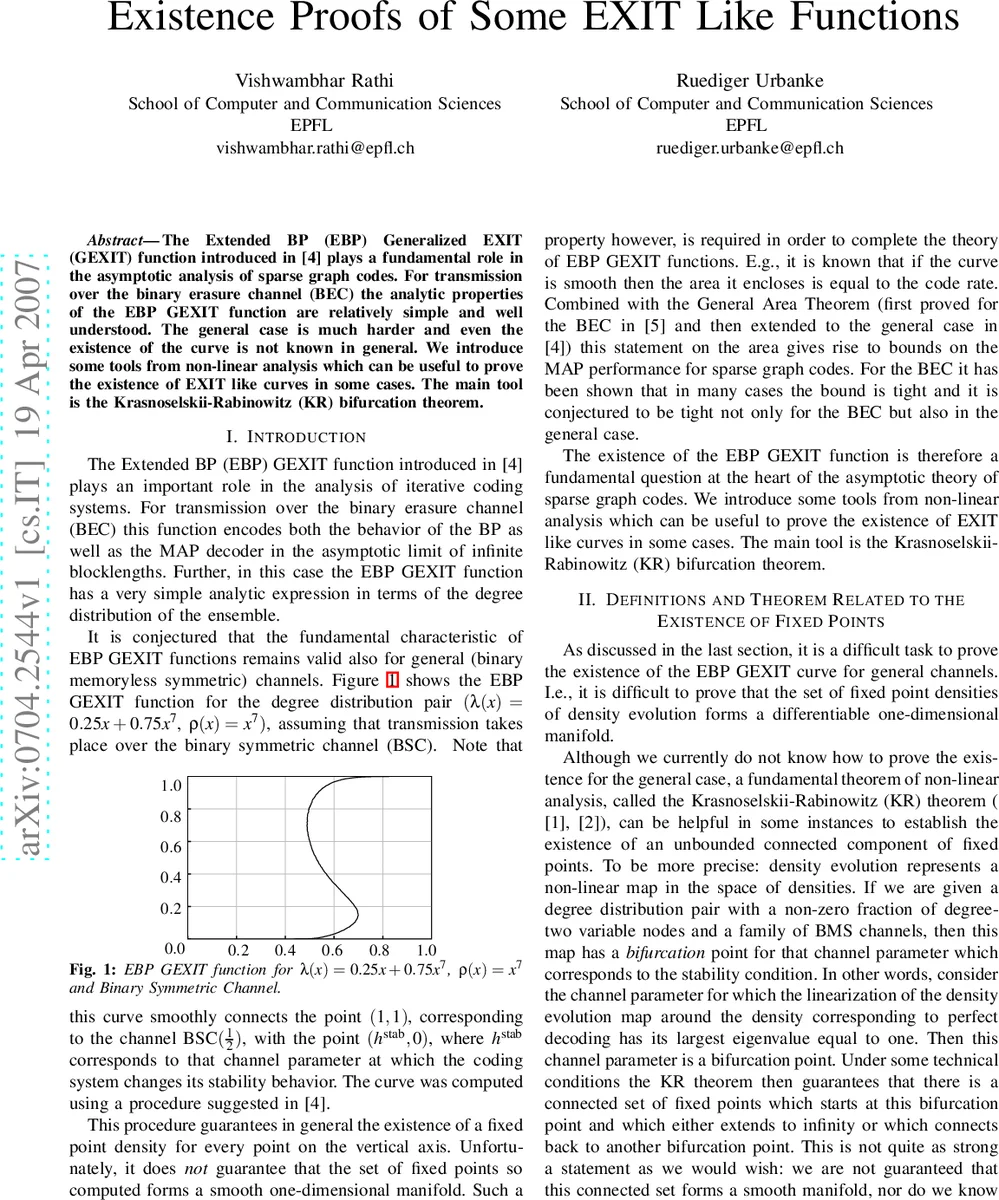
The Extended BP (EBP) Generalized EXIT (GEXIT) function introduced in \cite{MMRU05} plays a fundamental role in the asymptotic analysis of sparse graph codes. For transmission over the binary erasure channel (BEC) the analytic properties of the EBP GEXIT function are relatively simple and well understood. The general case is much harder and even the existence of the curve is not known in general. We introduce some tools from non-linear analysis which can be useful to prove the existence of EXIT like curves in some cases. The main tool is the Krasnoselskii-Rabinowitz (KR) bifurcation theorem.
💡 Research Summary
The paper addresses a fundamental open problem in the asymptotic analysis of sparse‑graph codes: the existence of the Extended BP (EBP) Generalized EXIT (GEXIT) curve for general binary memoryless symmetric (BMS) channels. While for the binary erasure channel (BEC) the GEXIT function admits a simple closed‑form expression in terms of the degree distributions and its analytic properties are well understood, for arbitrary BMS channels even the existence of a smooth one‑dimensional manifold of fixed points of density evolution has not been proved.
To tackle this, the authors bring in a powerful tool from nonlinear functional analysis: the Krasnoselskii‑Rabinowitz (KR) bifurcation theorem. The theorem applies to a completely continuous map (G:\mathbb{R}\times X\to X) on a Banach space (X) that is Fréchet‑differentiable at the trivial fixed point (x=0). If the linearisation (T) at zero has an eigenvalue (1/\mu) of odd algebraic multiplicity, then the point ((\mu,0)) is a bifurcation point and there exists a maximal closed connected component (C_\mu) of non‑trivial fixed points containing ((\mu,0)). Moreover, either (C_\mu) is unbounded in (\mathbb{R}\times X) or it meets another bifurcation point ((\mu^*,0)). A complementary result guarantees that if (1/\mu) is not an eigenvalue of (T), then no nearby non‑trivial fixed points exist.
The paper first illustrates the theorem on the BEC. For a degree‑distribution pair ((\lambda,\rho)) the density‑evolution map reduces to the scalar polynomial (G(\epsilon,x)=\epsilon\lambda(1-\rho(1-x))). The Fréchet derivative at zero is (\epsilon T x = \epsilon\lambda’(0)\rho’(1)x); thus the eigenvalue is (\lambda’(0)\rho’(1)) and the bifurcation point is (\epsilon_c = 1/(\lambda’(0)\rho’(1))). Since the space is one‑dimensional, the KR theorem predicts a connected component of fixed points emanating from ((\epsilon_c,0)) that is unbounded, which indeed coincides with the explicit BEC GEXIT curve.
The more challenging case of the binary symmetric channel (BSC) with min‑sum decoding is then tackled. Messages are represented as log‑likelihood ratios and, after observing that they always lie on the lattice ({\dots,i\ln\frac{1-p}{p},\dots}), the authors introduce a quantized version where the message alphabet is bounded to ({-M,\dots,M}). This yields a finite‑dimensional state space (X=\mathbb{R}^{2M}) and a vector‑polynomial density‑evolution map (G). The map is completely continuous (Lemma 1) and Fréchet‑differentiable at zero, with derivative of the form (pT+T’) where (p) is the BSC crossover probability. To fit the KR framework, the authors consider the transformed operator ((I- T’)^{-1}T) (Lemma 3) and study its eigenvalues.
Two concrete quantized examples are presented. For (M=2) the transformed matrix has two non‑zero real eigenvalues (1/\mu_1\approx3.5002) and (1/\mu_2\approx-2.7049), each of odd multiplicity. Hence both ((\mu_1,0)) and ((\mu_2,0)) are bifurcation points. The KR theorem then forces either unbounded components or a single connected component containing both points. Numerical computation shows the latter: a single component (C) that passes through both bifurcation points, with a stable branch, an unstable branch, and a second stable branch. The threshold for successful decoding is identified as (p^*\approx0.0962).
For (M=3) the transformed matrix has a single non‑zero eigenvalue (1/\mu\approx2.098). By Theorem 2 there can be at most one bifurcation point, so the second KR alternative (connection to another bifurcation) is impossible; consequently the component (C_\mu) must be unbounded.
These examples demonstrate that the KR bifurcation theorem can guarantee the local existence of a connected set of density‑evolution fixed points around the stability threshold for a broad class of channels and decoders, even when an explicit analytic description of the GEXIT curve is unavailable. While the theorem does not yet establish global smoothness of the EBP GEXIT curve (required for the area theorem and tight MAP performance bounds), it provides a rigorous foundation for the conjectured relationship between the EXIT area and code rate in the general BMS setting. The paper thus bridges coding theory and nonlinear analysis, opening a pathway for further rigorous results on EXIT‑like functions in modern coding systems.
Comments & Academic Discussion
Loading comments...
Leave a Comment