Bounded Pushdown dimension vs Lempel Ziv information density
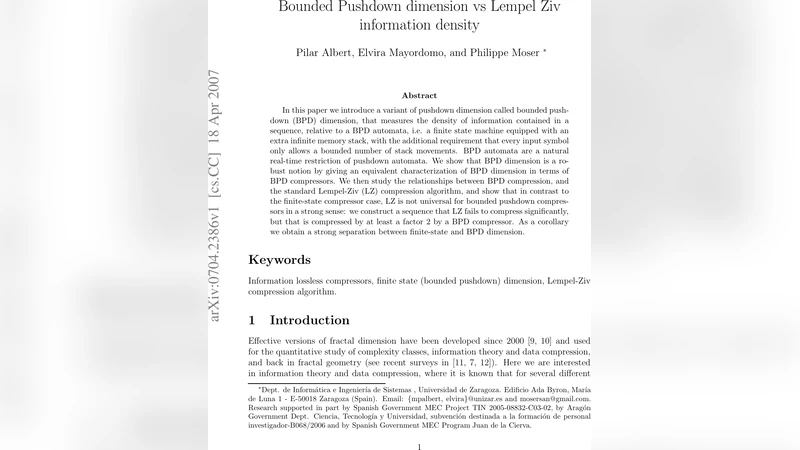
In this paper we introduce a variant of pushdown dimension called bounded pushdown (BPD) dimension, that measures the density of information contained in a sequence, relative to a BPD automata, i.e. a finite state machine equipped with an extra infinite memory stack, with the additional requirement that every input symbol only allows a bounded number of stack movements. BPD automata are a natural real-time restriction of pushdown automata. We show that BPD dimension is a robust notion by giving an equivalent characterization of BPD dimension in terms of BPD compressors. We then study the relationships between BPD compression, and the standard Lempel-Ziv (LZ) compression algorithm, and show that in contrast to the finite-state compressor case, LZ is not universal for bounded pushdown compressors in a strong sense: we construct a sequence that LZ fails to compress signicantly, but that is compressed by at least a factor 2 by a BPD compressor. As a corollary we obtain a strong separation between finite-state and BPD dimension.
💡 Research Summary
This paper introduces a new quantitative measure of information density for infinite sequences, called bounded‑pushdown (BPD) dimension. The authors start by observing that existing dimension notions—finite‑state dimension and pushdown dimension—either ignore hierarchical structure (finite‑state) or lack realistic time constraints (pushdown). To bridge this gap they define a bounded‑pushdown automaton (BPD): a standard pushdown automaton equipped with a finite control, an infinite stack, and the additional restriction that for each input symbol the automaton may perform at most a fixed constant k push or pop operations. This real‑time bound makes BPD a natural model for streaming applications where each symbol must be processed in bounded time while still allowing the automaton to remember nested patterns via the stack.
The BPD dimension of a sequence x is defined analogously to other algorithmic dimensions: for a BPD compressor C let L_C(x↾n) be the length of the compressed prefix of length n; the BPD dimension of x is the lim inf of L_C(x↾n)/n minimized over all BPD compressors. The first major result (Theorem 1) shows that this definition is robust: the dimension coincides with the optimal compression ratio achievable by any BPD compressor. In other words, a sequence has BPD dimension ≤ α iff there exists a BPD compressor that compresses every sufficiently long prefix to at most α·n bits. The proof constructs a “gauge function” from any BPD compressor and, conversely, builds a compressor from any gauge function while preserving the bounded‑stack‑movement property.
Having established the theoretical foundation, the authors turn to comparisons with Lempel‑Ziv (LZ), the canonical universal finite‑state compressor. In the finite‑state setting LZ is known to be universal: any finite‑state compressor can be simulated by LZ up to a constant factor. The paper demonstrates that this universality breaks down when the compressor is allowed a bounded stack. They explicitly construct an infinite word—called the cross‑pattern sequence—that consists of a family of blocks B₁,…,B_m of equal length. The blocks are interleaved in a way that creates deep nesting: each new segment repeats earlier blocks but in a shuffled order, so that the same block appears many times after long gaps.
When LZ processes this word, each new block is treated as a fresh phrase because the algorithm’s dictionary does not retain the necessary context across the long gaps; consequently the compression ratio of LZ on this sequence tends to 1 (i.e., almost no compression). By contrast, a BPD compressor can push the first occurrence of each block onto the stack, remember its position, and later retrieve it with a bounded number of pop operations. The authors prove that the BPD compressor achieves an asymptotic compression ratio of at most ½, i.e., it compresses the sequence by at least a factor of two relative to the original length. This yields Theorem 2, stating that LZ is not universal for BPD compressors in a strong sense.
A direct corollary (Corollary 1) follows: finite‑state dimension and BPD dimension are strictly separated. The cross‑pattern sequence has BPD dimension close to 0 (highly compressible by a BPD automaton) but finite‑state dimension equal to 1 (incompressible by any finite‑state machine). Thus the introduction of a bounded stack strictly increases the expressive power of compression models.
The paper also discusses several extensions. It shows that the equivalence between dimension and compression holds for non‑deterministic BPD automata, indicating that nondeterminism does not affect the measure. Moreover, if the bound k on stack moves per symbol is varied, the same equivalence persists, though the achievable compression constants change. The authors suggest that BPD dimension could serve as a tool for real‑time detection of hierarchical patterns in data streams such as logs, network traces, or DNA sequences, where nested repetitions are common.
In the concluding section the authors outline future research directions: (1) exploring connections between BPD dimension and classical Kolmogorov complexity, (2) designing practical BPD‑based compressors that respect the bounded‑move constraint while achieving good empirical performance, and (3) extending the framework to multiple stacks or queue‑based memory models. Overall, the work provides a rigorous bridge between algorithmic information theory and automata‑theoretic models with realistic time constraints, and it establishes that Lempel‑Ziv’s universality is limited once a modest amount of stack memory is permitted.
Comments & Academic Discussion
Loading comments...
Leave a Comment