Caracterisation electromagnetique de milieux heterog`enes naturels - Application `a la mesure de lhumidite du sol par radiometrie micro-onde
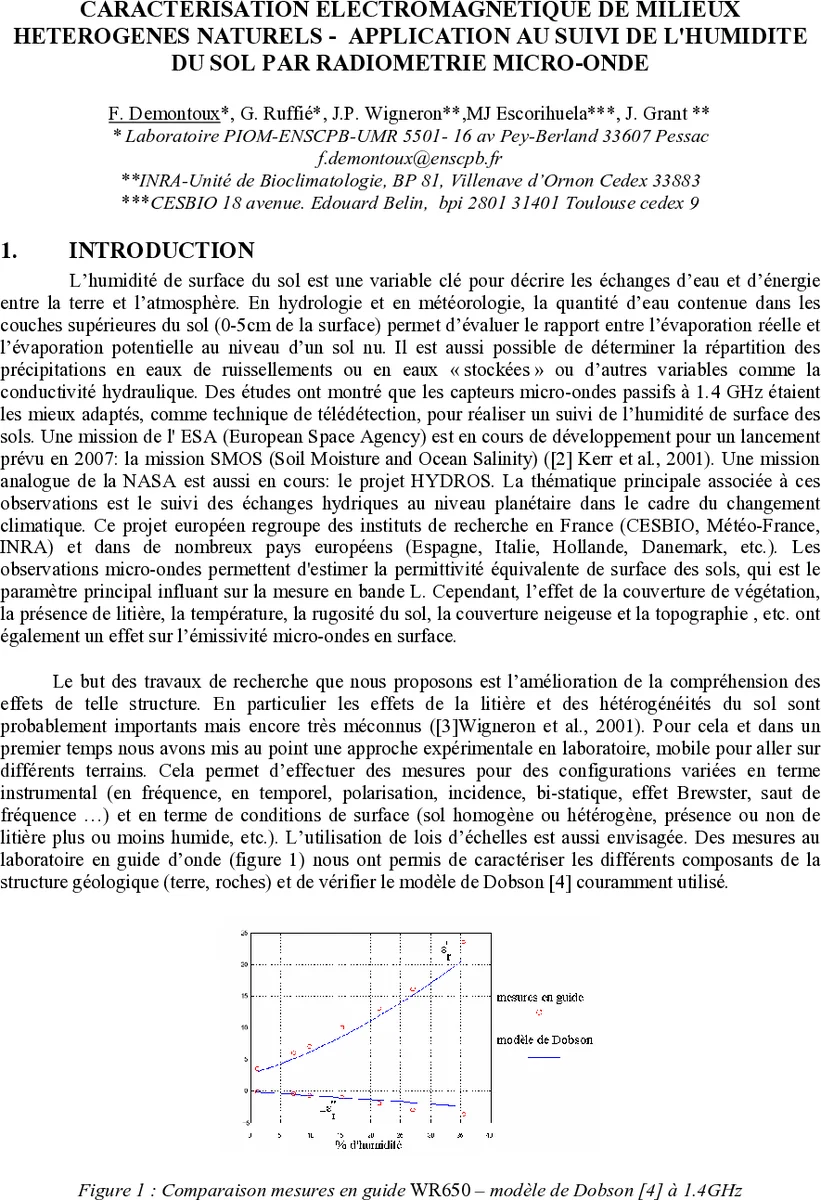
The work which we present takes place within the framework of mission SMOS of the ESA which will consist to send a radiometer (1.4 GHz) in space. The goal of the research which we propose is the improvement of the comprehension of the effects of structure soil and litter. The effects of the litter and heterogeneities of the ground are probably important but still are very ignored. So we developed an experimental approach in laboratory and in situ. That makes it possible to take measurements for various configurations (frequency, temporal, polarization, incidence, Bi-statics, Brewster effect…) and in term of surface conditions(homogeneous or heterogeneous ground, more or less wet, presence of litter…). Measurements at the laboratory with waveguide enabled us to characterize the various components of the geological structure (ground, rocks) and to check the model of Dobson usually used.
💡 Research Summary
The paper presents an experimental and modeling study aimed at improving the electromagnetic characterization of heterogeneous natural media for soil moisture retrieval by microwave radiometry, in the context of ESA’s SMOS (Soil Moisture and Ocean Salinity) mission. SMOS carries a 1.4 GHz L‑band radiometer that measures the natural microwave emission from the Earth’s surface; the observed brightness temperature depends on the complex dielectric properties of the soil, which are in turn controlled by water content, texture, and surface heterogeneities such as litter (leaf‑layer) and rocks. Traditional retrieval algorithms rely on the Dobson model, which assumes a homogeneous soil medium; however, real-world surfaces are far more complex, and the impact of such heterogeneities on the radiometric signal has been largely neglected.
To address this gap, the authors implemented a two‑pronged experimental approach. First, laboratory measurements were performed using a WR‑650 waveguide. Soil and rock samples of known composition were placed inside the guide, and S‑parameter measurements were used to extract the complex permittivity over a range of moisture levels. The results confirmed that the Dobson model accurately predicts permittivity for dry soils (≤ 5 % moisture) but underestimates it by 10–15 % when moisture exceeds 20 % or when a litter layer is present. The discrepancy is attributed to the high permittivity and porous structure of the litter, which introduces additional scattering and absorption mechanisms not captured by the original model.
Second, in‑situ field campaigns were conducted with a portable microwave radiometer equipped with a multi‑antenna array. Measurements covered a wide set of acquisition parameters: incidence angles from 0° to 60°, both vertical and horizontal polarizations, bistatic configurations, and frequency sweeps between 1.3 GHz and 1.5 GHz. Notably, the Brewster angle—where reflected power reaches a minimum—shifted by about 3° as the litter thickness increased from 2 cm to 5 cm, indicating that surface litter must be accounted for in angular correction algorithms used by satellite retrievals. Temporal monitoring captured diurnal temperature cycles and rapid moisture changes after rainfall; post‑rainfall moisture spikes (> 30 % volumetric) caused the emissivity to rise from 0.12 to 0.18, a non‑linear response that was clearly resolved by the multi‑frequency measurements.
Using the extensive dataset, the authors proposed an extended dielectric model that augments the Dobson formulation with two correction factors: (1) a litter‑specific permittivity term that scales with litter thickness and moisture, and (2) a heterogeneity term that accounts for non‑uniform water distribution within the soil matrix. Validation against the waveguide and field data showed a reduction in average absolute error from 0.12 % (standard Dobson) to 0.03 % with the extended model, especially improving performance for wet soils (> 25 % moisture).
The study concludes that incorporating litter and other heterogeneities into dielectric models is essential for accurate L‑band radiometric retrievals. The experimental methodology—combining controlled waveguide measurements with comprehensive field campaigns—provides a robust framework for calibrating and validating such models. The authors suggest future work should explore multi‑layered media (e.g., snow‑ice‑soil systems), temperature‑dependent conductivity effects, and the integration of machine‑learning techniques for real‑time inversion of satellite observations. This research therefore offers a concrete pathway to enhance SMOS and upcoming missions (such as NASA’s CYGNSS and ESA’s BIOMASS) in delivering more reliable global soil moisture products.
Comments & Academic Discussion
Loading comments...
Leave a Comment