Interface groups and financial transfer architectures
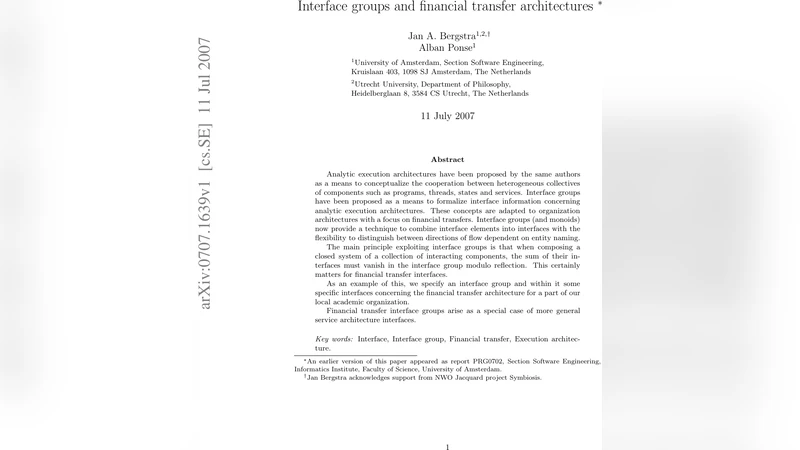
Analytic execution architectures have been proposed by the same authors as a means to conceptualize the cooperation between heterogeneous collectives of components such as programs, threads, states and services. Interface groups have been proposed as a means to formalize interface information concerning analytic execution architectures. These concepts are adapted to organization architectures with a focus on financial transfers. Interface groups (and monoids) now provide a technique to combine interface elements into interfaces with the flexibility to distinguish between directions of flow dependent on entity naming. The main principle exploiting interface groups is that when composing a closed system of a collection of interacting components, the sum of their interfaces must vanish in the interface group modulo reflection. This certainly matters for financial transfer interfaces. As an example of this, we specify an interface group and within it some specific interfaces concerning the financial transfer architecture for a part of our local academic organization. Financial transfer interface groups arise as a special case of more general service architecture interfaces.
💡 Research Summary
The paper extends the authors’ earlier work on Analytic Execution Architectures (AEA) – a formalism for describing cooperation among heterogeneous components such as programs, threads, states and services – to the domain of organizational structures, with a particular focus on financial transfer architectures. The central technical contribution is the introduction of “interface groups” (and the related notion of interface monoids) as algebraic structures that capture interface information in a way that respects directionality and entity naming.
An interface element is modeled as a triple (entity, direction, amount). The direction distinguishes whether the element represents an outgoing or incoming flow for the given entity. The set of all such elements, equipped with a binary “+” operation, forms an abelian group: the neutral element is 0, each element has an inverse (its reflection), and the operation is associative and commutative. A monoid is defined similarly but without requiring inverses, which is useful for one‑way flows.
The authors define a “reflection modulo” equivalence: an element and its inverse cancel each other, so that in a closed system the sum of all interface elements must be the zero element of the group. This “closure principle” is the key invariant for financial transfer architectures: if a collection of interacting components (departments, labs, finance office, students, external partners, etc.) is truly closed, the algebraic sum of all declared transfers must vanish.
To illustrate the theory, the paper models a part of a local academic organization. The entities considered include academic departments, research labs, a central finance office, students, and external partners. Typical financial actions—budget allocations, research‑grant disbursements, tuition payments, external project revenues—are expressed as interface elements. For example, a budget allocation of €5 million from the finance office to a department is recorded as (Finance → Dept :+5M) and the department’s receipt as (Dept ← Finance :-5M). When all such records are added using the group operation, the total should be 0. The authors present a concrete data‑driven simulation showing that, after correcting a few deliberately introduced errors (missing or duplicated entries), the sum indeed collapses to zero, thereby confirming the consistency of the modeled financial flows.
Beyond the financial case, the paper argues that interface groups are a special instance of a more general “service architecture interface” framework. Any service interaction—function calls, data exchanges, security handshakes—can be abstracted as a direction‑aware triple and placed within the same algebraic setting. Consequently, the same closure verification can be applied to non‑financial IT services, offering a unified mathematical basis for architectural validation.
The authors propose a practical design‑verification workflow: (1) enumerate all interface elements during requirements engineering; (2) construct the interface group and compute the aggregate sum; (3) if the sum is non‑zero, diagnose the discrepancy (e.g., missing transaction, double counting, asymmetric flow) and amend the design; (4) once the sum is zero, the system is deemed closed and financially consistent. This approach supplies a quantitative check that complements traditional qualitative modeling tools such as UML diagrams or sequence charts, which lack built‑in mechanisms for detecting accounting inconsistencies.
In conclusion, the paper demonstrates that interface groups provide a rigorous, flexible method for modeling and verifying financial transfer architectures within complex organizations. By enforcing the vanishing‑sum invariant modulo reflection, architects can detect and correct errors early in the design phase, thereby reducing financial risk and improving overall system reliability. The methodology is also extensible to broader service‑oriented architectures, suggesting a promising avenue for future research in formalized IT system design.
Comments & Academic Discussion
Loading comments...
Leave a Comment