Equivariant monads and equivariant lifts versus a 2-category of distributive laws
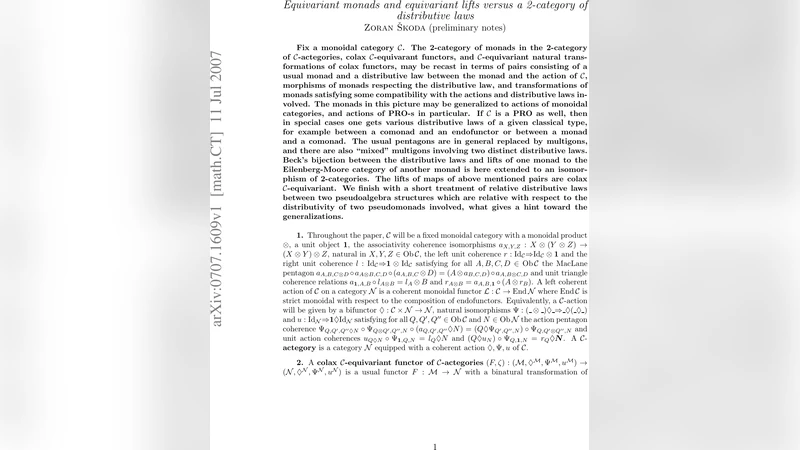
Fix a monoidal category C. The 2-category of monads in the 2-category of C-actegories, colax C-equivarant functors, and C-equivariant natural transformations of colax functors, may be recast in terms of pairs consisting of a usual monad and a distributive law between the monad and the action of C, morphisms of monads respecting the distributive law, and transformations of monads satisfying some compatibility with the actions and distributive laws involved. The monads in this picture may be generalized to actions of monoidal categories, and actions of PRO-s in particular. If C is a PRO as well, then in special cases one gets various distributive laws of a given classical type, for example between a comonad and an endofunctor or between a monad and a comonad. The usual pentagons are in general replaced by multigons, and there are also ``mixed’’ multigons involving two distinct distributive laws. Beck’s bijection between the distributive laws and lifts of one monad to the Eilenberg-Moore category of another monad is here extended to an isomorphism of 2-categories. The lifts of maps of above mentioned pairs are colax C-equivariant. We finish with a short treatment of relative distributive laws between two pseudoalgebra structures which are relative with respect to the distributivity of two pseudomonads involved, what gives a hint toward the generalizations.
💡 Research Summary
The paper develops a comprehensive 2‑categorical framework for equivariant monads and their distributive laws, starting from a fixed monoidal category C. The authors first construct the 2‑category 𝔄(C) whose objects are C‑actegories (categories equipped with a left action of C), whose 1‑morphisms are colax C‑equivariant functors (functors preserving the C‑action up to a coherent natural transformation), and whose 2‑morphisms are C‑equivariant natural transformations. Within this ambient 2‑category they consider monads (M, μ, η) and show that each such monad can be equivalently described as a pair consisting of an ordinary monad on the underlying category together with a distributive law λ : C⊗M ⇒ M⊗C that mediates between the C‑action and the monad.
The distributive law λ is required to satisfy a family of coherence diagrams that generalize Beck’s classic pentagon. Because the C‑action may involve arbitrary tensor products, the coherence conditions become “multigons’’ of various arities (triangles, squares, pentagons, etc.). When two distinct distributive laws λ₁ and λ₂ are present simultaneously, “mixed’’ multigons appear, expressing compatibility between the two ways in which the C‑action can be interchanged with the monad.
Morphisms between such pairs are defined as monad morphisms f : M → N that respect the distributive law, i.e. the diagram N ∘ f ∘ λ_M = λ_N ∘ (C⊗f) ∘ f ∘ M commutes. 2‑cells are natural transformations α : f ⇒ g that are C‑equivariant and satisfy an obvious compatibility with λ. Thus the authors obtain a 2‑category that is isomorphic to the 2‑category of monads in 𝔄(C).
A central result is the 2‑categorical extension of Beck’s bijection between distributive laws and lifts of one monad to the Eilenberg‑Moore category of another. The paper proves that giving a distributive law λ for a pair (M, N) is equivalent to providing a colax C‑equivariant lift of N to the category of M‑algebras, and vice‑versa. Moreover, this correspondence respects 1‑ and 2‑morphisms, yielding an isomorphism of 2‑categories rather than merely a set‑level bijection.
The authors then specialize to the case where C itself is a PRO (a strict monoidal category whose objects are natural numbers and whose tensor is addition). In this setting, C‑actegories are precisely PRO‑actions, and the distributive laws become “PRO‑distributive laws’’ between PRO‑monads, PRO‑comonads, or between a PRO‑monad and a plain endofunctor. Classical examples such as a monad–comonad distributive law, a comonad–endofunctor law, or a monad–endofunctor law appear as special instances when the PRO is chosen appropriately (e.g., the PRO for monoids, for comonoids, or for the free‑algebra construction). The multigon coherence conditions translate into familiar algebraic identities (associativity, coassociativity, compatibility) but now organized in a higher‑dimensional diagrammatic language that reflects the underlying PRO structure.
Finally, the paper sketches a further generalization to “relative distributive laws’’ between two pseudo‑algebra structures that are themselves relative to two pseudomonads. Here the authors consider two pseudomonads P and Q acting on a 2‑category, each equipped with a pseudo‑algebra structure, and define a relative distributive law as a modification that intertwines the two actions in a coherent way. This construction hints at a broader theory of interacting higher‑dimensional algebraic structures, potentially applicable to enriched category theory, higher operads, and quantum algebra.
Overall, the work unifies several strands of categorical algebra: equivariant monads, distributive laws, PRO‑actions, and higher‑dimensional coherence. By recasting monads in the 2‑category of C‑actegories as ordinary monads equipped with a C‑distributive law, and by extending Beck’s correspondence to a full 2‑categorical equivalence, the paper provides a powerful and flexible language for handling monads and comonads that live in an equivariant or multi‑operadic environment. The treatment of PROs and the brief foray into relative pseudomonad distributive laws open avenues for future research in areas where multiple algebraic structures must coexist and interact coherently.
Comments & Academic Discussion
Loading comments...
Leave a Comment