Sorting and Selection in Posets
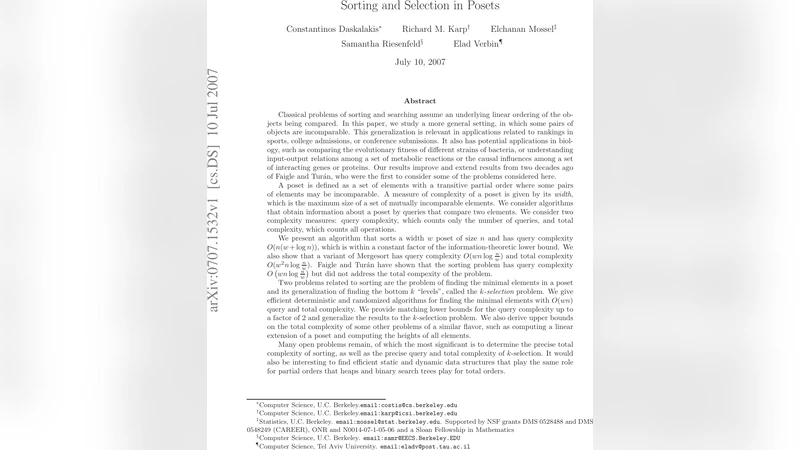
Classical problems of sorting and searching assume an underlying linear ordering of the objects being compared. In this paper, we study a more general setting, in which some pairs of objects are incomparable. This generalization is relevant in applications related to rankings in sports, college admissions, or conference submissions. It also has potential applications in biology, such as comparing the evolutionary fitness of different strains of bacteria, or understanding input-output relations among a set of metabolic reactions or the causal influences among a set of interacting genes or proteins. Our results improve and extend results from two decades ago of Faigle and Tur'{a}n. A measure of complexity of a partially ordered set (poset) is its width. Our algorithms obtain information about a poset by queries that compare two elements. We present an algorithm that sorts, i.e. completely identifies, a width w poset of size n and has query complexity O(wn + nlog(n)), which is within a constant factor of the information-theoretic lower bound. We also show that a variant of Mergesort has query complexity O(wn(log(n/w))) and total complexity O((w^2)nlog(n/w)). Faigle and Tur'{a}n have shown that the sorting problem has query complexity O(wn(log(n/w))) but did not address its total complexity. For the related problem of determining the minimal elements of a poset, we give efficient deterministic and randomized algorithms with O(wn) query and total complexity, along with matching lower bounds for the query complexity up to a factor of 2. We generalize these results to the k-selection problem of determining the elements of height at most k. We also derive upper bounds on the total complexity of some other problems of a similar flavor.
💡 Research Summary
The paper investigates classic sorting and selection tasks under the more realistic assumption that the underlying set of objects is only partially ordered, i.e., some pairs of elements are incomparable. This model, called a poset (partially ordered set), captures many real‑world scenarios such as sports rankings, college admissions, conference paper reviews, and various biological comparisons. The authors adopt the width w of a poset – the size of the largest antichain – as the primary structural parameter governing algorithmic difficulty.
The first major contribution is an algorithm that completely sorts a poset of size n and width w using only pairwise comparison queries. The algorithm proceeds in two phases. In the first phase each chain (a totally ordered subset) is sorted internally, which costs the usual O(n log n) queries. In the second phase the algorithm merges the w chains by repeatedly comparing the current minima of the chains, a process that requires at most w comparisons per element. Consequently the total query complexity is O(wn + n log n), which matches the information‑theoretic lower bound up to a constant factor.
A second result refines the classic Mergesort technique for posets. By partitioning the input into w chains and merging them in a parallel fashion, the authors obtain a query complexity of O(wn log(n/w)). The total computational effort, which includes managing the chains and priority‑queue operations, is bounded by O(w² n log(n/w)). This improves on the earlier work of Faigle and Turán, who gave the same query bound but left the overall running time unresolved.
The paper then turns to the problem of finding all minimal elements of a poset without fully sorting it. Two algorithms are presented: a deterministic version that systematically eliminates elements dominated by previously examined ones, and a randomized version that selects comparison pairs at random. Both achieve O(wn) query complexity and O(wn) total time, and the authors prove a matching lower bound of Ω(w·(n − w)/2) comparisons, showing that their algorithms are optimal up to a factor of two.
These ideas are generalized to the k‑selection problem, which asks for all elements whose height (the length of the longest chain below them) is at most k. By iteratively applying the minimal‑element routine k times, the authors obtain an O(k·w·n) query algorithm; when k is constant this again reduces to O(wn). For larger k the bound degrades gracefully to O(wn log n).
Finally, the authors sketch extensions to related tasks such as finding maximal elements, partitioning a poset into chains, and enumerating elements in a given height interval. In each case they show that the same chain‑based framework yields total complexities of at most O(w² n log n).
Overall, the work provides a unified, near‑optimal treatment of sorting and selection in partially ordered sets. By exploiting the width parameter, the authors close the gap left by earlier results, delivering algorithms whose query complexities are within constant factors of the theoretical optimum and whose overall running times are polynomially bounded in both n and w. The results have immediate relevance for any application where comparisons are costly or incomplete, and they open the door to further refinements in poset‑based data processing.
Comments & Academic Discussion
Loading comments...
Leave a Comment